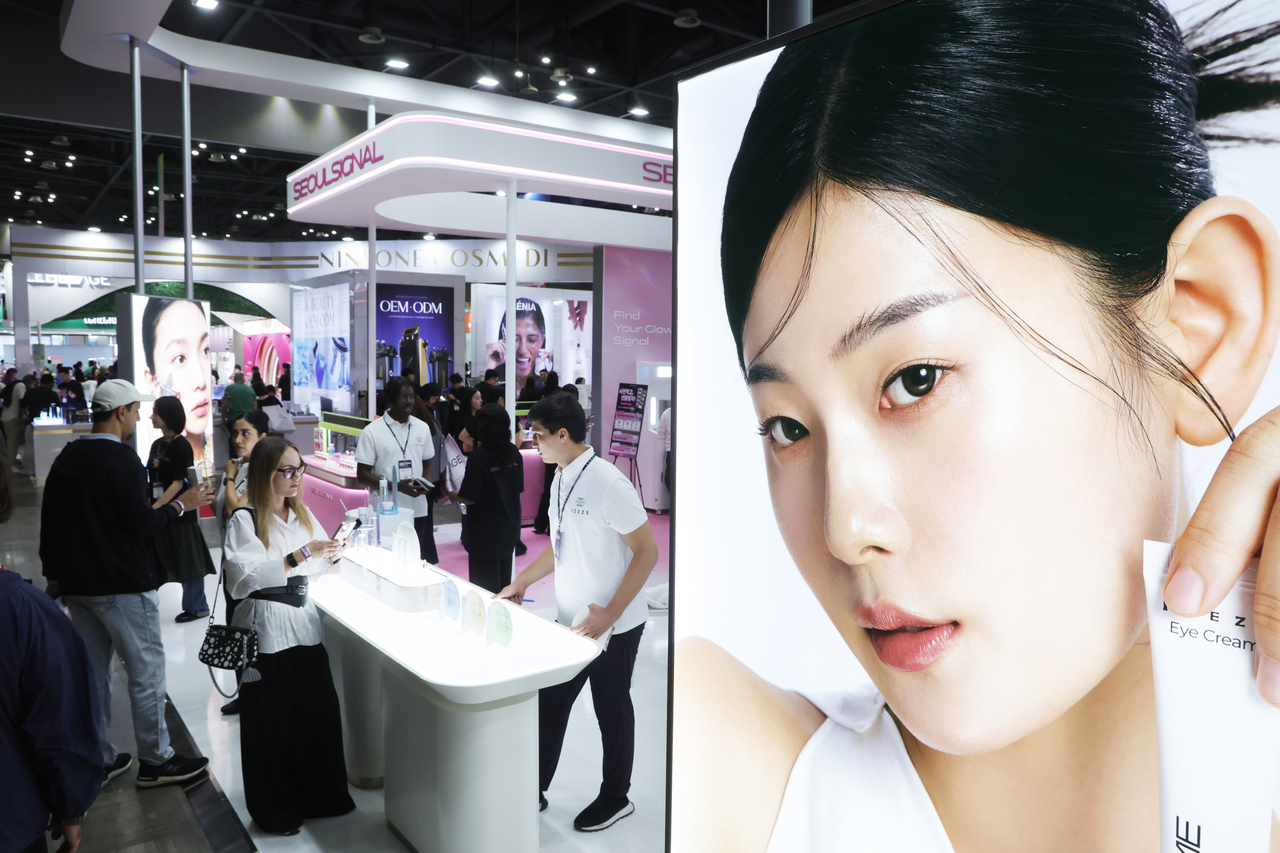
In 2019, cosmetics brand Joseon Beauty posted annual sales of around 100 million won ($75,100). Last year, it surpassed 450 billion won. The brand built a global following in the United States and Europe, and its Malgeunssal Suncream — co-developed with Kolmar Korea — topped Amazon's sunscreen category during Black Friday.
Anua is another indie brand that has grown into a global player. The Founders, the company behind Anua, posted sales of 717.7 billion won last year, up 67.8 percent from the previous year. A Cosmax client, Anua has expanded into 160 countries, building its profile primarily in the US and Japan.
As South Korea marks what is historically its first year of annual exports topping $1 trillion, K-beauty is playing a meaningful role in that expansion. Small and indie brands in particular have driven cosmetics exports to a record high.
According to the Ministry of SMEs and Startups, cosmetics exports by small and medium-sized enterprises reached $8.53 billion in the first 10 months of this year, up 27.1 percent from the same period last year. That figure already surpasses last year's full-year total of $8.21 billion — a record set in just 10 months.
Cosmetics have emerged as the leading driver of SME export growth. Total SME exports for the January–October period reached $107.6 billion, up 9.9 percent year-on-year, surpassing $100 billion on a 10-month cumulative basis for the first time in history. Overall cosmetics exports during the same period reached $12.4 billion, exceeding last year's full-year record of $11.4 billion.
The geographic diversification of exports is also notable. SME cosmetics exports grew 27.5 percent in North America and 57.8 percent in Europe. Latin America saw the sharpest jump, with exports surging 160.3 percent. South Korean cosmetics are finding new markets well beyond the traditional strongholds of the US and China.
Indie brands are at the heart of this growth. Where the domestic cosmetics industry once relied on the brand recognition and distribution networks of large conglomerates, smaller brands are now winning over overseas consumers with differentiated products.
The spread of online retail channels and social media has lowered the barriers for indie brands entering foreign markets. Without large advertising budgets or offline distribution networks, brands can build overseas recognition on the strength of their products and consumer response alone. Demand is growing particularly in categories where Korean cosmetics excel, including skincare and sun care.

The domestic original design manufacturing industry has also been central to the rise of indie brands. Small cosmetics companies that cannot afford their own production facilities can enter the market by outsourcing product development and manufacturing to ODM firms. Under this division of labor, brand companies focus on product planning, marketing and overseas sales, while ODM firms handle research and production.
The growth of this ecosystem is reflected in the earnings of Kolmar Korea and Cosmax, both of which posted record-level quarterly sales in the third quarter of this year.
Kolmar Korea's consolidated sales in the third quarter reached 828.2 billion won, up 21.3 percent year-on-year, while operating profit rose 40.5 percent to 81.9 billion won. Cosmax posted even sharper growth: third-quarter consolidated sales climbed 49.6 percent to 875.8 billion won, and operating profit jumped 94.9 percent to 83.3 billion won.
The rise of indie brands is reshaping the structure of South Korea's cosmetics industry. Where large cosmetics companies once led overseas expansion through their own brands and production facilities, the industry now increasingly operates through a collaborative model in which small brands, ODM firms and retail and logistics companies each contribute their own expertise.
Kolmar Korea Chief Executive Choe Hyeon-gyu, speaking at a recent meeting with SMEs and Startups Minister Lee So-young, said cosmetics have a unique characteristic in that "brands, research and development, manufacturing, retail and logistics are each interconnected to create an export industry."
However, it has been noted that sustaining K-beauty's momentum will require building stable overseas distribution channels rather than depending on the popularity of individual brands or products. As competition in foreign markets intensifies, developing products tailored to local consumer demand and responding to the proliferation of imitation products remain key challenges. Lee said the government would "actively support K-beauty's global expansion wherever it can."
boo@heraldcorp.com