
First payout under insurance claim trust regime
Beneficiaries include young adult and minor children
Contracts worth 100 million to 300 million won account for nearly half of all deals, driven by people in their 40s and 50s
Fees: 1% execution charge plus 0.3% annual management fee

Kim Seon-hui, 25, grew up in a single-parent household and lost her mother suddenly in January. Unsure how she would manage on her own, she recalled her mother once mentioning she had taken out a life insurance policy "to help out, even a little." When she and her older sister visited the insurer, they learned the death benefit on their mother's whole life policy was 50 million won (about $33,900). But the trust division then told her that her mother had separately set aside 140 million won (about $94,800) in a product called an insurance claim trust — designated solely for her, the younger daughter. What had her mother been thinking when she made those arrangements?
The case marks the first payout under the insurance claim trust regime introduced in November 2024, under which a trust company receives and manages a policyholder's death benefit and disburses it to beneficiaries according to instructions set before death. The product has taken hold as a new model for inheritance planning. At Samsung Life alone, the cumulative value of contracts nearly quintupled in just 15 months — from 103.8 billion won (about $70.3 million) to 500.7 billion won (about $339 million). With the first real payout now on record, the mechanics of how the system works after death — and what it costs — are coming into clearer view.
What is an insurance claim trust?
Think of it as attaching an instruction manual to a life insurance policy. When a policyholder dies, the trust company receives the death benefit, manages it, and pays it out to the beneficiary according to a schedule the policyholder set while alive. The core purpose is not simply to transfer money but to provide a financial safety net for beneficiaries — minors, young adults just entering the workforce, or children with disabilities — who may not be equipped to manage a large lump sum.
A conventional trust takes custody of assets such as cash, real estate or shares, and is used for asset management or inheritance and gift planning. An insurance claim trust works differently: what is transferred to the trust company is not the money itself but the right to claim it. The product is less about moving assets and more about designing who receives the money, when, and how. Policyholders can also set it up relatively simply, without a separate asset transfer process.
Until now, death benefits were paid out in a single lump sum to heirs or named beneficiaries the moment a claim was filed. That left little room for the deceased to tailor a payout plan to a family's circumstances, and a sudden windfall could prove harmful to beneficiaries unaccustomed to managing large sums. To help households manage assets more systematically as South Korea enters a super-aged society, the government amended the enforcement decree of the Capital Markets Act in November 2024 to include death benefits as eligible trust assets. The arrangement has long been used in the United States and Japan as a means of protecting surviving family members, and it is now taking root in South Korea as a way for parents to ensure financial support continues for their children even after they are gone.
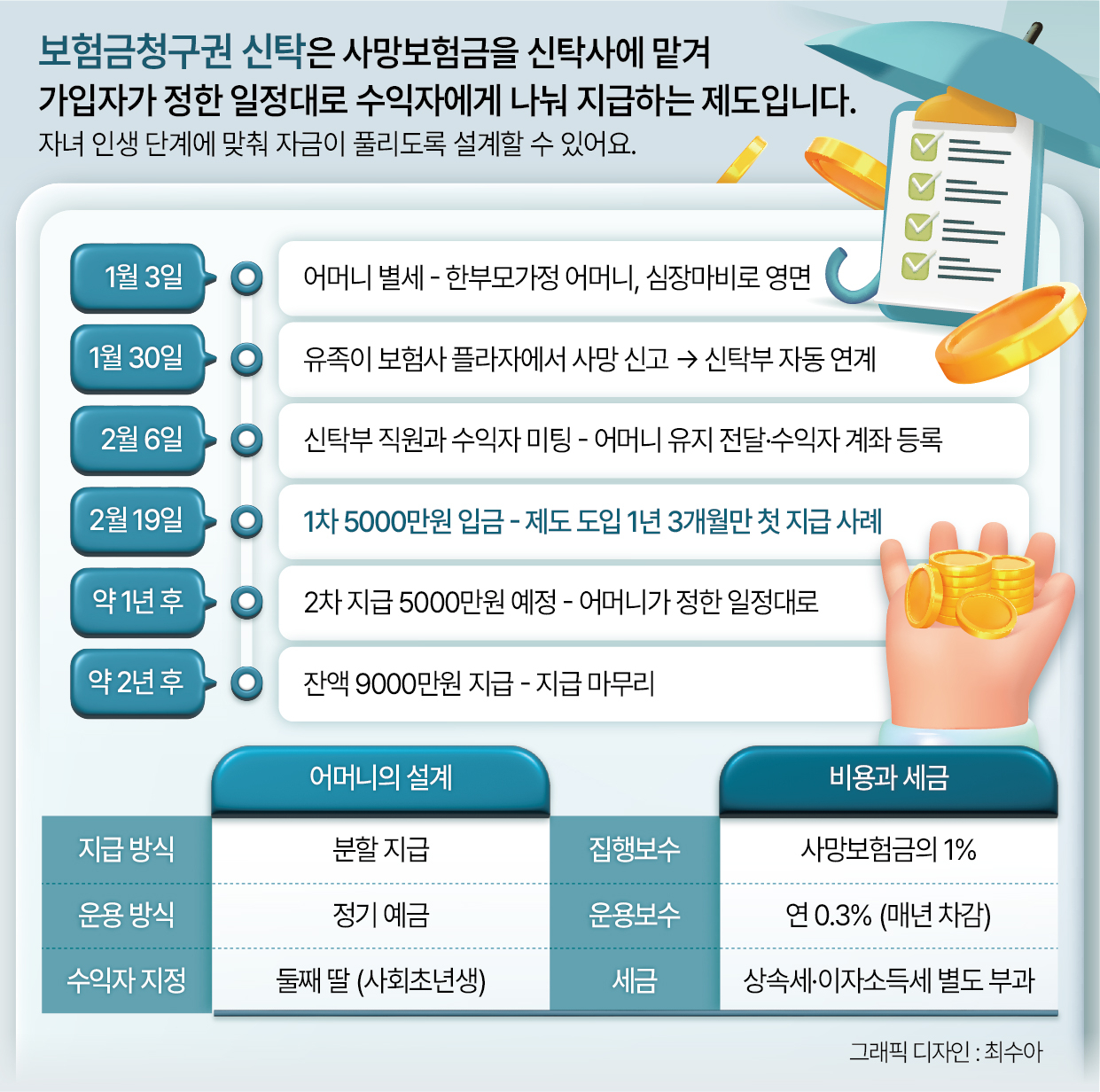
The insurance claim trust regime was introduced in November 2024 as part of an amendment to the Capital Markets Act enforcement decree, allowing death benefits to be placed in trust for the first time in South Korea.
What happened after the mother died?
Kim's payout is the first to be made since the insurance claim trust regime launched in November 2024. The timeline unfolded as follows.
Her mother died Jan. 3. On Jan. 30, the family visited an insurance company plaza to file a death notification, which automatically triggered a referral to the trust division. A week later, on Feb. 6, a trust division representative met with Kim in person to convey her mother's final wishes and register the bank account into which the benefit would be deposited. Thirteen days after that, on Feb. 19, the first installment of 50 million won (about $33,900) arrived.
An ordinary death benefit is paid out immediately as a lump sum once a claim is filed, but a benefit held in trust follows a different path. The trust company holds the right to file the claim, so a separate process applies. The system is designed so that the trust company is automatically notified when the family files a death report with the insurer, meaning beneficiaries face no penalty even if they were unaware a trust had been set up.
Why did the mother choose installment payments?
She was worried about her younger daughter, who had just started her working life. Receiving 140 million won (about $94,800) all at once could make the money hard to manage, and there was concern that others might try to take advantage of her. After a financial planner explained that death benefits could be placed in trust, the mother designed the payout schedule herself to match her daughter's life stages.
The trust contract listed the payment schedule and the beneficiary's name in the mother's own handwriting. There was no video message or separate will, but the trust contract itself became the vessel for her final message. The trust company said a settlor can use the contract to pass on whatever they want to say. That is precisely why the insurance claim trust has drawn particular attention from families with young adult children, minors, or children with disabilities who cannot live independently.
How is the 140 million won managed in the year after death?
At Samsung Life, death benefit funds are managed exclusively in fixed-term deposits. The interest rate applied is the one-year fixed deposit rate in effect at the time the benefit is transferred to the trust company, and the settlor has no option to choose a different investment approach. Because death benefits are funds directly tied to a surviving family's financial stability, the guiding principle is capital preservation with no risk of principal loss.
Interest earned on the deposit during the management period belongs to the beneficiary and is subject to income tax on interest. In practice, the 50 million won (about $33,900) Kim received after one year included the interest accrued over that period, and that interest is taxed the same way as ordinary bank deposit interest.
What does it cost, and does it reduce inheritance tax?
There are two fee components. An execution fee equal to 1 percent of the death benefit is deducted when the trust is executed — in Kim's case, 1 percent of 140 million won (about $94,800), or 1.4 million won (about $948), as a one-time charge. On top of that, an annual management fee of 0.3 percent applies for as long as the trust company holds and disburses the funds.
However, using a trust does not reduce inheritance tax. The full 140 million won (about $94,800) counts as part of the taxable estate. The core value of an insurance claim trust lies not in tax savings but in controlling when and how the money is paid out. The settlor can design exactly who receives the benefit, on what schedule, and under what conditions.
What if the beneficiary urgently needs a large sum before the schedule allows?
In principle, the terms of a trust contract cannot be changed after the settlor — in this case, the mother — has died. The benefit is paid out on the schedule she set, and the beneficiary cannot simply demand a lump sum at will. That restriction is itself a safeguard, protecting the beneficiary from squandering the money or falling prey to outside pressure.
There are exceptions, however. A lump-sum conversion is permitted only for reasons explicitly stated in the trust contract. The most common qualifying circumstances include cases where the beneficiary cannot meet basic living expenses without the trust assets, where treatment for a serious illness lasting six months or more is required, and where a court has confirmed another heir's claim to a statutory share of the estate and that share must be paid from the trust assets. It is therefore important for the settlor to specify, when drafting the trust, which situations should qualify as exceptions.
How much has the insurance claim trust market grown in a year?
Growth has been rapid. At Samsung Life alone, the cumulative contract value jumped from 103.8 billion won (about $70.3 million) across 259 contracts at the end of 2024 to 324.1 billion won (about $220 million) across 1,114 contracts by the end of last year, then surpassed 500.7 billion won (about $339 million) across 1,638 contracts on March 17. That is nearly a fivefold increase in 15 months.
A notable shift is the trend in average contract size. The average fell from 380 million won (about $257,000) in May last year to 310 million won (about $210,000) a year later — a sign that a market that started among the wealthy is going mainstream, driven by people in their 40s and 50s. Contracts in the 100 million to 300 million won range account for 48.4 percent of new contracts this year, and those below 100 million won (about $67,700) make up another 26.7 percent. Children are the most commonly named beneficiaries. Samsung Life said that as real contract cases have become known in the field, more customers are combining trust arrangements not only with existing whole life policies but also with new death insurance policies they are taking out.
When might this be worth considering for your own family?
There are four main situations. The first is when a parent has young adult or minor children who would struggle to manage a large sum at once — Kim's case falls squarely here. The second is a household with a child with a developmental disability or other condition that makes independent living difficult; the trust can be structured so the benefit is used steadily to support that child's life.
The third is grandparents who want to transfer assets to grandchildren in stages, with payouts timed to specific milestones such as tuition or a wedding. The fourth is when a spouse will be left behind who may have difficulty managing assets due to dementia or advanced age.
What are the eligibility requirements, and how should you choose a trust company?
The eligibility requirements are clear-cut. The base death benefit under the main policy must be at least 30 million won (about $20,300). The policyholder, the insured and the trust settlor must all be the same person. There must be no outstanding policy loan, and only direct lineal relatives or a spouse may be named as beneficiaries. Not all financial institutions offer the product, so contracts must be made through an insurer, bank or securities firm that holds a trust business license.
Three factors matter when choosing a trust company. The first is expertise in insurance contract structures and payout design — crafting a trust arrangement suited to a family's circumstances requires a thorough understanding of both insurance and trust law. The second is financial soundness: because the benefit is paid out over several years, the trust company's asset health and scale are important. The third is consulting capability. Because payout structures vary enormously depending on family circumstances and goals, it is worth confirming that the company provides thorough consultation before a contract is signed.

psj@heraldcorp.com




