Budget rises W30.3b (3.7%) from this year; general account surplus falls by about W22b
Depletion of integrated fiscal stabilization fund reserves and repayment burden make austerity unavoidable
Social welfare budget of W479.5b accounts for 56% of total; focus on home care, youth spaces and Sinchon commercial district recovery
Seodaemun-gu has drawn up an 855.5 billion won ($643 million) budget proposal for 2027, placing care services and residents' livelihoods at the top of its priorities despite deteriorating fiscal conditions.
With available resources shrinking and fund repayment obligations growing, the district has moved to trim ceremonial and routine expenditures and concentrate spending on projects directly tied to residents' daily lives.
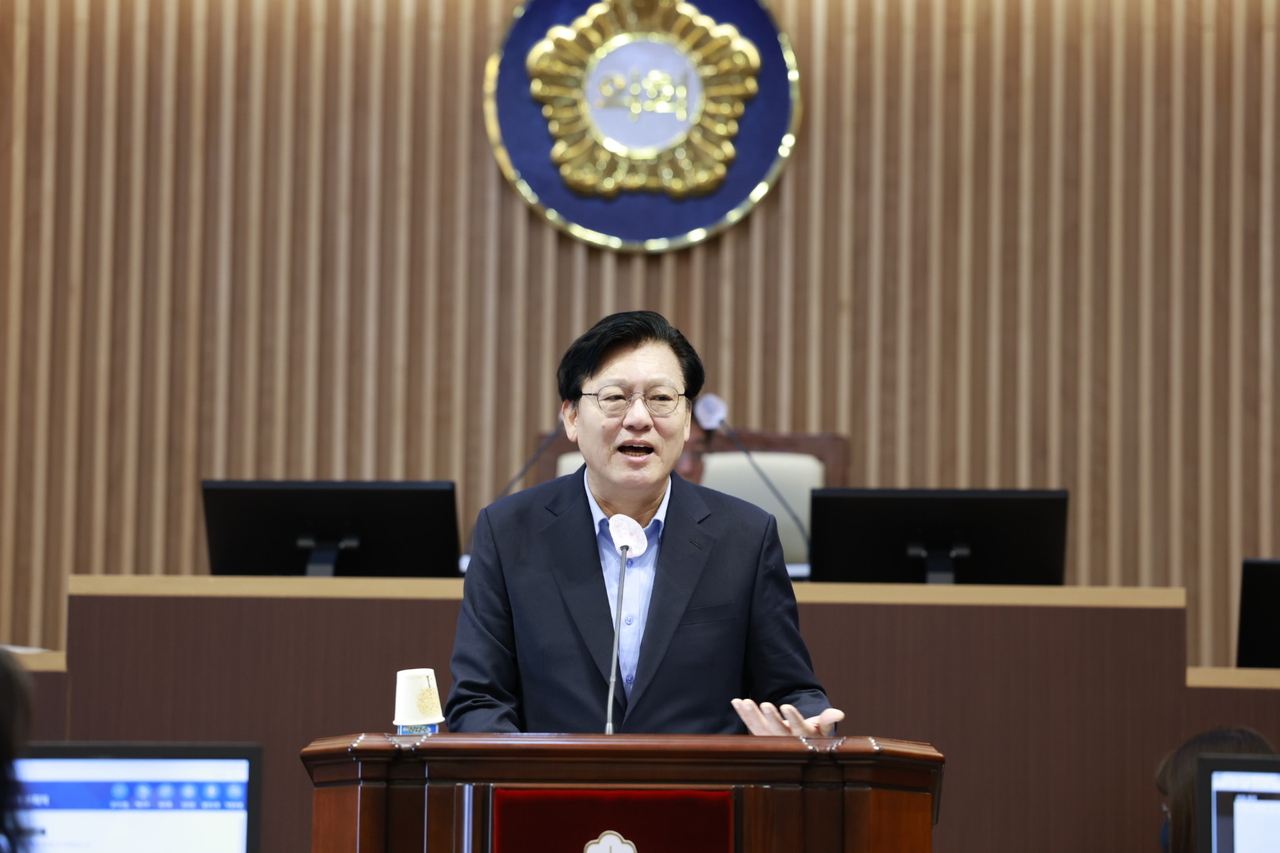
Seodaemun-gu District Mayor Park Un-gi said in a policy address to the district assembly's regular session Thursday that the district had "reviewed existing expenditures first to secure the resources needed for care and livelihoods."
The 2027 budget proposal, submitted to the district assembly on Nov. 4, totals 855.5 billion won — up 30.3 billion won, or 3.7 percent, from this year's original budget. It is divided into a general account of 845.5 billion won and a special account of 10 billion won.
The fiscal outlook, however, is far from comfortable. The district deposited 35 billion won of surplus general account funds into its integrated fiscal stabilization fund in 2022, only to withdraw the entire amount in 2023 and 2024. Last year, a shortfall in the general account forced the district to borrow 22.6 billion won from the fund.
Rising personnel costs, utility bills and the district's share of national and city government subsidy programs have further squeezed the resources available for self-funded projects. The general account surplus has been set at around 33 billion won, down about 22 billion won from this year's original budget.
In response, the district has begun restructuring its budget by reviewing whether existing programs should be abolished or scaled back whenever new projects are considered. Even resident-requested projects are ranked by necessity, urgency and expected impact before receiving funding.
Social welfare commands the largest share of the budget, at 479.5 billion won — about 20.5 billion won more than this year and equivalent to 56.05 percent of total spending.
The proposal allocates 1.3 billion won in marriage support grants and 3 billion won in newborn support grants to encourage marriage and childbirth. An additional 729 million won has been set aside to expand home care visits for elderly residents and people with disabilities, helping them maintain healthy daily routines in their own homes.
The district also plans to link home medical visits with care services and invest 177 million won in building a Seodaemun AI welfare package system to provide tailored welfare services for each eligible resident.
Investment in youth development and local economic recovery also stands out in the proposal.
The district will connect nine local universities with startup and investment institutions to build a foundation for youth AI entrepreneurship, and will expand activity spaces where young people can work, engage with culture and network. Some 233 million won has been earmarked for creating youth spaces, and 311 million won for operating the Sinchon Youth Creative Lab.
For the struggling Sinchon commercial district, the district will introduce "Sinchon PASS," a program linking food, performances and hands-on experiences. Some 144 million won will go toward launching the program and establishing a cooperative council, while 50 million won has been set aside for a research project to develop themed specialty streets in the Yeonhui area.
The budget also bolsters infrastructure. Some 1.46 billion won has been allocated for construction of an underground parking lot as part of the Seoyeon Middle School complex project, and 1.83 billion won for building an urban regeneration complex center in Cheonyeon-dong.
A campaign to plant 300,000 trees in response to the climate crisis will also get under way in earnest. The district has set aside 42 million won to promote the use of reusable containers and plans to add coverage for heat- and cold-related illnesses to its residents' safety insurance.
Alongside this, about 952 million won has been allocated to support the 14 neighborhood resident councils that relaunched this year, strengthening the foundation for resident-led solutions to local issues.
"Even in difficult fiscal times, we must protect residents' daily lives and avoid passing burdens on to future generations," Park said. "We will cut habitual and unnecessary spending and direct resources first to care and livelihoods."
The 2027 budget proposal is set to receive final approval from the district assembly after deliberation on Dec. 15.
seouldream01@heraldcorp.com