Mayor calls for additional new towns, expanded rail and road networks to support projected population surge
Yongin Special City Mayor Lee Sang-il attended a dinner meeting Wednesday hosted by Prime Minister Han Seong-sook with mayors of Gyeonggi Province cities, where he outlined the scale of population growth expected from the development of the Yongin semiconductor cluster.
Lee stressed the urgent need to expand housing supply and build out road and rail infrastructure in Yongin, and called on the government for active support.
The gathering brought together Lee and the mayors of 23 other Gyeonggi Province cities, including Suwon, Hwaseong, Icheon and Anseong. Kim I-tak, first vice minister of the Ministry of Land, Infrastructure and Transport, and Shin Jin-chang, vice chairman of the Financial Services Commission, also attended on behalf of the government.
At the meeting, Lee said the development of what would be the world's largest semiconductor cluster in Yongin is expected to bring in roughly 400,000 additional residents. He called for the designation of additional semiconductor support new towns, a shorter project timeline for the public housing district, expanded road and rail networks, and improvements to regulations on private housing supply.
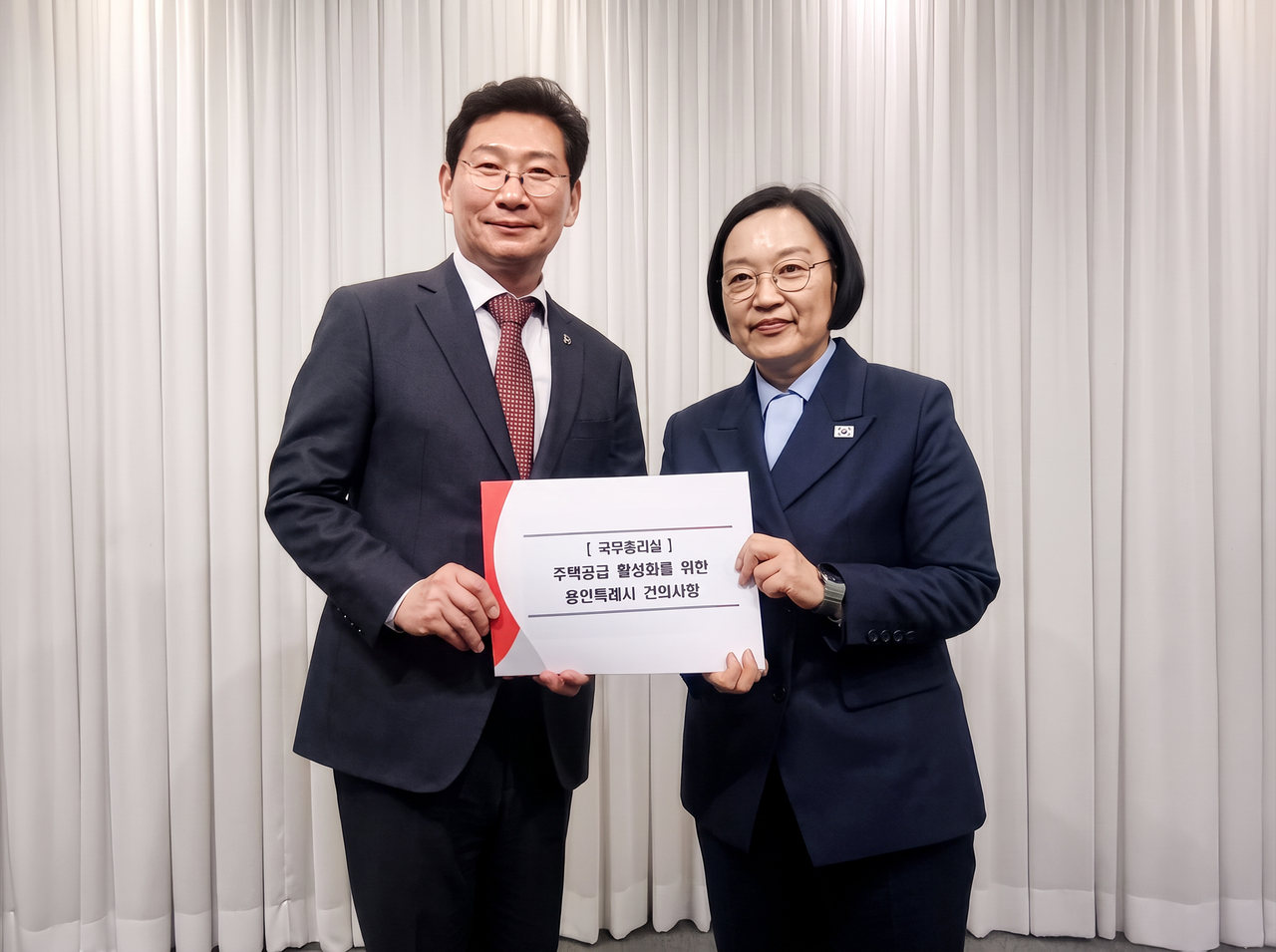
Lee also handed Prime Minister Han a document containing eight formal proposals, including those items.
"In Yongin, the world's largest semiconductor cluster — spanning about 11.88 million square meters and encompassing Samsung Electronics' national industrial complex and SK hynix's general industrial complex — is taking shape, and more than 400,000 people are expected to move in as a result," Lee said. "To accommodate that population growth, we estimate that more than 190,000 housing units will be needed, yet the public housing district planned in Idong-eup, Cheoin-gu — the semiconductor-focused new town — is no more than 20,000 units."
"If we fail to adequately respond to the surge in housing demand from the semiconductor cluster, a housing shortage could emerge in the southern Greater Seoul area and home prices could become destabilized," Lee said. "I ask the government to designate additional large-scale, publicly led residential districts in Yongin and to shorten the project timeline for the Idong-eup public housing district as much as possible."
"To disperse housing demand from Seoul, we need to develop additional new towns in areas like Yongin, where job growth is driving a rapid surge in development demand," Lee said. "This will not only expand housing supply but also significantly strengthen the international competitiveness of the semiconductor cluster."
Lee also called for expanded road and metropolitan rail networks linked to the semiconductor industrial complexes being developed in southern Yongin.
"Once large-scale semiconductor industrial complexes are established in southern Yongin, housing demand and traffic volume are expected to increase sharply," Lee said. "We need to build out key arterial roads, including constructing a new bypass for National Route 42 in connection with the ongoing expansion of National Route 45, which is being pursued with an exemption from a preliminary feasibility study."
"The government's work on the Fifth National Railway Network Development Plan is in its final stages, and I understand an announcement is expected in December," Lee said. "The Southern Gyeonggi Metropolitan Railway is a line that would benefit residents of four southern Gyeonggi cities — Yongin, Seongnam, Suwon and Hwaseong — all key advanced-industry hubs. Its cost-benefit ratio has been confirmed at 1.2, and the Gyeonggang Line extension would play an important role in improving access to the semiconductor national industrial complex and the Idong-eup public housing district. I sincerely hope both are included in the Fifth National Railway Network Development Plan."
"The Southern Gyeonggi East-West Cross Line — also known as the Semiconductor Line — is a rail network that would connect Hwaseong Dongtan, the Yongin Advanced System Semiconductor Cluster national industrial complex, the Yongin Semiconductor Cluster general industrial complex, and SK hynix's headquarters in Bubal, Icheon," Lee said. "I ask that this line also be included in the Fifth National Railway Network Development Plan to strengthen connectivity between semiconductor industry hubs."
"The Bundang Line extension — from Giheung Station through Dongtan 2 to Osan University Station — which was included in the Fourth National Railway Network Development Plan, is infrastructure essential to the semiconductor industry's growth and would do much to relieve chronic traffic congestion in areas such as Bora-dong," Lee said. "I ask for your help in moving that project forward quickly."
"I hope to see a denser national rail network laid across the country," Lee said, adding that he hopes the government's fiscal investment in the Fifth National Railway Network Development Plan will reach at least 100 trillion won ($75.1 billion).
Regarding Yongin Platform City, a joint urban development project between Gyeonggi Province and Yongin Special City, Lee asked that an interchange for the Gyeongbu Underground Expressway be installed as originally planned.
"Yongin Platform City is an urban development project in an area with high residential appeal," Lee said. "If the Gyeongbu Underground Expressway interchange proceeds as planned, it can be connected to a GTX transfer center to create an outstanding residential environment that integrates transportation and culture."
Lee also called for regulatory reforms to revitalize private urban renewal projects and boost housing supply in city centers.
"To stimulate private housing supply, we need to fix unreasonable regulations that cause project delays or force scale-backs," Lee said. "There is a need to reform the relevant laws — for example, by expanding the scope of cases in which private developers can pay a fee for public facility installation instead of building the infrastructure themselves, and by easing the requirement to establish district-unit plans for residential zones within natural conservation areas."
"A basic plan for the renewal of aging planned cities, which a local government head draws up for part of a city, requires approval from the provincial governor — a process that takes considerable time due to procedures such as passing through the Gyeonggi Province Urban Planning Committee," Lee said. "Delays in establishing the basic plan also delay housing renewal and supply, so I ask that consideration be given to transferring approval authority for the aging planned city renewal basic plan to the special city mayor, as is already the case for the apartment remodeling basic plan and the urban and residential environment improvement basic plan."
Lee also raised the issue of securing domestic water supplies needed for the semiconductor cluster development and large-scale housing construction.
"Demand for domestic water in Yongin is rising rapidly due to the semiconductor industrial complex development and various other development projects," Lee said. "Yongin is in talks with the Ministry of Climate, Environment and Energy to secure additional domestic water for a stable housing supply, and I ask that Prime Minister Han also take a close interest in this matter."
Yongin's current domestic water supply capacity stands at about 445,000 cubic meters per day, and the city estimates it will need to secure an additional 100,000 cubic meters per day to prepare for future population growth.
"I ask for the government's active attention and support so that housing, transportation and everyday infrastructure can be put in place on time as Yongin grows into the heart of South Korea's semiconductor industry," Lee said.
fob140@heraldcorp.com