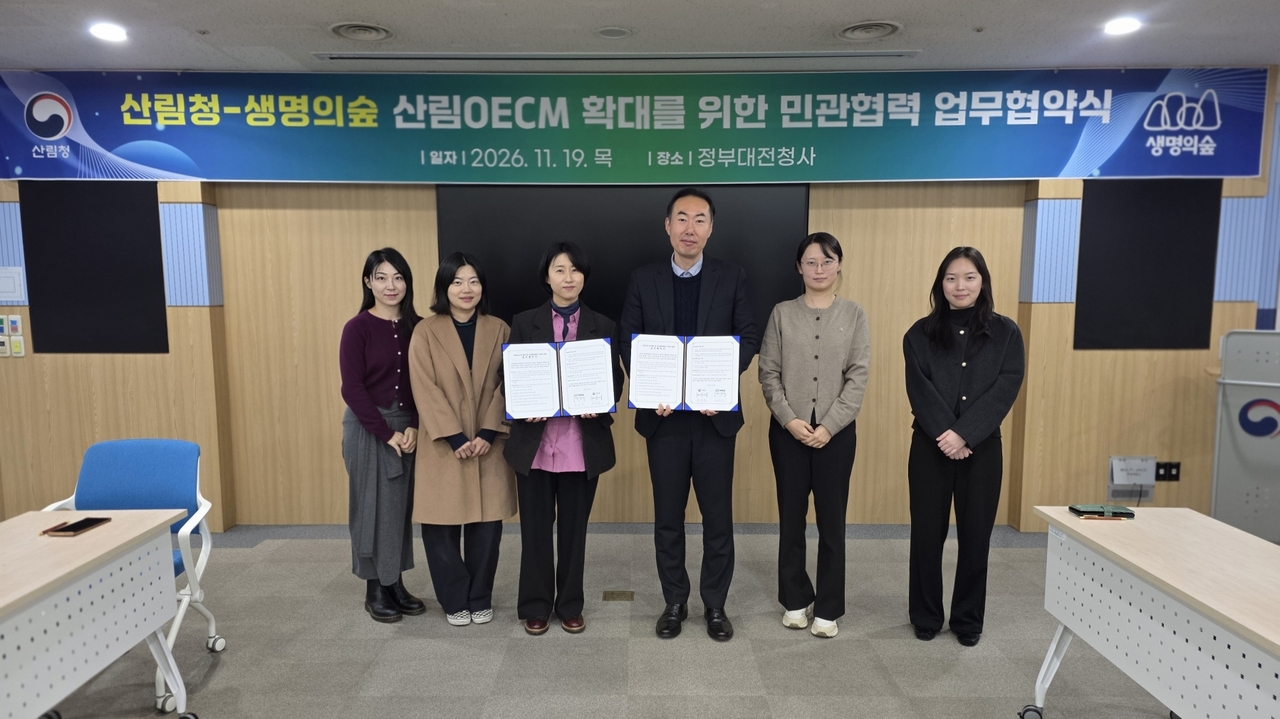
The Korea Forest Service and Life of Forest signed an MOU Thursday to expand forest OECMs, covering registration, conservation, management and monitoring.
A public-private cooperation framework has been established to identify forests with high biodiversity conservation value and to support the full cycle of forest OECM work — from registration and conservation to management and monitoring — through collaboration between the government and civil society.
The Korea Forest Service announced Thursday that it signed a memorandum of understanding with Life of Forest at the Government Daejeon Complex to expand forest Other Effective area-based Conservation Measures (OECM) and promote sustained forest biodiversity conservation.
OECMs are areas that are not legally designated protected zones but where biodiversity is conserved over the long term through effective management. The international community is pursuing the "30by30" target — conserving at least 30 percent of the world's land and ocean by 2030 — and OECMs are one of the primary tools for achieving that goal.
Under the agreement, the two organizations will cooperate on identifying and registering forest OECM candidate sites, developing a public-private cooperation model and carrying out pilot projects, sustaining the conservation, management and monitoring of designated OECM areas, expanding the participation of diverse stakeholders including businesses, civil society and local communities, and promoting civic engagement and public awareness for forest biodiversity conservation.
The Korea Forest Service will handle policy, regulatory and administrative support related to forest OECMs, while Life of Forest will build a public-private cooperation model by identifying candidate sites, consulting with stakeholders, connecting private-sector resources including businesses, and broadening civic participation.
Similar public-private approaches to forest biodiversity conservation exist abroad. In Aya, Miyazaki Prefecture, Japan, five organizations — including the central government, local authorities and civic groups — have collaborated since 2005 on the Aya Evergreen Broadleaf Forest Project, jointly conserving and managing roughly 10,000 hectares of forest.
The participating organizations coordinate through a joint consultative body to advance forest conservation and restoration and to promote community involvement. The area was designated a UNESCO Biosphere Reserve in 2012.
"This agreement is significant in that it combines the government's policy support with civil society's on-the-ground capacity to create a new cooperative model for forest biodiversity conservation," said Park Young-hwan, director of the Korea Forest Service's Forest Environment Protection Division. "We will continue to expand public-private cooperation so that businesses, local communities and other diverse actors can voluntarily participate in forest conservation."
kwonhl@heraldcorp.com