Net external assets up $280.7 billion in Q3
Foreign securities investment down $164.3 billion
Residents' overseas securities up $40.1 billion
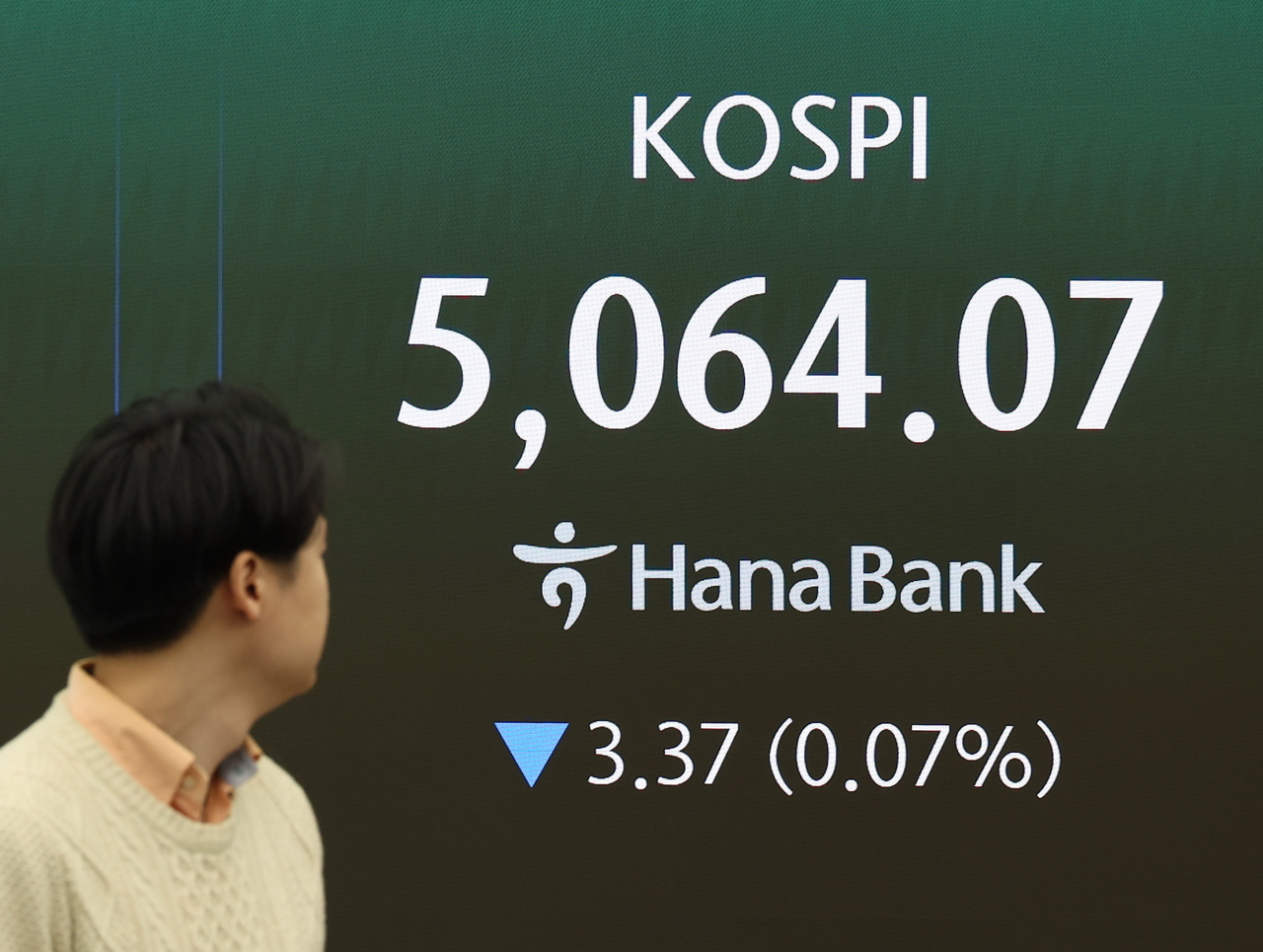
South Korea's net external financial assets — the difference between what the country is owed from abroad and what it owes to foreign creditors — posted their largest quarterly increase on record in the third quarter, the Bank of Korea said Thursday. The surge was driven by a sharp drop in the assessed value of shares held by foreign investors, caused by a plunge in domestic stock prices, alongside an increase in overseas securities investment by Korean residents.
According to the Bank of Korea's international investment position report released Thursday, South Korea's net external financial assets stood at $344.8 billion at the end of the third quarter, up $280.7 billion from $64 billion at the end of the second quarter. It was the largest quarterly increase since the statistics were first compiled in 1994.
Net external financial assets are calculated by subtracting external financial liabilities from external financial assets. A positive figure means the country is owed more than it owes. The larger the figure, the stronger the country's overall capacity to meet its external payment obligations.
In the second quarter, the figure had fallen by $689.5 billion — also a record, driven by a sharp rally in domestic stock prices — before reversing course entirely in the third quarter. The balance rose 5.4 times in a single quarter.
Breaking down the components, external financial assets rose $137.9 billion, from $3.08 trillion at the end of the second quarter to $3.22 trillion at the end of the third quarter. External financial liabilities fell $142.9 billion, from $3.02 trillion to $2.88 trillion over the same period.
Within external financial assets, residents' overseas securities investment rose $40.1 billion. Equity securities increased $34.2 billion on expanded net purchases of stocks, while debt securities rose $5.9 billion as net purchases of bonds turned positive. Other investments grew $40.8 billion, with loans, trade credits and overseas deposits all rising on the back of strong exports.
On the liabilities side, foreign investors' securities investment in South Korea fell $164.3 billion. Equity securities plunged $188.8 billion as the assessed value of holdings declined with the drop in domestic stock prices. Debt securities, however, rose $24.5 billion, as won appreciation increased the translated value of those holdings.
Moon Sang-yoon, head of the Bank of Korea's overseas investment statistics team, said a substantial increase in external financial assets combined with a substantial decrease in external financial liabilities drove the sharp rebound in net external financial assets. "The increase in external financial assets ranked fourth-largest on record, while the decrease in external financial liabilities was the largest ever," Moon said.
Moon added that external financial assets grew due to expanded net purchases of overseas equities by residents and strong export performance, while external financial liabilities shrank because the sharp fall in domestic stock prices reduced the assessed value of foreign equity holdings, even as the won strengthened considerably.
South Korea's external claims stood at $1.25 trillion at the end of the third quarter, up $66.7 billion from $1.18 trillion at the end of the second quarter. External claims refer to assets within external financial assets for which the right to receive repayment at maturity from abroad is confirmed.
Short-term external claims rose $55.5 billion, led by trade credits (up $14.8 billion), while long-term external claims increased $11.2 billion, driven mainly by direct investment in debt instruments (up $7.2 billion).
External debt rose $17.7 billion, from $812.8 billion at the end of the second quarter to $830.6 billion at the end of the third quarter. Net external claims — external claims minus external debt — reached $416.8 billion, rising $49 billion in a single quarter for the largest quarterly increase on record. The absolute level of net external claims was also the highest since the end of the first quarter of 2022.
Short-term external debt, with maturities of one year or less, accounted for 22.8 percent of total external debt, down 1.7 percentage points from the end of the second quarter. The ratio of short-term external debt to reserve assets also fell 3.5 percentage points to 42.9 percent. "Both short-term external payment capacity and the soundness of external debt improved," Moon said.

kimstar@heraldcorp.com