- DGIST and Korea University develop technology that cuts unnecessary current to as low as 1/240th of previous levels
- Technique uses spontaneous phase separation of materials for use in wearables and biosignal sensors

Korean researchers have developed a next-generation light sensor technology that dramatically reduces unnecessary current flowing even in the absence of light, enabling precise detection of even faint light signals.
The Daegu Gyeongbuk Institute of Science and Technology announced Thursday that a research team led by Ko Seo-jin, a professor in its Department of Energy Engineering, jointly developed a high-sensitivity organic photodetector with a team led by Woo Han-young, a professor in the Department of Chemistry at Korea University. The device suppresses unwanted current by exploiting the tendency of certain materials to separate on their own.
An organic photodetector is a device that converts light into electrical signals. Because it can be made lightweight and flexible, it has drawn attention for use in wearable devices such as smartwatches and in biosignal measurement applications.
A key limitation of existing devices, however, is the presence of "dark current" — current that flows even when no light is present. The larger the dark current, the harder it becomes to distinguish faint light signals from noise, reducing the sensor's accuracy.
To address this, the research team focused on the arrangement of materials within the photoactive layer, which absorbs light.
The photoactive layer consists of an electron donor material, which releases electrons, and an electron acceptor material, which receives them. When the two materials mix randomly, the arrangement favors separating light-generated charges, but it can also create pathways through which unnecessary current flows.
The team took advantage of "phase separation," a phenomenon in which different materials naturally segregate according to their properties.
Newly developed electron acceptor materials — YTEG-4F and YTEG-4Cl — were blended with the electron donor polymer PM6 and heat-treated at 120 degrees Celsius for 10 minutes.
As a result, a "vertical phase separation" emerged in which the electron acceptor materials concentrated toward the bottom of the layer while the electron donor materials gathered toward the top. As the materials settled into stable positions on their own, a structure formed that suppresses unnecessary charge influx and leakage current.
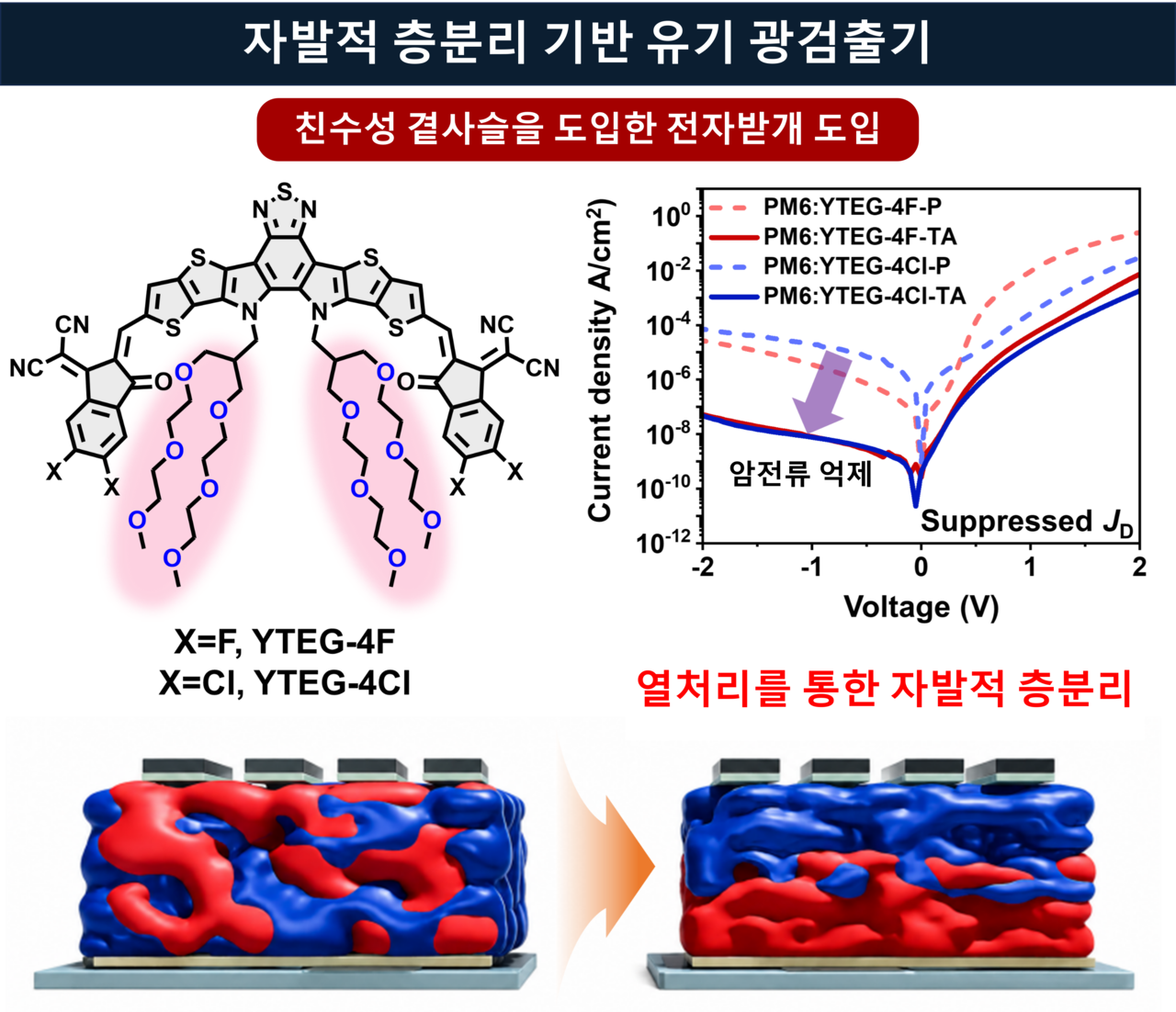
The two photodetectors developed by the team showed dark current levels reduced to approximately 1/240th and 1/205th, respectively, of those in comparison devices using the existing Y6 material. Near-infrared detection capability at a wavelength of 780 nanometers improved 4.2-fold and 8.5-fold, respectively.
The team also successfully used the photodetectors to measure pulse waves, confirming their potential for use in wearable healthcare devices that detect subtle changes in light to monitor biosignals such as heart rate.
However, further verification is needed before the technology can be commercialized, including demonstrating equivalent performance on flexible substrates and confirming long-term stability and durability under repeated bending.
"This research is significant in that it uses the thermodynamic properties of materials to naturally control internal structure, and connects that to suppressing unnecessary current and improving photodetection performance," Ko said. "We expect it to be applied to the development of various optoelectronic devices, including high-sensitivity near-infrared sensors and wearable healthcare devices."
Park Se-jeong, a doctoral candidate affiliated with the Korea Research Institute of Chemical Technology and Sungkyunkwan University, Jeong Sang-young of the Korea Research Institute of Chemical Technology, and Eom Yun-ji of Korea University served as co-first authors. The findings were published in the international journal Advanced Functional Materials.
nbgkoo@heraldcorp.com