Raon Private Centro's 45㎡ unit draws 65.5-to-1 ratio
Small-unit applications up 22 percentage points in 3 years
Pre-sale costs, loan curbs and household changes fuel the shift

The preference for smaller homes is becoming increasingly pronounced in Seoul's apartment subscription market. In the second half of this year, among Seoul apartment complexes that offered both small and large unit types for general pre-sale, more than 8 in 10 first-priority local-area subscription applications were concentrated in units under 60 square meters (exclusive use area). Compared with three years ago, the supply share of small units remained similar at around 60 percent, but the application share jumped from 62 percent to 84 percent.
According to the real estate industry on Thursday, the first-priority local-area subscription for Jungnang-gu's Junghwa Station Raon Private Centro, held Tuesday, showed a stark contrast between its smallest and largest unit types. The 45-square-meter unit drew 262 applications for 4 households, recording the complex's highest competition ratio at 65.5 to 1, while the 126-square-meter unit received no applications for its 2 available households. Of the 10 unit types offered, only the 93-, 98- and 126-square-meter types failed to close within the local-area round and were carried over to the wider-area application stage.
At the complex, small units under 60 square meters — the 45-, 58- and 59-square-meter types — accounted for 20 of the 53 general-supply households, less than 40 percent of total supply. Yet in terms of applications, 820 of the 1,025 total submissions targeted those three types. The 59-square-meter type alone drew 349 applications — nearly three times the combined 122 applications received by the two 84-square-meter types.
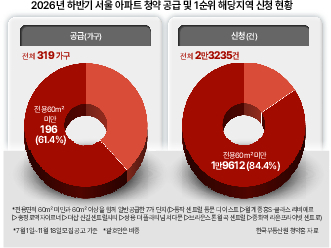
The preference for smaller homes has become a clear trend in the recent subscription market. According to the Korea Real Estate Board's subscription platform, among Seoul apartment complexes that published general-supply notices in the second half of this year (July 1 through Nov. 18) offering both units under and at or above 60 square meters, seven complexes met the criteria: Dongjak Central Dongmun the East, Wolgye Jungheung S-Class Riviere, Chungjeongno Station Xi Rene, The Sharp Singil Central City, KGM The Platinum Seodaemun, Brownstone Wolgok Central and Junghwa Station Raon Private Centro.
An analysis of first-priority local-area application results for those complexes showed that of 319 general-supply households, 196 — about 61.4 percent — were units under 60 square meters. Applications, however, were far more skewed: of 23,235 total submissions, 19,612, or 84.4 percent, targeted small units.
Three years ago, the supply and application shares for small units were roughly in line with each other. An analysis of 10 complexes meeting the same criteria during the same period in 2023 — Raemian La Grande, Cheongye SK View, Sangdo Prugio Clavenue, Hoban Summit Gaebeong, e-Convenience World Dapsimni Arteporé (national housing), The Sharp Gangdong Central City, e-Convenience World Gangdong Prestige One, Imun I'Park Xi, Dobong Kumho Eoulim Riverpark and Hillstate e-Convenience World Munjeong — found that 1,390 of 2,314 general-supply households, or about 60.1 percent, were small unit types.
At that time, small-unit applications totaled 59,350 of 95,470 first-priority local-area submissions, accounting for 62.2 percent. This year, the supply share of small units rose by 1.4 percentage points, while the application share climbed by 22.2 percentage points.
Analysts attribute the small-unit preference to a combination of shifting household composition, rising pre-sale costs and tighter loan regulations. As one- and two-person households grow more common, demand from buyers who find smaller spaces sufficient has increased. At the same time, rising pre-sale prices and shrinking borrowing capacity have given buyers greater incentive to choose smaller, more affordable units.
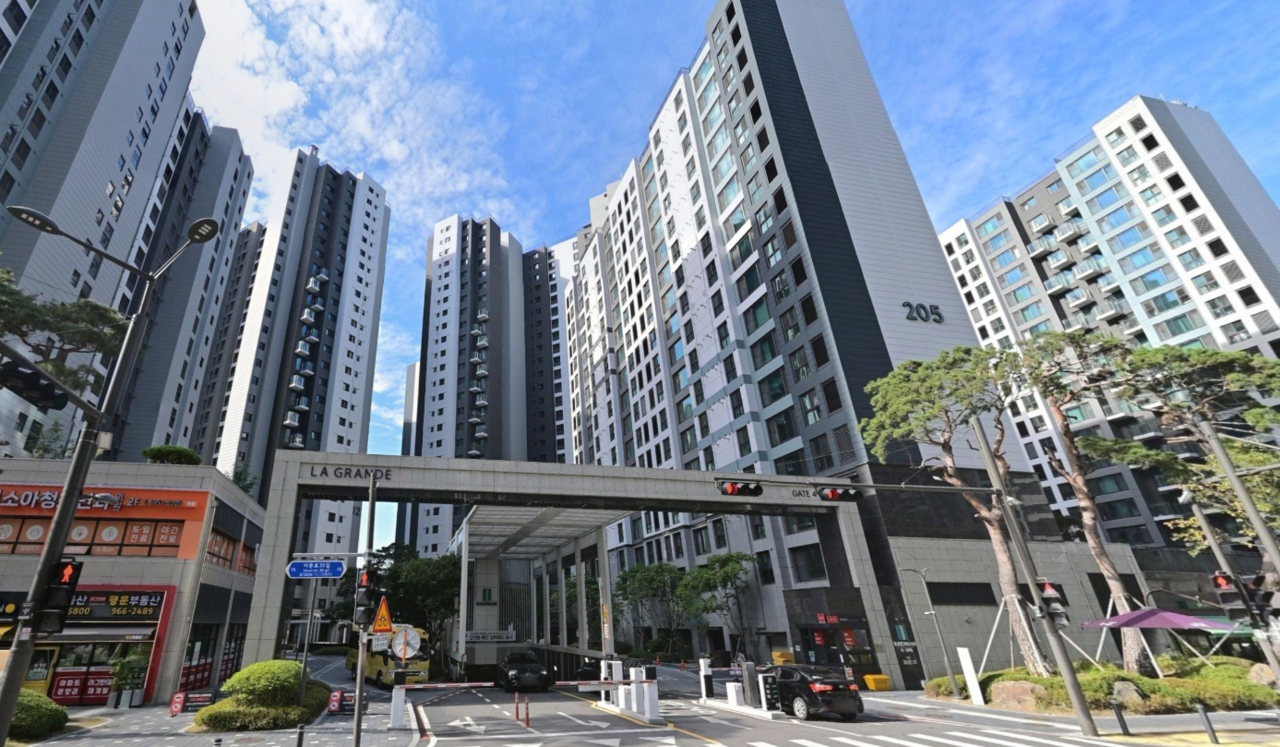
Three years ago, there were cases where the competition ratio for the standard 84-square-meter type — widely known as the "national unit size" — was more than double that of smaller units within the same complex. In August 2023, Raemian La Grande in Dongdaemun-gu, Seoul, received 9,499 local-area subscription applications for 91 households across three 84-square-meter types, recording an average competition ratio of 104.4 to 1. At the time, the general-supply allocation for units under 60 square meters was 299 households — more than three times the 84-square-meter supply — yet applications reached only 13,813, yielding a comparatively low ratio.
This year, by contrast, subscription demand for units at or above 84 square meters has fallen sharply. The supply share of unit types at 84 square meters and above was similar in both periods — 30.4 percent in 2023 and 31.3 percent in 2026 — but the application share plunged from 24.2 percent to 11.4 percent.
Competition ratios by size band also shifted markedly. In 2023, units between 60 and 84 square meters posted the highest ratio at 59.1 to 1, followed by units under 60 square meters at 42.7 to 1 and units at 84 square meters and above at 32.8 to 1. This year, the ratio for units under 60 square meters climbed to 100.1 to 1, while the 60-to-84-square-meter band fell to 41.9 to 1 and the 84-square-meter-and-above category dropped to 26.6 to 1.
Experts forecast that the preference for smaller units will become the new normal in the subscription market. Lee Dong-hyun, a senior real estate specialist at Hana Bank, said changing views on family life and a range of economic pressures are pushing housing buyers toward practical, value-oriented choices. "Smaller apartments are now well-equipped with community amenities and other facilities, so there is less reason to pay a large sum for a pre-sale unit and then shoulder high maintenance fees," he said.
Lee added that feedback from pre-sale officials also points in the same direction. "I hear that these days the 59-square-meter type is more popular than the 84-square-meter type," he said. "The 59-square-meter has already become the mainstream, and I expect this trend to deepen further going forward."
shy@heraldcorp.com