High rates, sluggish domestic demand blamed for rising corporate delinquencies
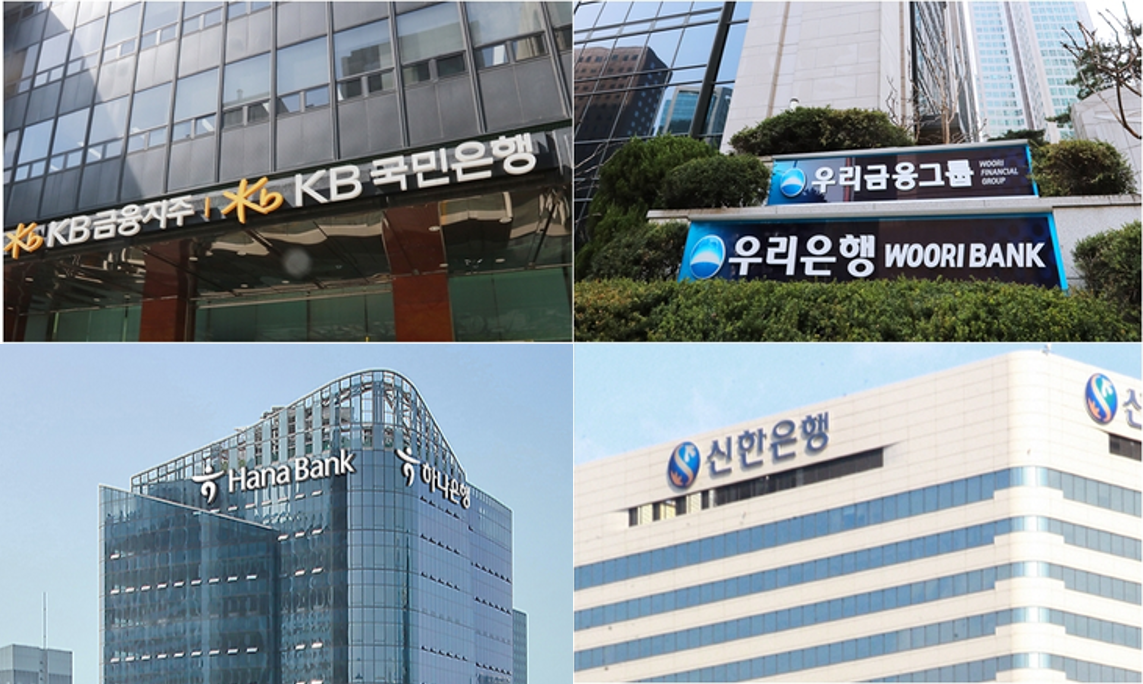
Substandard loans at Korea's four major commercial banks grew 23 percent over the first nine months of this year while loan-loss provisions rose only 2.4 percent, pushing the average coverage ratio down 25.2 percentage points and raising concerns about the banks' capacity to absorb future credit losses.
Quarterly reports by KB Kookmin Bank, Shinhan Bank, Hana Bank and Woori Bank show that the combined substandard-and-below loans of the four lenders stood at 5.59 trillion won ($4.18 billion) at the end of the third quarter, up 1.04 trillion won from 4.55 trillion won at the end of last year. Over the same period, combined loan-loss provisions edged up 185.1 billion won — from 7.78 trillion won to 7.97 trillion won. The respective growth rates were 22.9 percent and 2.4 percent, with provisions rising far more slowly than bad loans.
As a result, the four banks' average loan-loss coverage ratio — provisions as a share of substandard-and-below loans — fell to 146.8 percent at the end of the third quarter from 172.0 percent at the end of last year, a drop of 25.2 percentage points. Compared with the end of 2024, when the ratio stood at 204.2 percent, the decline widens to 57.4 percentage points.
The coverage ratio measures how much of a buffer a bank has set aside against its bad loans: the higher the figure, the greater the capacity to absorb potential losses. However, banks note that the amount of provisions required varies depending on the likelihood of recovering funds through collateral and other means, so a falling coverage ratio alone does not necessarily indicate weakened loss-absorption capacity.
Among the four lenders, Woori Bank recorded the steepest drop, with its coverage ratio falling 45.8 percentage points — from 172.6 percent at the end of last year to 126.8 percent at the end of the third quarter. Hana Bank's ratio declined 29.8 percentage points, from 136.3 percent to 106.5 percent. KB Kookmin Bank fell from 206.0 percent to 191.4 percent, and Shinhan Bank from 173.1 percent to 162.5 percent.
Hana Bank posted the fastest growth in substandard loans, with its bad-loan balance rising 42.4 percent — from 1.28 trillion won at the end of last year to 1.82 trillion won at the end of the third quarter. Woori Bank's substandard loans grew 27.2 percent, from 1.05 trillion won to 1.33 trillion won. KB Kookmin Bank's balance rose 10.8 percent to 1.29 trillion won, while Shinhan Bank's increased 8.6 percent to 1.15 trillion won.
On the provisions side, Hana Bank increased its loan-loss reserves 11.3 percent from the end of last year to 1.94 trillion won. KB Kookmin Bank's provisions grew 2.9 percent to 2.48 trillion won, and Shinhan Bank's rose 1.9 percent to 1.87 trillion won. Woori Bank was the outlier, cutting its provisions 6.5 percent — from 1.8 trillion won to 1.69 trillion won.
The banks attributed the rise in bad loans to a prolonged high-interest-rate environment and a delayed economic recovery, which have eroded the repayment capacity of businesses and vulnerable borrowers. The banks pointed to rising delinquencies among small and medium-sized enterprises, self-employed business owners and some financially stretched individuals, compounded by court-led restructuring filings at a handful of large conglomerates.

forest@heraldcorp.com