Seoul subway lines and GTX-A to slow from Friday; KTX and SRT workers join Monday
Delays of 10–20% expected from Friday as trains run to strict safety rules
Commuters and university entrance exam takers likely to be affected
Management sends negotiation letter to union; talks expected Tuesday
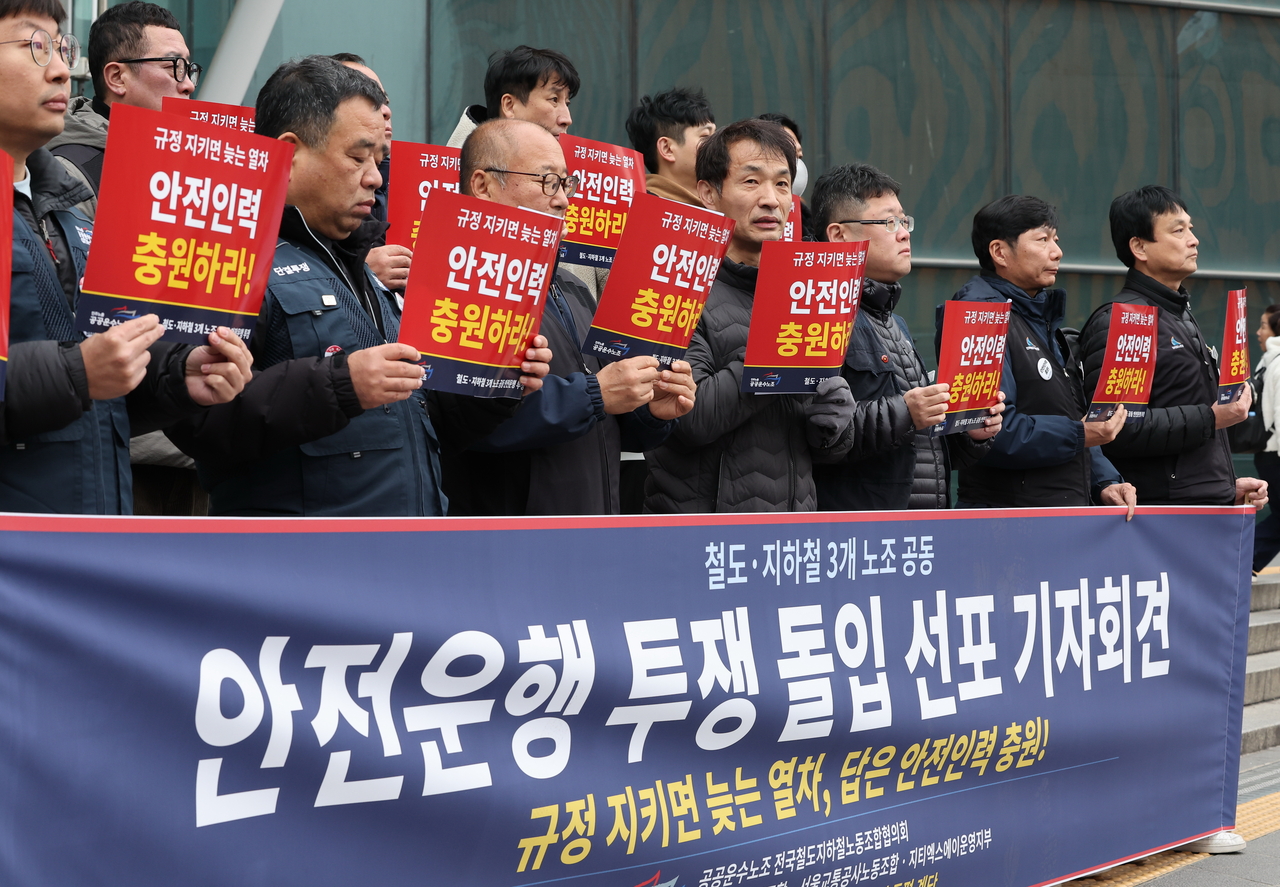
Subway services in Seoul are expected to slow starting Friday — the day after the 2027 college entrance exam — as the Seoul Metro workers' union launches a "safe operation" campaign ahead of a planned general strike on Nov. 25. The disruption is likely to affect morning and evening commuters as well as university applicants sitting essay-based admissions tests in the coming weeks. The union and management are set to hold talks before the strike deadline, leaving open the possibility that the walkout could be called off.
The union held a press conference in front of Seoul Station on Wednesday alongside the Public Transport Workers' Union's National Railway and Subway Labor Council, the Korean Railway Workers' Union and the GTX-A Operations Branch, announcing a joint "safe operation" campaign beginning Friday.
Under the plan, the union — which operates Seoul subway lines 1 through 8 and the phase 2–3 sections of Line 9 — will begin the campaign Friday. GTX-A will follow the same schedule. Workers on KTX and SRT services, however, will join the action on Monday.
During a "safe operation" campaign, union train operators will not increase speed or shorten dwell times to make up for schedule delays, according to the union. Workers in the vehicle, technology, facility and electrical divisions will carry out all hazardous tasks in pairs. Special inspections and additional work will be refused, and overtime and holiday shifts will not be worked.
Trains are expected to run behind schedule as a result. "Until now, when trains fell behind, drivers would speed up beyond the regulated limit or close the doors and depart before all passengers had finished boarding," a union official said. "Once we switch to safe operations, everything will be done strictly by the manual, and we expect delays of around 10 to 20 percent compared to normal."
Commuters and students preparing for university essay exams are expected to face disruption. Kyung Hee University, Korea University, Sogang University, Sungkyunkwan University and Sookmyung Women's University have essay exams scheduled for Saturday and Sunday. Sejong University, Ewha Womans University, Chung-Ang University, Hankuk University of Foreign Studies and Hanyang University have theirs set for Nov. 28 and Nov. 29 — after the planned strike date of Nov. 25.
The union plans to continue the safe operation campaign until Nov. 25, when the general strike is scheduled to begin. Negotiations remain possible, however. The union said it received a letter from management on Tuesday requesting that talks be held.
"Whether the general strike goes ahead as planned or is called off will depend on what management proposes," a union official said. "The negotiation schedule has not been set yet, but based on past precedent, we expect it to be Tuesday — the day before the strike."
The union's demands include an end to restructuring and timely recruitment of frontline staff, resolution of staffing shortfalls caused by long-term vacancies, additional safety personnel, and a 5.2 percent increase in labor costs compared with the previous year. The union has said it is willing to accept up to a 3.5 percent wage increase in line with government guidelines.
Seoul Metro is currently pursuing a restructuring plan that would cut 2,212 positions. The union is demanding the plan be scrapped and that at least 1,313 safety workers be hired before the end of the year.
If the union proceeds with the strike on Nov. 25, only the essential service personnel designated under the essential maintenance agreement will remain on duty, with all other union members joining the walkout.
Under a strike scenario, service on Lines 1, 3 and 4 — which Seoul Metro co-operates with Korail — is expected to fall to around 50 percent of normal capacity. Lines 2 and 5 through 8, operated solely by Seoul Metro, are projected to run at 70 to 80 percent of normal.
ikson@heraldcorp.com