- KAIST reduces ruthenium particles to 1 nanometer to maximize catalyst efficiency
- Greater electron supply accelerates reaction; no performance loss after 100-hour test
South Korean researchers have developed a technology that boosts ammonia production rates by up to 57 times by breaking precious metals into smaller particles.
KAIST said Thursday that a research team led by Choi Min-ki, a professor in the Department of Chemical and Biomolecular Engineering, developed a catalyst technology that improves ammonia production efficiency by controlling the particle size of ruthenium, a precious metal, and identified the underlying mechanism.
Ammonia is a key raw material for fertilizers and has drawn attention as a next-generation medium for storing and transporting hydrogen. Producing ammonia, however, requires high temperatures and pressure, consuming enormous amounts of energy. Developing high-performance catalysts that accelerate the chemical reaction is essential to reducing that energy demand.
Ruthenium shows excellent catalytic performance for ammonia synthesis, but its high price and limited reserves have constrained its industrial use.
The research team tackled the problem by reducing ruthenium particles to the nanometer scale.
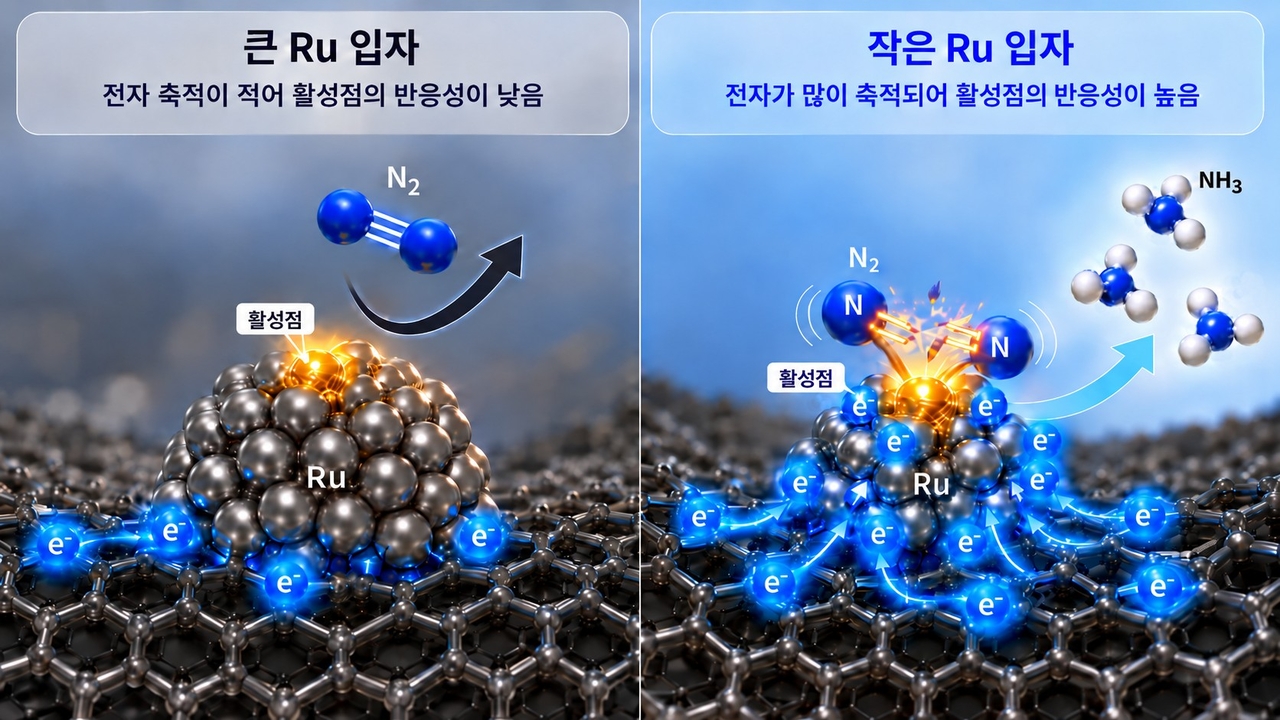
Shrinking the particle size increases the surface area of the same amount of metal, creating more sites where nitrogen and hydrogen can react. The team also confirmed that as particles grow smaller, the catalytic activity at each individual reaction site increases as well.
The researchers added barium oxide (BaO), which facilitates electron supply, to the ruthenium catalyst and compared reaction characteristics across different particle sizes.
As ruthenium particles shrank, electrons transferred more readily from the barium oxide to the ruthenium surface. Those electrons helped break nitrogen bonds, accelerating the ammonia synthesis reaction.
In experiments, ruthenium particles measuring 1 nanometer — one-billionth of a meter — produced ammonia at a rate 4.4 times higher per reaction site than 10-nanometer particles.
Combined with the increase in the number of available reaction sites, the overall ammonia production rate using the same amount of ruthenium rose 57-fold.

The research team used carbon nanotubes as the catalyst support. Carbon nanotubes are highly resistant to the degradation that occurs when carbon converts to methane in high-temperature hydrogen environments.
In a 100-hour ammonia synthesis experiment, the catalyst showed no decline in performance and produced no methane.
The findings are expected to inform future development of technologies that reduce the amount of ruthenium needed in catalysts and achieve high ammonia productivity at lower temperatures and pressures. The research team noted, however, that the 57-fold performance improvement does not mean energy consumption or production costs in actual industrial processes would fall by the same proportion.
"This research clarified the principles behind efficiently using expensive precious metals to increase ammonia productivity," Choi said. "We will build on this to develop ammonia production catalysts that consume less energy even at lower temperatures and pressures."
The findings were published online June 17 in the Journal of the American Chemical Society.
nbgkoo@heraldcorp.com