President speaks to Asia-Pacific business leaders at Qianhai International Convention Center
'Manufacturing AX' vision combines Korea's industrial base with AI
Calls for joint response to semiconductor, energy and critical-minerals supply chain risks
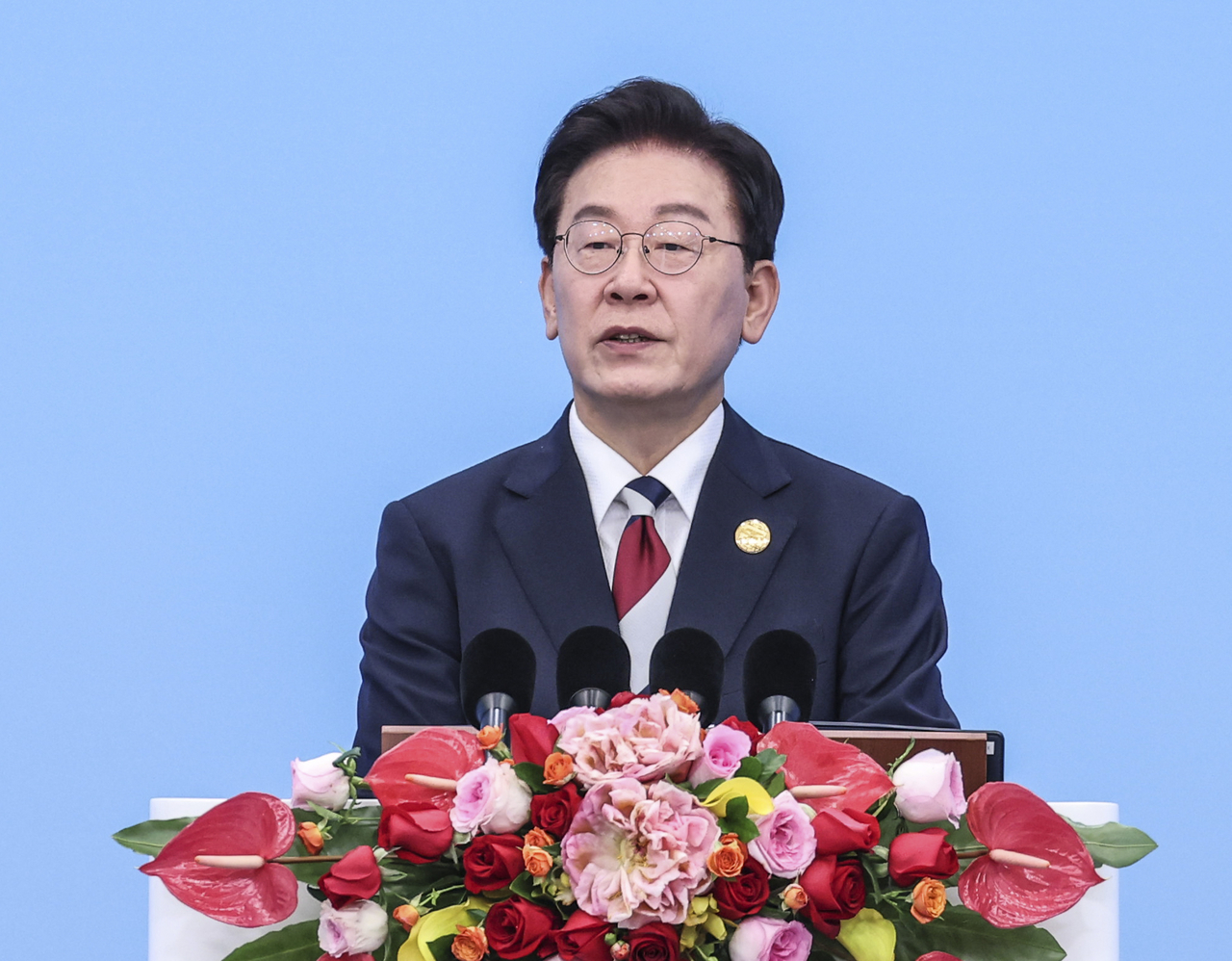
President Lee Jae-myung, in Shenzhen, China, for the APEC Leaders' Summit, made the case Wednesday (local time) before a gathering of global business leaders for practical economic solidarity rooted in "openness, innovation and cooperation" to push through protectionism and supply chain disruptions.
Speaking at the 2026 APEC CEO Summit at the Qianhai International Convention Center in Shenzhen, Lee noted that this year's summit carries the theme "Co-create, Co-prosper for the Future," and recalled APEC's founding moment. "Thirty-seven years ago, in January 1989, a momentous proposal was made in Seoul, South Korea — that we build prosperity and a shared future across the Asia-Pacific together," he said. "The brilliant journey APEC has traveled since then has been a dazzling history of growth, proving that mutual trust is the shortest path to mutual prosperity."
Lee said APEC, whose economy has grown roughly sixfold and whose goods trade has expanded roughly tenfold since its founding — now accounting for about 61 percent of world GDP and about 46 percent of global trade — faces a critical turning point. "Protectionism is deepening economic fragmentation, and geopolitical tensions and global economic uncertainty are growing," he said. "Last year in Gyeongju, APEC's three core tasks were connectivity, innovation and prosperity. I believe the same sense of urgency underlies this year's Shenzhen APEC agenda of openness, innovation and cooperation." He added: "Even as trade barriers rise, we must not stop opening up. We must extend the benefits of the AI revolution as innovation for all. And we must cooperate more closely to build stable industrial foundations and supply chains."
Lee particularly urged that tangible, immediate change for businesses take priority over sweeping slogans. "To break through the current situation of rising barriers to trade and investment, we must first produce changes that companies can feel right now, before pursuing the grand goal of economic integration," he said. "We need a flexible, pragmatic approach that respects each country's circumstances and positions while steadily accumulating the fruits of cooperation, starting in areas where it is possible."
Lee also laid out a vision for inclusive AI-era innovation and South Korea's "Manufacturing AX" initiative. "South Korea is actively pursuing Manufacturing AX — combining the manufacturing capabilities we have built up over many years with AI technology," he said. "But if AI cooperation takes place only among leading nations and companies, the potential for growth will be limited, and AI risks becoming a catalyst that deepens economic fragmentation rather than alleviating it."
He went on to say that "companies in developing countries must also be able to raise productivity through AI, and small ideas from small businesses must be able to grow into new products and services." Lee pledged that South Korea would lead the way in sharing experience accumulated on the factory floor, expanding exchanges of businesses and talent, and spreading the fruits of innovation across the Asia-Pacific region. "The APEC AI Initiative adopted at last year's Gyeongju APEC was our collective promise to realize that future together," he said.
Lee also made a forceful call for supply chain security cooperation spanning advanced semiconductors, energy and critical minerals. "No matter how advanced an AI technology may be, it cannot be properly deployed on the factory floor without advanced semiconductors and a stable energy supply — and stable semiconductor production itself requires materials, equipment, technology and talent from many countries," he said. "The international community must work together to build systems that can identify supply chain threats early, and must jointly pursue stable supply and demand for critical minerals and energy."
Referencing Shenzhen as a hub of innovation where drones, electric vehicles, AI and robots have become part of daily life, Lee urged business leaders to embrace bold challenges. "The future is not given to those who wait — it is built together by those who dare to pursue new possibilities," he said. "I trust that you will join us in making the 2026 APEC, a stage for cooperation connecting 21 economies across four continents, a shared arena where all of us can cultivate greater prosperity."
sunpine@heraldcorp.com