S. Korea's golf population stands at about 4.99 million, having surpassed Japan's since 2021
Annual rounds played per golfer trail Japan by 7.5
South Korea has about 1.39 million more golfers than Japan, but its golf course market has grown to a comparable size — even as domestic greens fees remain roughly four times higher than those in Japan.
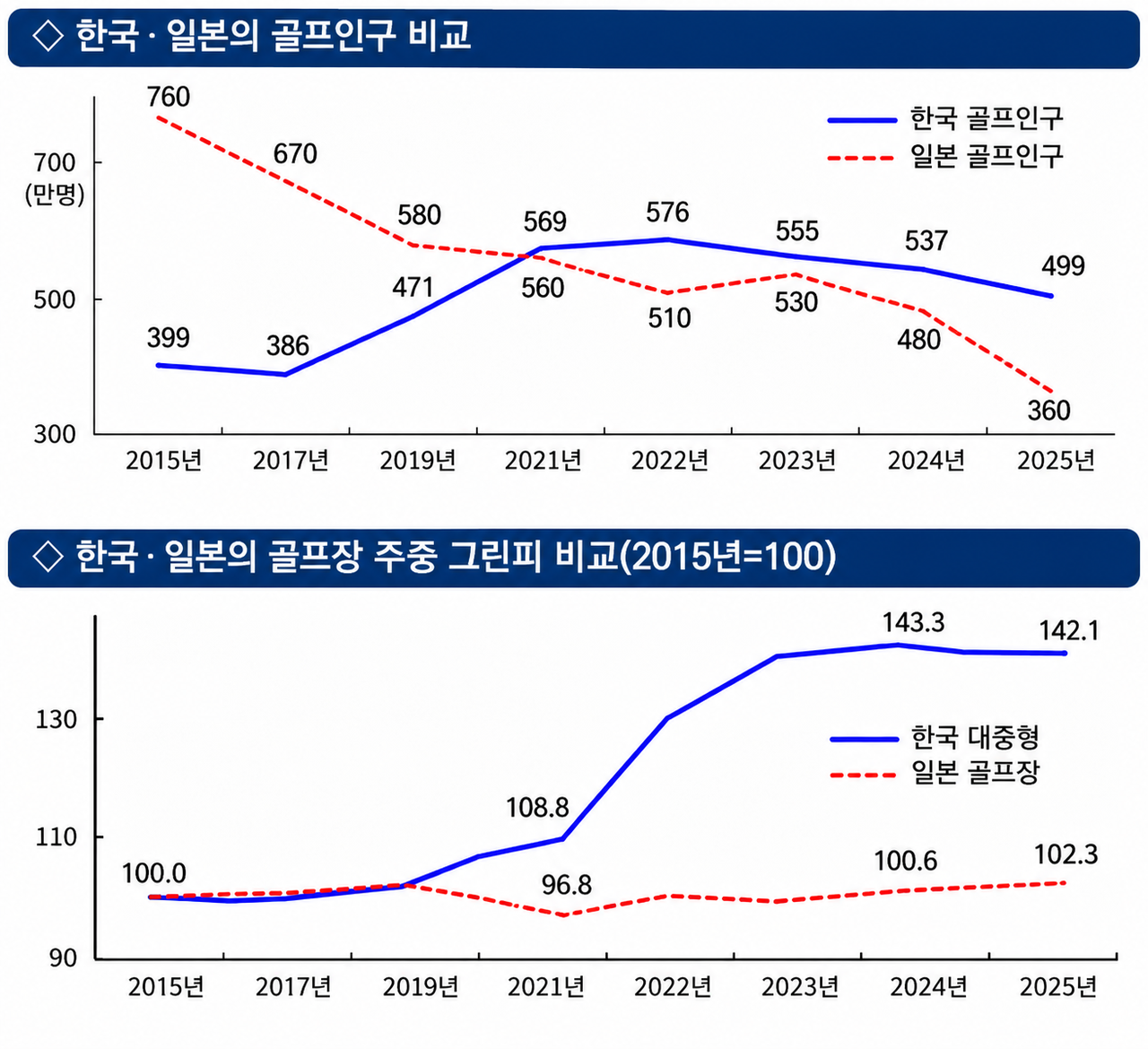
According to a report on the golf course industries of South Korea and Japan released Thursday by the Korea Leisure Industry Research Institute, South Korea had about 4.99 million golfers last year, compared with about 3.6 million in Japan — a gap of about 1.39 million. South Korea has maintained that lead since surpassing Japan in 2021.
South Korea's golf population climbed from about 4.7 million in 2019 to about 5.69 million in 2021, when the COVID-19 pandemic fueled a surge in outdoor leisure activity, before falling back to about 4.99 million last year. Japan has also seen a decline, from about 5.8 million in 2019 to about 5.6 million in 2021 and about 3.6 million last year.
Despite having more golfers, South Korea trails Japan significantly in how often players actually hit the course. South Korean golfers averaged 9.4 rounds per year last year, compared with 16.9 in Japan — a gap of 7.5 rounds. South Korea's figure rose by 0.6 rounds from 2023, while Japan's fell by 0.4.
The institute identified high greens fees as the primary driver of that gap. As of May this year, the average weekday greens fee at a public golf course in South Korea was 167,600 won ($125), three times the 55,800 won charged in Japan. Weekday greens fees in South Korea have risen 40.1 percent since 2016, while Japan's have increased just 4.5 percent over the same period.
The gap widens further when cart and caddie fees are included. The average all-in weekday cost per person at a South Korean public course was 228,900 won, compared with 59,300 won in Japan — 3.9 times higher.
More than 90 percent of golf courses in Japan operate without caddies, and many outside the greater Tokyo area do not charge separately for carts. South Korea, by contrast, requires caddies at most courses, adding a significant cost on top of the greens fee. The average weekday greens fee at a South Korean public course fell 2.6 percent, from 172,100 won in 2023 to 167,600 won in May this year — but that figure is still about 40 percent higher than in 2020.
The two countries' golf course markets have converged considerably in size. South Korea's total golf course market — combining greens fees, cart fees, food and beverage sales, and caddie fees — reached 8.62 trillion won last year, just 1.9 percent smaller than Japan's 8.79 trillion won.
South Korea's market peaked at 9.50 trillion won in 2022, riding the pandemic-era boom, and outpaced Japan for three consecutive years from 2022 through 2024. As domestic golf enthusiasm cooled, however, Japan reclaimed the lead last year.
Excluding caddie fees, South Korea's golf course market stood at 6.9 trillion won, or 21.5 percent smaller than Japan's. The difference reflects a structural distinction: in South Korea, caddies typically operate as independent contractors, so their fees are not counted as course revenue, whereas in Japan, caddies employed directly by courses have their fees recorded as part of course sales.
Seo Cheon-beom, director of the Korea Leisure Industry Research Institute, said the domestic golf industry must bring costs down to slow the decline in the number of golfers if it is to sustain long-term growth. "If the current high-cost structure persists, it will lead to an outflow of foreign currency as more golfers travel abroad, and will hinder the development of the domestic golf course industry," Seo said.
yjc@heraldcorp.com