Korea Water Resources Corporation launches development council Wednesday, aiming to accelerate the government's goal of 100 GW of renewable energy by 2030
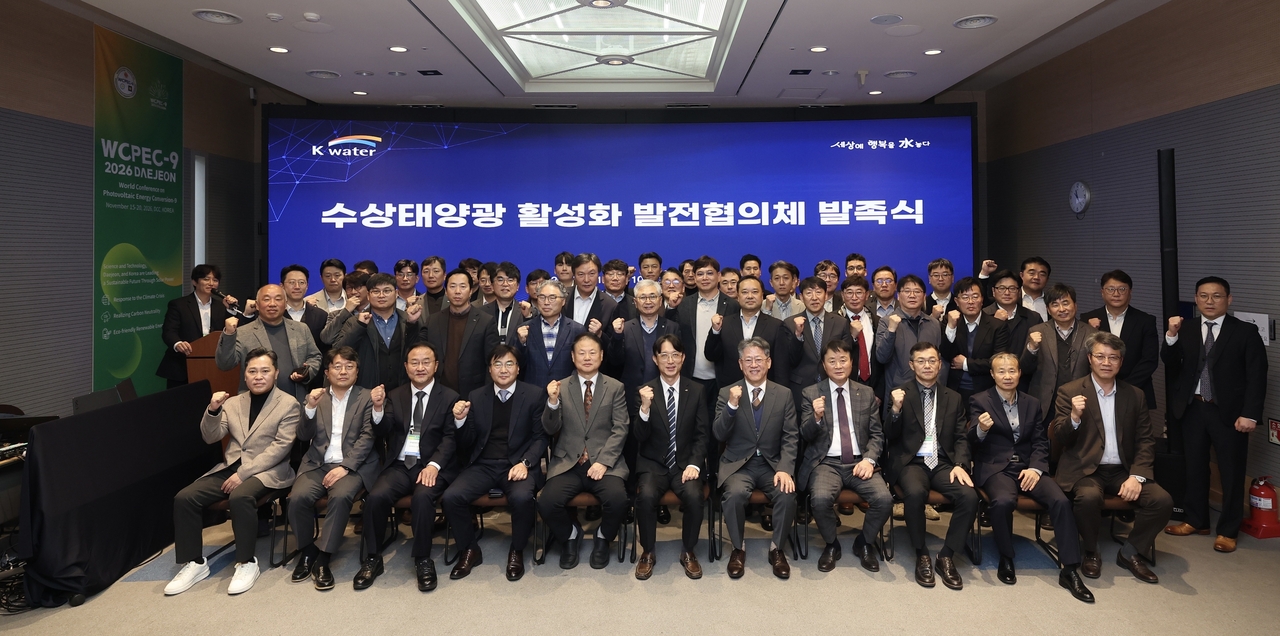
Korea Water Resources Corporation (K-water) held the inaugural ceremony of a floating solar activation development council Wednesday at the Daejeon Convention Center in Yuseong-gu, Daejeon, to promote the domestic floating solar industry and build a supporting industrial ecosystem.
The council, in which more than 50 public and private institutions, academia and research bodies participate under K-water's overall management, was launched to combine public institutional support with private-sector technology, address key challenges facing the floating solar industry, and help the government meet its target of deploying 100 GW of renewable energy by 2030.
Floating solar is a key renewable energy source that generates large-scale electricity using the water surfaces of dams and reservoirs without disturbing separate land sites. It can also reduce the burden of building new transmission infrastructure by linking to existing hydropower transmission networks through a cross-transmission approach.
Scaling up floating solar deployment requires constant communication and joint public-private action to respond to fluctuations in raw materials prices and shifts in the policy environment, as well as to resolve industry-wide challenges such as easing permitting regulations, localizing equipment production and cutting unit costs.
In response, K-water established an official communication channel the industry had long requested and built a governance structure combining public institutional support with private-sector technology.
The council will operate on a standing basis through three specialized subcommittees — policy recommendations, technical construction, and equipment and materials — holding biannual plenary meetings chaired by the council chair and ad hoc meetings chaired by the general coordinator to discuss practical cooperation measures.
The policy recommendations subcommittee will focus on rationalizing permitting regulations and improving the institutional regime, while the technical construction subcommittee will prioritize reducing project costs, standardizing design and construction, and ensuring safety. The equipment and materials subcommittee will concentrate on developing and localizing high-efficiency modules and new mooring technologies.
At the inaugural ceremony, the council finalized its operating rules and appointed subcommittee chairs. As its first agenda item, it discussed plans to establish performance and evaluation standards for floating structures in collaboration with the Korea Conformity Laboratories.
K-water said it plans to use the council's launch as an opportunity to strengthen cooperation with relevant agencies, minimize administrative and technical delays in project execution, and lead efforts to secure global competitiveness for the domestic floating solar industry and achieve carbon neutrality.
Oh Bong-geun, head of K-water's renewable energy division, said a standing communication channel combining public institutional support and private-sector technology is essential to securing real momentum for expanding floating solar deployment. "Through this council, the government, public institutions, industry and academia will work closely together to achieve regulatory reform and technological innovation, creating an opportunity for the domestic floating solar industry ecosystem to take a significant leap forward," Oh said.
thlee@heraldcorp.com