- Korea Basic Science Institute confirms CML buildup in liver tissue of fatty liver patients
- Mini liver grown from human stem cells shows fat accumulation, inflammatory response

South Korean researchers have confirmed that a specific sugar toxin accumulates heavily in the liver tissue of fatty liver patients and have shown that the substance triggers fat buildup and inflammation in a miniature liver model grown from human stem cells.
The Korea Basic Science Institute announced Wednesday that a research team led by Han Eun-hee of its Ochang Bio and Environmental Research Division, working jointly with Ha Sang-geun of the Korea Food Research Institute and Professor Jeon Dae-won of Hanyang University, has identified the effects of carboxymethyllysine (CML) — a type of advanced glycation end product — on fatty liver disease.
Fatty liver disease is a condition in which fat accumulates excessively in the liver. In some patients it progresses to steatohepatitis, a form of liver inflammation, and can advance further through fibrosis — a hardening of liver tissue — to cirrhosis.
It had previously been known that advanced glycation end products, commonly called "sugar toxins," which form during the metabolism of sugars and fats, are associated with fatty liver disease. However, it remained unclear which specific sugar toxin directly contributes to liver damage.
The research team compared six liver tissue samples and 12 serum samples from fatty liver patients and healthy individuals.
While no significant difference was found in the overall level of advanced glycation end products, CML was detected in greater quantities in the liver tissue of fatty liver patients. In blood samples, however, no difference in CML concentration was observed.
This suggests that blood levels of sugar toxins alone are insufficient to accurately gauge the amount of CML that has accumulated in the liver.
To determine how CML affects liver cells, the team cultured human stem cells for about four weeks to produce liver organoids — miniature liver models.
Liver organoids are three-dimensional cell models that replicate some of the structure and function of the liver. Because they contain not only liver cells but also cells resembling immune cells and those involved in fibrosis, they allow researchers to observe the complex reactions that occur in actual liver tissue.
When the team administered CML to these mini livers, fat accumulation increased as the concentration rose.
Mitochondria, which handle energy production in cells, showed stress responses, and levels of inflammation-related substances and collagen — which plays a role in the fibrosis process — also increased.
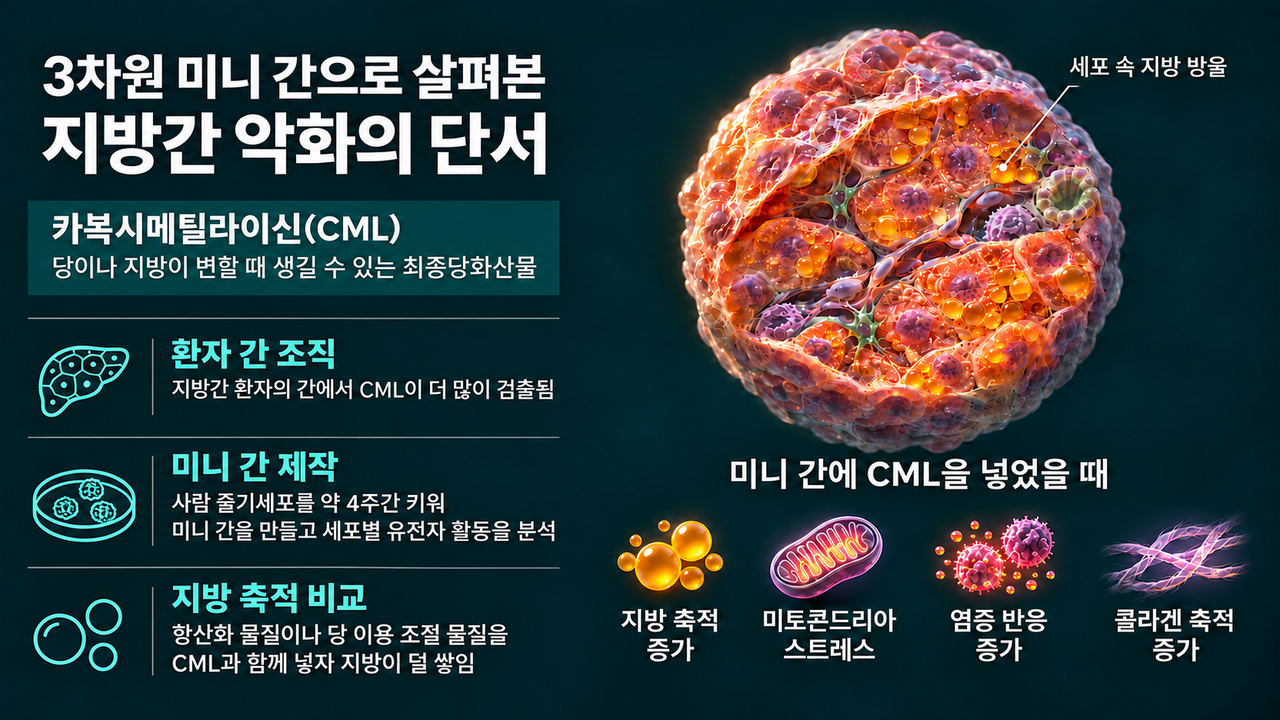
The research team also identified ways to reduce the fat accumulation triggered by CML.
When NAC, a substance that suppresses oxidative stress; 2DG, which affects cellular glucose metabolism; and clodronate, which inhibits the activity of macrophages — a type of immune cell — were each administered alongside CML, fat accumulation decreased.
The findings suggest that oxidative stress, glucose metabolism and immune cell activity may all play a role in the fat accumulation caused by CML.
However, these substances were not drugs used to verify a treatment effect but experimental agents used to confirm the underlying mechanisms of cellular response.
In mouse experiments, the team also confirmed that administering CML for 12 weeks led to CML accumulation in the liver and changes in fibrosis-related gene expression. Actual fibrosis — the physical hardening of liver tissue — was not observed, however.
"We confirmed that CML in a liver model made from human stem cells triggers not only fat accumulation but also inflammation and fibrosis-related responses," Han said. "The reduction in fat accumulation when cellular responses were modulated could provide a new clue for intervening in the progression of fatty liver disease."
The findings were published in the November issue of Pharmacological Research, an international journal in the field of pharmacology.
nbgkoo@heraldcorp.com