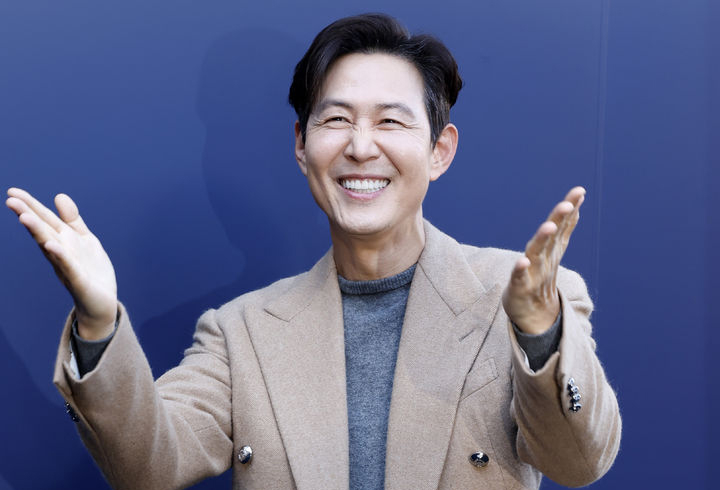
Actor Lee Jung-jae has been drawn into a controversy over allegedly unfair business dealings with Artist Company, the talent agency of which he is the largest shareholder.
According to Dispatch, Lee's contract with Artist Company stipulates that revenue from his entertainment activities up to 4 billion won ($2.99 million) is split 9-to-1 in his favor, while any amount above that threshold goes entirely to Lee, with the agency receiving nothing. In effect, no matter how much Lee earns, Artist Company can take home no more than 400 million won — 10 percent of the 4 billion won cap.
Lee in fact earned more than 20 billion won, including fees for appearing in seasons 2 and 3 of Netflix's "Squid Game," yet Artist Company received only 400 million won, with the remainder going to Lee. The payments were made through Lee's personal business entity, Verdant Hills, which received 20.1 billion won from Artist Company last year.
Artist Company's earnings have deteriorated sharply in the meantime. The agency posted sales of 46.7 billion won and an operating loss of 4 billion won last year, and has recorded an operating loss of about 2.4 billion won through the first three quarters of this year.
As Lee collected large sums, Artist Company's share price plummeted. The stock opened 2025 at 13,610 won per share but was trading at 3,690 won on Wednesday, a collapse of 73 percent in roughly two years. Lee holds a 27.1 percent stake in the company, making him its largest shareholder.
Critics have raised questions about whether Lee's revenue-sharing terms amount to an unfair privilege compared with those of other Artist Company-affiliated actors, including Yeom Jung-ah, Lim Ji-yeon, Kim Hye-yoon and Jo Yi-hyun, whose contracts reportedly carry no cap on the agency's share of earnings.
Artist Company pushed back, saying the contract reflects "a standard management agreement that comprehensively takes into account the actor's performance, the company's investment and risk." The agency added that "even given Lee's status as a major shareholder, it would not be reasonable to impose terms less favorable than those at other agencies."
Dispatch also flagged the relocation of Artist Studio — formerly known as Raemong Raein and an affiliate of Artist Company — to a building owned by Lee. The company had been based in Nonhyeon-dong, Gangnam, Seoul, but after being acquired by Artist Company it moved to Lee's building in Cheongdam-dong, Gangnam, just 2.3 kilometers away, even though more than a year remained on its existing lease. The move reportedly resulted in double rent payments on both the old office and Lee's building. Lee's building had sat vacant for an extended period before the relocation, after which it generated rental income of 130 million won in 2025 and 90 million won in the first half of this year.
Artist Company said the move was made "to facilitate business coordination, management oversight and the building of a cooperative framework," and that the ownership of the building played no role in the decision.
The contract terms between Lee's cosmetics company, Vena Beauty — which Lee established as a personally owned corporation in March — and Artist Company's new business venture have also come under scrutiny. Three months after Vena Beauty was founded, Artist Company announced an entry into the cosmetics business in June and reportedly signed a deal to pay Vena Beauty a guaranteed minimum fee each year, along with a royalty equal to 10 percent of operating profit based on sales performance.
Artist Company said the arrangement was "a performance-linked structure chosen in lieu of a fixed modeling fee," describing it as "a structure designed for the mutual sustainability of the actor and the company, with the largest shareholder stepping forward first to set a precedent."
paq@heraldcorp.com