Ministry of Statistics releases 2026 social survey results
Share viewing marriage as necessary rises 2.5 percentage points to 55%; job insecurity ranks second among reasons to avoid marriage
Sense of social safety climbs from 28.9% to 37.8%; positive ratings for living environment up 7.2 percentage points
57% rate their health positively; middle and high school students' satisfaction with school life falls to 55.5%
More South Koreans now believe marriage is necessary than two years ago, and the share who feel their society is safe has risen sharply, according to a government survey released Wednesday.
Positive assessments of personal health and local living environments also increased. At the same time, satisfaction with school life among middle and high school students declined, and a growing share of respondents cited job insecurity as a reason to avoid marriage. Public sentiment improved across areas including family, health and safety, but burdens related to employment and education remain.
According to the 2026 Social Survey released Wednesday by the Ministry of Statistics, 55.0% of people aged 13 and older said they believe marriage is necessary — up 2.5 percentage points from 52.5% in 2024. The share had stood at 50.0% in 2022, marking two consecutive increases.
However, the improved attitude toward marriage did not reflect an easing of financial pressures. The most commonly cited reason for not marrying was insufficient funds for wedding costs, at 29.0%, followed by unstable employment at 15.5%. The share citing job insecurity rose 2.6 percentage points from 12.9% in 2024.
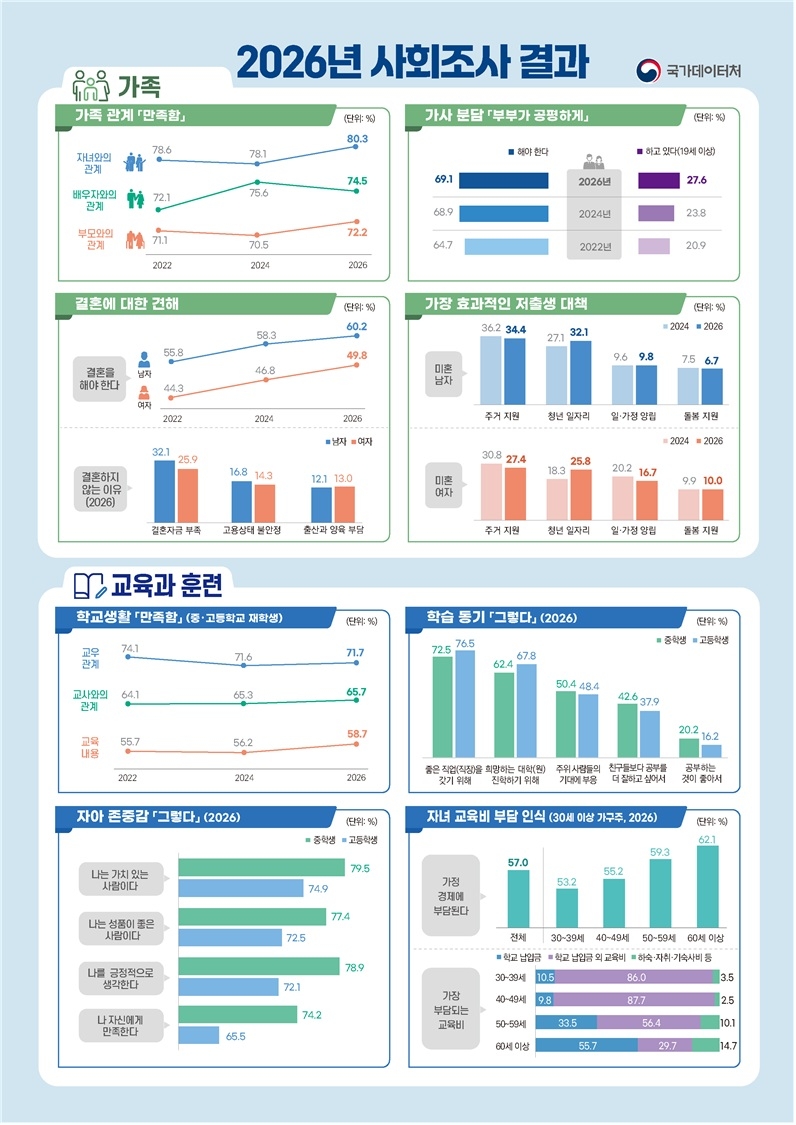
Residential support (32.0%) and youth job creation and employment assistance (25.7%) were cited as the most effective measures for addressing the low birth rate, together accounting for 57.7% of responses. The share selecting youth employment support rose 4.9 percentage points from two years ago, while the share favoring direct cash transfers fell from 8.0% to 6.7%.
Satisfaction with family relationships improved. Some 66.3% of respondents said they were satisfied with their overall family relationships, up 2.8 percentage points from two years ago. Satisfaction with spousal relationships stood at 74.5%, and satisfaction with parental relationships at 72.2%.
Yet a wide gap persisted between attitudes and reality on household chores. While 69.1% said couples should share housework equally, only 27.6% said they actually do — a gap of 41.5 percentage points.
In education, students' satisfaction with school life declined. The share of middle and high school students satisfied with school life overall fell 1.8 percentage points from 2024 to 55.5%. The most common reason students gave for studying was to secure a good job or career, at 74.6%, followed by gaining admission to a desired university or graduate school at 65.3%.
The share of respondents who said their children's education costs were a financial burden fell 3.9 percentage points from two years ago to 57.0% — still above half, but a notable improvement.
Meanwhile, the share of people who said they had received as much education as they wanted rose 3.6 percentage points to 64.9%. Among those who said they had not, financial circumstances were the most frequently cited reason, at 55.3%.
South Koreans' self-assessed health also improved. The share who rated their health as good rose 3.2 percentage points from 2024 to 57.0%.
Health-related behaviors broadly improved as well. The share who said they exercise regularly climbed from 48.4% to 51.7%, crossing the 50 percent mark. The share eating breakfast rose from 63.3% to 65.8%, and the share getting regular health checkups increased from 86.5% to 88.3%.
The share reporting stress in daily life fell 4.6 percentage points from two years ago to 33.8%. Stress levels in home life, work life and school life all declined.
Perceptions of social safety showed among the largest improvements of any category surveyed. The share who said South Korean society is generally safe rose 8.9 percentage points from 28.9% in 2024 to 37.8%. The figure stood at just 13.2% in 2016, meaning positive responses have risen 24.6 percentage points over a decade.
The share who said society has become safer compared with five years ago also rose 13.0 percentage points from two years ago to 34.9%, while 34.7% said they expect society to be safer five years from now — up 11.8 percentage points.
Despite the improved safety perceptions, sources of anxiety remained. Crime was cited as the biggest safety concern at 22.4%, followed by national security (17.6%), economic risk (15.7%) and lack of public morality (9.7%).
The share who said they feel safe walking at night rose 2.1 percentage points from two years ago to 71.6%. However, the share who said they feel anxious walking alone at night showed a stark gender gap — 42.1% among women and 14.5% among men.
Assessments of local living environments also improved. The share who said the overall living environment in their area is good rose 7.2 percentage points from 49.4% in 2024 to 56.6%.
By category, green spaces received the highest positive rating at 64.2%, followed by light pollution (52.6%), air quality (48.8%), waterways (46.5%), soil (45.6%) and noise and vibration (43.3%). Positive ratings rose across all categories compared with two years ago.
Environmental anxieties persisted, however. Nearly six in 10 respondents — 59.6% — said they feel anxious about fine dust. Concerns about climate change (46.2%), hazardous chemicals (34.4%) and radiation (33.9%) were also substantial.
The share in favor of paying taxes or levies for environmental protection fell 0.5 percentage points from 2024 to 49.7%.
The survey was conducted over 16 days from May 13 to May 28 and covered more than 34,000 household members aged 13 and older living in approximately 19,000 sampled households nationwide. It examined public perceptions across five areas: family, education and training, health, crime and safety, and living environment.
fact0514@heraldcorp.com