Expansion at Seosan test center
Facility is South Korea's only hypersonic engine test site
New building to support research on hypersonic vehicles
and engines for reusable space launch vehicles
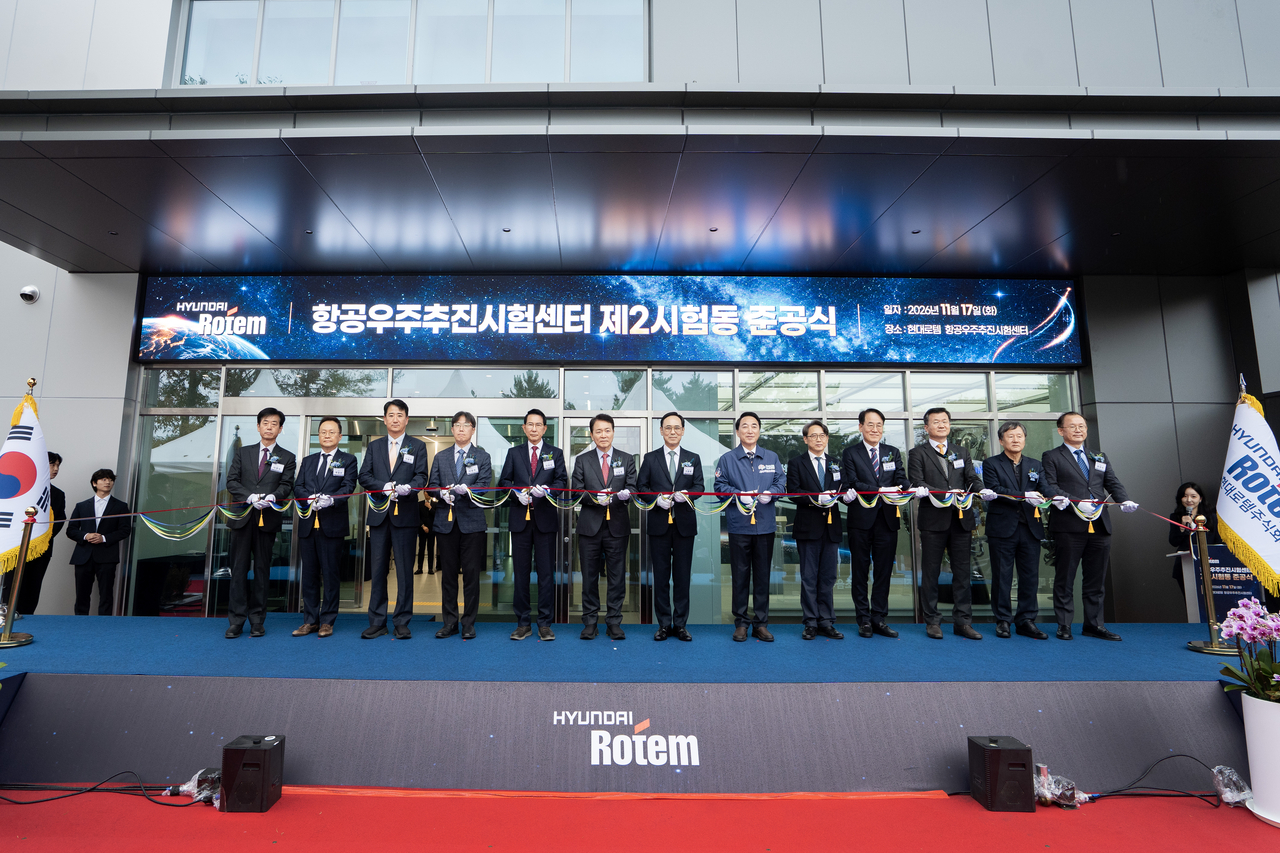
Hyundai Rotem held a completion ceremony Tuesday for the second test building at its Aerospace Propulsion Test Center in Seosan, South Chungcheong Province, the company announced Wednesday.
The Seosan center, established in 1998 across approximately 23,100 square meters, is approaching its 30th anniversary and has served as a foundational hub for South Korea's aerospace industry as the country moves toward a privately led New Space era.
The center is home to South Korea's first and only hypersonic and supersonic engine test facilities. It has been the site of development milestones ranging from the country's first liquid-propellant rocket engine — the KSR-III — to the propulsion system test infrastructure for the Nuri space launch vehicle, cementing its role as a comprehensive aerospace technology base.
The ceremony was attended by South Chungcheong Province Governor Park Soo-hyun, People Power Party lawmaker Seong Il-jong of the Seosan-Taean constituency, Seosan Mayor Lee Wan-seop, Agency for Defense Development Acting Director Ko Deok-gon, Korea Aerospace Research Institute Vice President Hwang Chang-jeon, Defense Acquisition Program Administration (DAPA) project support director Lee Jong-ju, and Defense Technology Promotion Research Institute director Lee Yong-jin, along with Hyundai Rotem President and CEO Lee Yong-bae and other company executives.
In his welcoming remarks, Lee said the Seosan center embodies "more than 30 years of blood and sweat from researchers dedicated to localizing guided-weapon and launch vehicle engine technology," calling it "a space that holds the history of Hyundai Motor Group's pursuit of national strength and the cosmos." He added that he was confident the new second test building "will make a significant contribution to South Korea's defense self-reliance and its rise as a space power."
The newly built second test building, set to enter full operation next year, will work alongside the existing first building as a core research base for developing hypersonic engines, methane engines for reusable space launch vehicles — in the 35-ton and 10-ton classes — and key engine components.
The facility houses propulsion test equipment capable of stable combustion testing for various aerospace engines, as well as performance testing rooms for evaluating individual components. Safety management systems have also been fully installed to allow researchers to focus on development work.
Hyundai Rotem is also pressing ahead with hypersonic engine research and development. The company is working on two types of hypersonic engines: a solid scramjet engine and a dual-mode ramjet engine.
The scramjet engine is designed for missiles flying at speeds exceeding five times the speed of sound. It is suited for high-speed, long-range flight while maintaining maneuverability and terminal strike capability.
The dual-mode ramjet engine can switch between ramjet and scramjet modes depending on speed, allowing the vehicle to change its operating mode. It requires more advanced technology than the solid scramjet engine.
Earlier, Hyundai Rotem participated in the Agency for Defense Development-led Korean hypersonic vehicle program, known as HyCore, where it was responsible for designing, manufacturing and assembling the combustor assembly, combustor operating components and auxiliary equipment — achieving results that exceeded the program's target speed. The project applied Hyundai Rotem's scramjet engine technology.
Hyundai Rotem, which in 2006 became the first in South Korea to successfully conduct a methane engine combustion test, last year won a contract from the Defense Technology Promotion Research Institute to develop methane engine technology for reusable launch vehicles — making it the first domestic effort to develop such an engine. Methane produces less soot during combustion and offers greater cost efficiency, making it well suited for reusable launch vehicles.
In addition, the company is accelerating development of key engine components for the uppermost stage of a launch vehicle, which places satellites into orbit.
"This is not simply an infrastructure expansion," a Hyundai Rotem official said. "We intend to concentrate our capabilities so that this becomes a pillar of future growth — a foundation for securing our own proprietary propulsion technology in the next-generation aerospace engine market."
Meanwhile, Hyundai Rotem received an integrated A-plus rating — the "very excellent" tier — in the 2026 ESG ratings for listed companies published by the Korea Institute of Corporate Governance and Sustainability (KCGS). The company said it had "achieved improvements despite challenges in the environmental and social categories stemming from the nature of our business structure, which includes defense."
likehyo85@heraldcorp.com