Co-exhibits next-gen AI inference chip with Japan's PFN
Logic chip and DRAM stacked vertically amid HBM supply crunch
Tape-out targeted for first quarter of next year
On-device AI applications expected to expand
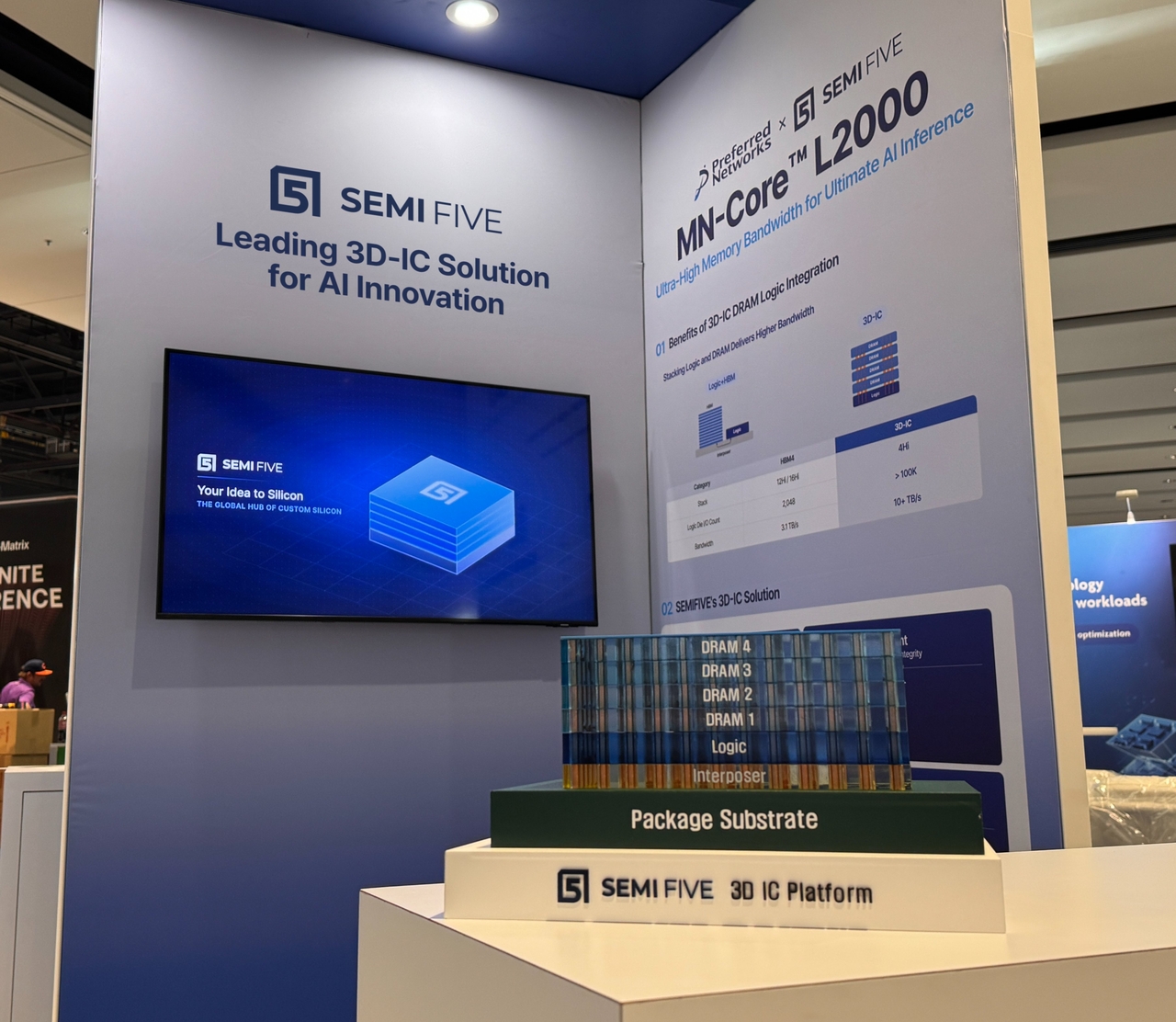
SemiFive, a company specializing in custom application-specific integrated circuit (ASIC) design, announced Tuesday that it unveiled its 3D-IC platform at SC26 in Chicago.
SemiFive is co-exhibiting the next-generation AI inference chip series "MN-Core L2000" at the booth of Japanese AI company Preferred Networks (PFN) at SC26, running through Thursday at McCormick Place in Chicago.
SemiFive partnered with PFN to develop the MN-Core L2000 series on its 3D-IC platform, making it the first product to emerge from the platform. SemiFive participated in the development as a turnkey solution partner.
The chip is optimized for generative AI inference and is expected to deliver improved inference speed and energy efficiency over its predecessor, the MN-Core L1000, in advanced AI agent and large-scale service environments. Tape-out is scheduled for the first quarter of next year.
The 3D-IC platform is a next-generation AI semiconductor solution that stacks logic chips and DRAM vertically. It has drawn attention as a potential alternative to high-bandwidth memory (HBM), which has faced supply shortages.
Unlike the HBM approach, which connects memory horizontally alongside a logic chip, the 3D-IC architecture forms hundreds of thousands of physical data channels vertically between the logic chip and DRAM.
The advantages of 3D-IC include memory bandwidth exceeding that of HBM, improved power efficiency and lower production costs. SemiFive said it has been proactively conducting research and development in 3D-IC technology in anticipation of these market shifts.
At SC26, the company disclosed the development progress and core design direction of its 3D-IC-based semiconductor, which is nearing commercialization.
SemiFive expects demand for 3D-IC in the custom AI semiconductor space to grow rapidly, projecting that it will gain recognition as a solution to complement the HBM supply shortage.
The company noted that 3D-IC is particularly well-suited for edge device applications — including on-device AI, robotics and smart devices — where compact form factors and ultra-low power consumption are essential, as the technology can significantly reduce horizontal footprint.
Daisuke Okanohara, co-founder and chief executive of PFN, said developing AI chips with a 3D stacked architecture involves more complex technical challenges than conventional chip development, including power consumption, heat dissipation and manufacturing yield. "We will work with SemiFive, which has a proven track record in custom semiconductor turnkey solutions, to overcome these technical hurdles and address the challenges facing AI today," he said.
Jo Myung-hyun, chief executive of SemiFive, said 3D-IC is a next-generation solution to overcome the limitations of HBM supply and demand, adding that the global market is seeing strong interest and a surge in inquiries. "SemiFive has proactively built its own 3D-IC platform and has already secured technological leadership," Jo said.
jeongwan@heraldcorp.com