Korea Fire Insurance Association holds fire recreation experiment at risk management seminar
Smoke detector triggered within about 10 seconds of power bank fire
Heat detectors mandatory, but smoke detectors still not required
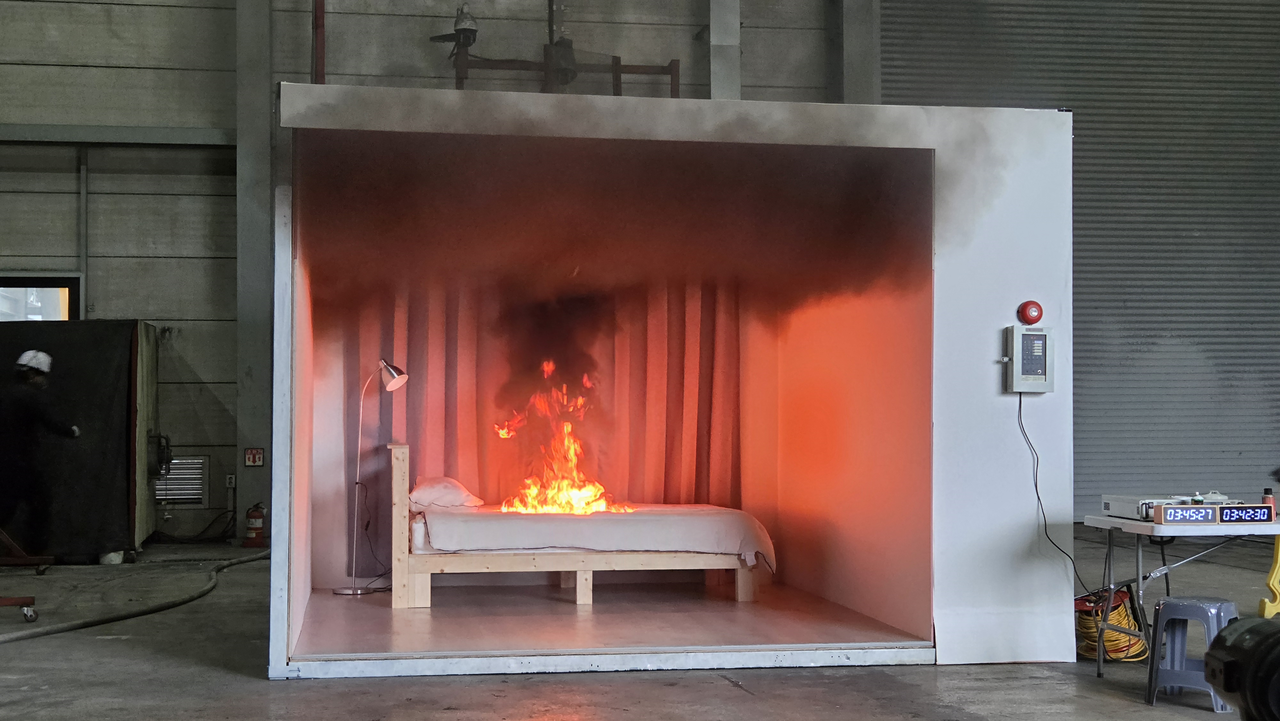
About three minutes into fast-charging a power bank on a bed in a roughly 6.6-square-meter bedroom, gray smoke began to rise. Within about 10 seconds, a smoke detector mounted on the ceiling sounded an alarm and announced that a fire had broken out. As acrid toxic fumes filled the room, sparks flew and flames spread instantly throughout the bedroom. At the same time, the heat detector activated and an evacuation announcement began to play.
The Korea Fire Insurance Association held a "Risk Management Technology Seminar" Tuesday at its affiliated fire prevention testing institute in Yeoju, Gyeonggi Province. The event featured a power bank fire recreation and a comparison experiment on the response times of heat and smoke detectors. The experiment was designed to demonstrate why smoke detectors — which can identify a fire before it fully ignites — must be installed. In fires where smoke spreads first, an early alarm is essential to give residents enough time to recognize the danger and begin evacuating.
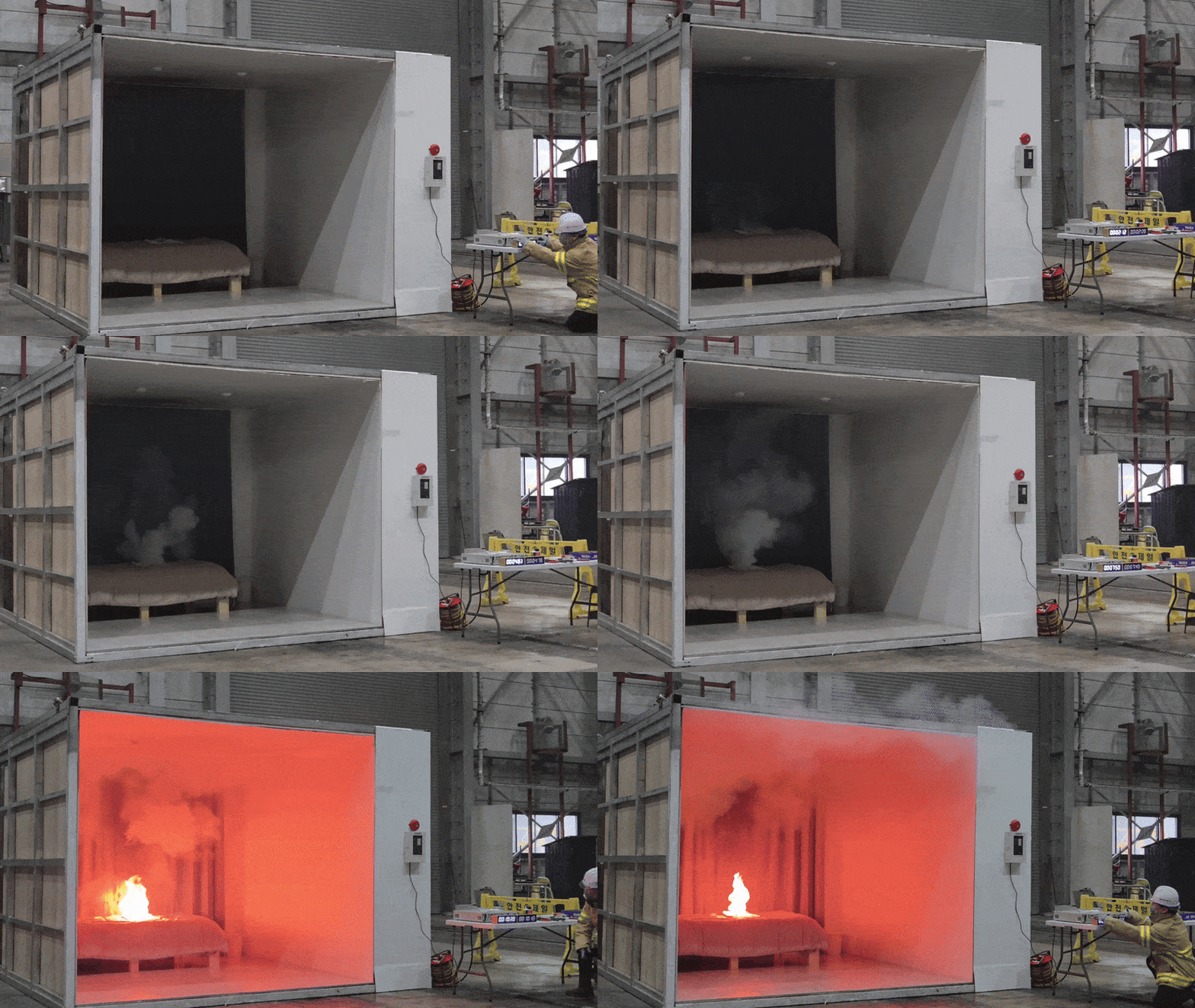
Fires that start from power banks typically follow the pattern seen in Tuesday's experiment: smoke appears first, and flames erupt and spread only after some time has passed. For residents to have a "golden time" to detect a fire and evacuate, a smoke detector must catch the smoke before a heat detector registers the heat from the flames.
There have been cases where delayed fire alarms led to greater tragedy. In July, a fire broke out at a villa in Galhyeon-dong, Eunpyeong-gu, Seoul, killing two elementary school siblings. In June and July last year, back-to-back fires at apartments in Busanjin-gu and Gijang-gun, Busan, claimed the lives of four children. When the government announced measures to prevent a recurrence of the Busan fires, it said the absence of fire alarms, sprinklers and other safety devices in the affected units had made early evacuation and firefighting difficult.
Kim Seong-je, a senior researcher at the fire investigation center of the fire prevention testing institute who led Tuesday's experiment, said, "The earlier the alarm sounds, the sooner evacuation can begin." Kim added that while heat detectors are currently required by law, many residential facilities remain in a blind spot for fire risk because smoke detectors are not installed. "Smoke detectors need to be installed in more residential facilities," Kim said.
Beyond power banks, overcharging other battery-powered devices commonly used in daily life — such as robot vacuum cleaners — can also significantly increase the risk of fire. Kim advised that batteries should be charged with a standard charger rather than a fast charger whenever possible, used before reaching a full 100 percent charge, and charged only when the user is home.
Meanwhile, the Korea Fire Insurance Association runs a safety culture campaign and a project to help vulnerable households enroll in residential fire insurance. An association official said the organization's goal is to get households in all 18 cities and provinces enrolled in fire safety insurance and to bring universal welfare equality to accident coverage, adding that awareness of the need for such insurance must spread more widely. South Jeolla Province and Gwangju have revised their ordinances to begin supporting vulnerable households in obtaining residential fire insurance from early next year, and South Chungcheong Province also plans to provide enrollment support next year.
won@heraldcorp.com