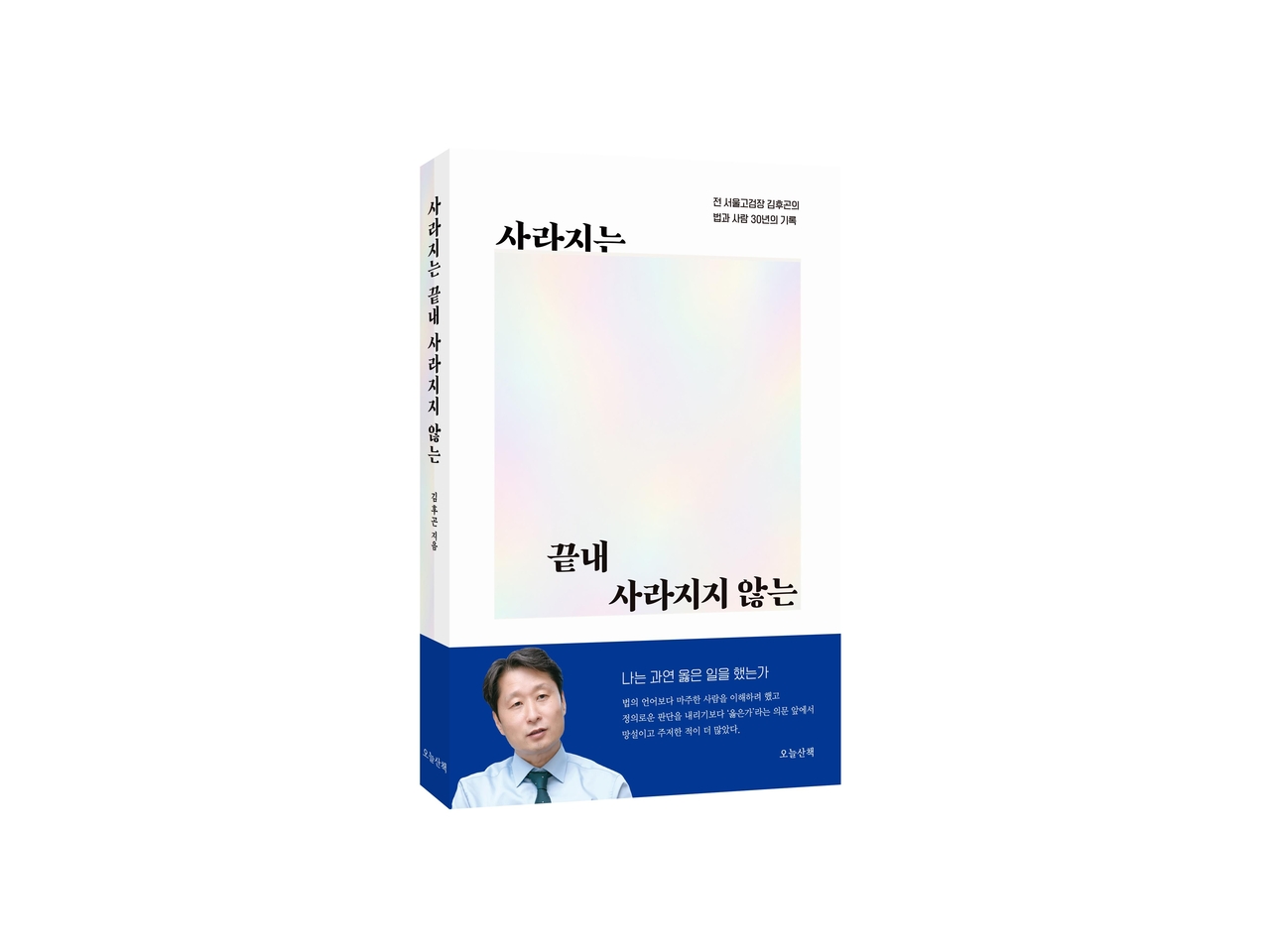
'What Disappears Yet Never Truly Disappears' hits shelves
Book concert set for Thursday at 7 p.m.
Thirty years in law — 27 as a prosecutor, three as a lawyer
A message to colleagues after the prosecutors' office dissolution
"I wavered enormously throughout my years as a prosecutor. Every time I saw myself faltering in the face of a case, I often thought: this profession does not suit me."
That confession opens the first essay collection by Kim Hu-gon, former chief of the Seoul High Prosecutors' Office, who spent 27 years as a prosecutor. Published by Oneulsanchaek under the title "What Disappears Yet Never Truly Disappears," the book chronicles his three decades in the law — 27 years as a prosecutor and three as a defense attorney.
The book traces his career from his first posting in 1996 as a junior prosecutor at the northern branch of the Seoul District Prosecutors' Office — later renamed Seoul Northern District Prosecutors' Office and now operating as the Seoul Northern District Public Prosecution Office — through his departure from the service in September 2022 as chief of the Seoul High Prosecutors' Office. Along the way, Kim held posts including chief of the special investigations unit at the Seoul Central District Prosecutors' Office, spokesperson for the Supreme Prosecutors' Office, head of the Supreme Prosecutors' Office's trial and litigation division, planning and coordination chief at the Ministry of Justice, chief of the Seoul Northern District Prosecutors' Office, and chief of the Daegu District Prosecutors' Office. He currently serves as managing partner at law firm Bae, Kim & Lee LLC.
Kim said that as he left the prosecutors' service, the first thing that came to mind was a taxi driver he had detained early in his career. The real perpetrator had been someone else, and the driver had served time in prison before being released. Kim tracked down the driver after the release and apologized in person. In the book, Kim writes: "Even now, many prosecutors press forward without ever considering that they might be wrong. Perhaps a good prosecutor is one who occasionally looks back and asks whether they were right."
The question — "Was what I did truly right?" — runs through the entire book. Kim begins by reflecting on cases where his judgment fell short or where circumstances he had failed to notice later came to light, what he calls his moments of "shame." Beyond the taxi driver case, one such episode involves a group of runaway girls he had enrolled in a law-compliance program, only to learn afterward that they had not had enough to eat.
He also recounts helping a released fraud convict locate a family member's address at the convict's request, and allowing the wives of detained union officials who had come to protest to meet their husbands inside his office.
"I should have understood from early on that while prosecutors handle cases, the job is really about seeing the people inside those cases," Kim writes. "Had more prosecutors thought that way, I do not believe the service would have reached the point of dissolution it faces today."
The book also revisits major cases from his career. Kim describes his role as a Ministry of Justice litigation official in drafting the government's brief during the 2004 impeachment trial of former President Roh Moo-hyun, and his experience heading the confirmation hearing preparation team for Cho Kuk, then a candidate for justice minister, in 2019.
He also looks back on his decision, as chief of the Seoul Northern District Prosecutors' Office, to file for a retrial on his own authority in the case of the late Lee So-seon, mother of labor martyr Jeon Tae-il, who had been convicted of violating a martial law decree. The case ended in acquittal 41 years later. The book also includes an account of how Kim and former Prosecutor General Lee Won-seok jointly drafted a statement by prosecutors general opposing the disciplinary action brought against the then-prosecutor general in 2020.
The book also sets out Kim's views on the overhaul of the criminal justice system that has unfolded since last year. While noting his skepticism toward separating investigation from indictment, Kim emphasizes the importance of "listening to and resolving the grievances of the public."
"Even after the prosecutors' office sign comes down, whether the institution is called a public prosecution office or a serious crimes investigation agency, only the form changes — the work itself does not disappear," Kim writes. "Regardless of the name, I hope many outstanding prosecutors remain and continue to play important roles wherever they are."
The book is divided into three chapters. The first, "There Are Circumstances Sadder Than the Crime," gathers stories of people Kim encountered in his office and interrogation rooms. The second, "The Strength to Endure Everything," turns to the everyday life of what he calls a "romantic prosecutor" — one sustained by literature, music and travel.
The third chapter, "To You, Standing Before the Law," addresses legal questions of practical use to general readers. Drawing on his experience in both prosecution and defense, Kim explains why deleting messages from a mobile phone ahead of a search and seizure can be legally problematic, what it means to retain a lawyer, and what to consider when negotiating a settlement.
Former Prosecutor General Lee Won-seok contributed a foreword, describing Kim's life as "the warm story of a man who moved through life like water flowing downstream, never against the current — a human story, all too human." Actor Yoo Joon-sang also offered an endorsement, writing that the stories Kim drew from a world of law and principle — told by a romantic prosecutor who loves literature and music and finds joy in guitar and travel — were deeply moving.
Kim will hold a book concert to mark the essay's publication Thursday at 7 p.m. at Seogyo Square inside the Seoul Lifestyle Culture Center Seogyo in Mapo-gu, Seoul.
pooh@heraldcorp.com