Minister visits modular housing construction site in Sejong
The government plans to expand modular housing orders to 20,000 units from next year through 2030, with construction costs exceeding those of conventional methods to be subsidized at 35 million won ($26,200) per unit.
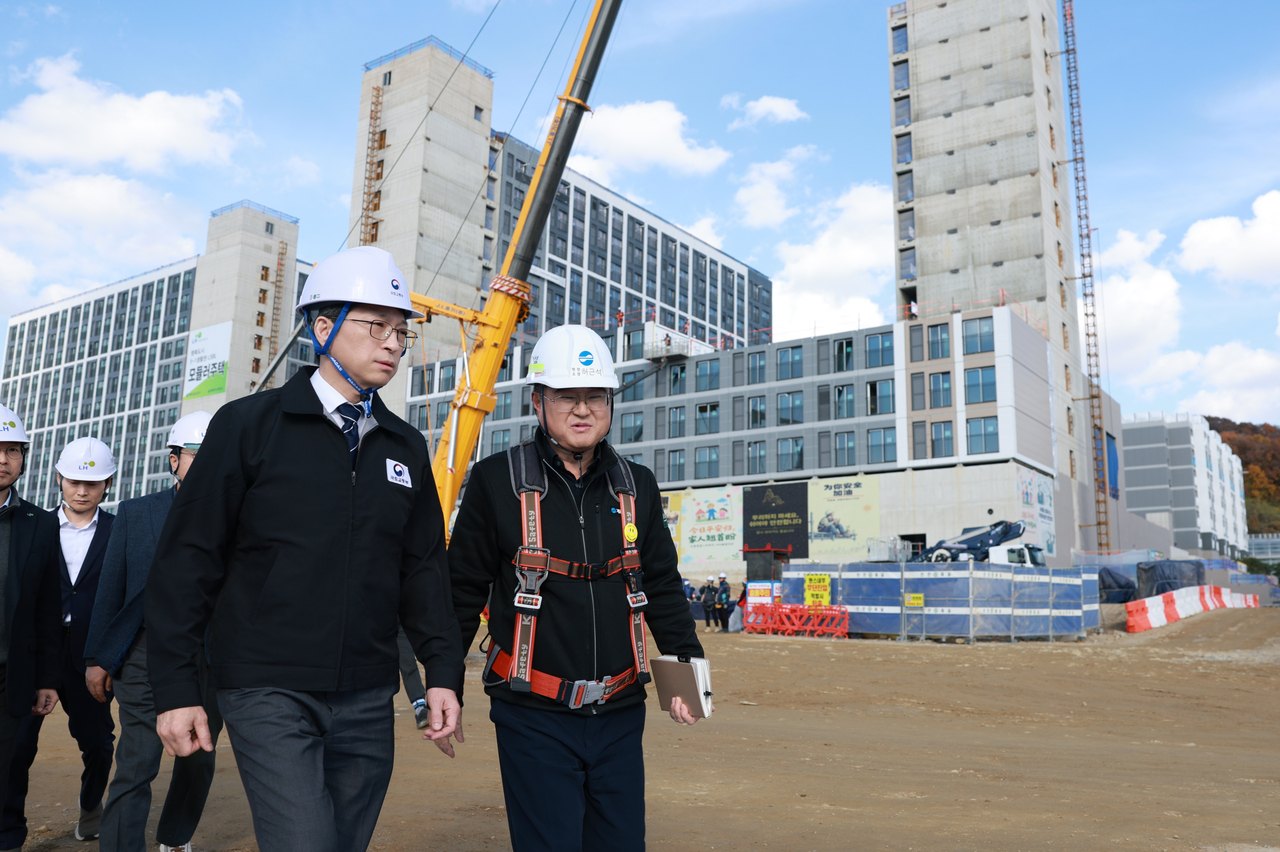
Land, Infrastructure and Transport Minister Hong Ji-seon announced the support measures Monday during a visit to a modular integrated public rental housing construction site in Sejong's District 5-1. Modular construction involves prefabricating a building's main structural components and parts of the interior at a factory before transporting and assembling them on site. The method has faced criticism for being roughly 30 percent more expensive than conventional construction.
"Amid growing difficulties at construction sites due to an aging workforce and a decline in skilled labor, modular construction is drawing attention as a key alternative that can shift the construction industry from labor-intensive to technology-driven work and significantly shorten build times," Hong said. "If you bring forward what is needed to develop the modular housing market, we will review it promptly and reflect it in policy."
The Ministry of Land, Infrastructure and Transport believes the public sector must first create stable demand for the modular industry to take hold. To that end, the ministry plans to expand public housing orders to 20,000 units by 2030, subsidize construction costs above 35 million won per unit, and pursue special legislation for modular construction. The government had previously announced in its Aug. 13 housing supply measures that it would raise the original supply target of 12,000 units. Korea Land and Housing Corporation has committed to providing 16,000 units — 70 percent of the total — and is already placing orders in areas including Namyangju Wangsuk and Goyang Changneung.
"We will work as one team with you to resolve difficulties," Hong added, urging construction workers on site to pay close attention to their health and safety.
The L5 block in Sejong's District 5-1, which Hong visited Monday, will house 1,327 integrated public rental units, of which 450 will be modular — the largest such development in the country. Factory-built modular units have been transported to the site since July and are being lifted and stacked into place by crane.
The complex originated as part of the Smart City National Pilot Project and is the first apartment development to adopt a "smart turnkey" procurement method, under which design and construction are bundled into a single bid incorporating advanced smart construction technology. The complex will also feature robot delivery, zero-energy systems and smart community technology.
At the site, Hong received briefings on modular housing industry trends and the progress of the L5 block from officials of Korea Land and Housing Corporation, the Korea Institute of Civil Engineering and Building Technology, and the Korea Iron and Steel Association. Hong then observed the process of factory-built units being joined and installed on site.
smh@heraldcorp.com