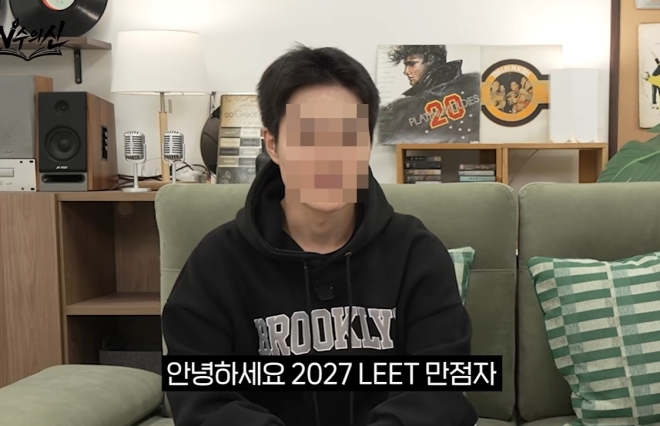
Amid the fallout from a top scorer on this year's certified tax accountant exam confessing to cheating with electronic devices and generative AI, questions are now being raised about the answer sheet of the first-ever perfect scorer on the Law School Admission Test, known as LEET. In response, Lee, 33, who achieved the perfect LEET score, announced a sweeping set of verification measures — including endoscopy checks of the ears, nose and mouth, and confirmation that no contact lenses are worn.
According to the college admissions industry, Lee scored perfect marks in both the verbal reasoning and analytical reasoning sections of the LEET administered last July. Lee said on social media that the Korean language section of the 2027 College Scholastic Ability Test would be livestreamed Thursday, when the exam is held, with Lee solving it in real time just as an actual test-taker would.
Lee, a 2026 enrollee in Seoul National University's dental school, became widely known after reportedly becoming the first person to achieve a perfect score since the LEET was introduced, going on to give interviews on multiple YouTube channels and publish a study guide based on the experience.
Lee plans to wait from 8:40 a.m. on the day of the CSAT, then print out the Korean language section immediately after the exam ends and the test paper is released, and complete it under the same conditions as the actual exam.
The choice of the CSAT Korean language section as a verification test appears to stem from the similarity between that section and the LEET verbal reasoning section, both of which assess reading comprehension and critical thinking through reading and literary passages.
Lee also said that, given the higher difficulty of the LEET verbal reasoning section compared with the CSAT Korean language section, a handicap would apply: completing the test in 65 minutes rather than the standard 80, while also answering 11 additional questions by including both elective subjects — speech and composition, and language and media.
Despite the announcement, internet users expressed skepticism, citing cheating methods such as rice grain-sized earphones, shirt-button micro-cameras and smart contact lenses. Lee responded Sunday with additional measures.
Lee said that before sitting the Korean language section, a physical search using two or more metal detectors would be conducted, adding that endoscopy checks of the ears, nose and mouth would also be performed, along with confirmation that no contact lenses are worn.

A top-ranked active instructor has also raised doubts about Lee, saying there are aspects of the perfect scorer's answer sheet that do not add up.
On Sunday, Noh Hyeong-seok, a verbal reasoning instructor at Mega Law School, appeared on a live broadcast of the YouTube channel "Heugwoo Story" and analyzed portions of Lee's answer sheet that have recently drawn scrutiny.
Noh achieved a perfect score in the LEET verbal reasoning section for the 2016 academic year and has continued to sit the actual exam every year for 10 consecutive years while working as an instructor. Noh raised questions about the pattern of answer corrections Lee made on the latter questions of the verbal reasoning section — specifically questions 25 through 27 — and on the final economics passage.
Noh first pointed to question 27, which was based on a science passage comparing vapor-compression heat pumps and absorption heat pumps. Noh said the passage and the answer choices made it clear whether a compressor was used, meaning a basic reading of the text should lead a test-taker to eliminate answer choice 3 first — yet the perfect scorer had initially selected that option before correcting it, which Noh said was difficult to understand.
Noh then raised questions about the final passage, which dealt with the temporal dimensions of law and economics.
The passage repeatedly emphasized the core premise that economics is forward-looking and does not consider past history, meaning answer choice 3 — which stated that the purchasing power of money is guaranteed through transaction records, i.e., the past — should have been immediately identifiable as the correct answer. Yet Lee had initially chosen option 4 before switching to option 3.
"As an instructor whose job is to correct the misreadings of test-takers, I simply cannot follow the thought process of someone with a perfect-score level of reading comprehension making those initial choices on those passages," Noh said. "The selections are far too out of character to be explained by a lapse in concentration in the latter half of the exam."
Meanwhile, Han, the top scorer on the certified tax accountant exam, said Sunday through a YouTube channel run by attorney Lee Don-ho that Han "cheated on both the first and second rounds of the tax accountant exam using electronic devices and generative AI," and submitted a voluntary confession to the Seoul Metropolitan Police Agency.
The Seoul Metropolitan Police Agency Metropolitan Investigation Unit's public crime investigation team said it is reviewing charges against Han including obstruction of official duties, interference with business operations and fraud. The Ministry of Economy and Finance, which oversees the tax accountant exam, said it would suspend the validity of Han's certificate of qualification. The Human Resources Development Service of Korea, which administers the exam on behalf of the ministry, said it would file a complaint against Han on charges of interference with business operations.
yeonjoo7@heraldcorp.com