Combined LCC equity value seen rising to 700 billion won
About 34% increase from pre-merger combined value
Hanjin KAL's indirect stake value to rise by 25.6 billion won
One-time integration costs of 28.6 billion won factored in
'No strong case for additional shareholder protection measures'
Shareholder feedback period open through Nov. 27
Hanjin KAL, the holding company of Hanjin Group, projects that merging its three low-cost carriers — Jin Air, Air Busan and Air Seoul — will generate annual synergies of 26 billion won ($19.5 million). The company also expects that route optimization and cost savings will lift the combined carrier's enterprise value, indirectly benefiting Hanjin KAL shareholders.
Hanjin KAL disclosed the results of its analysis of the merger's impact on enterprise value and shareholders through its investor relations channel Friday, according to industry sources. The company had announced in August that it would commission an external adviser to assess the merger's effect on shareholders.
Hanjin KAL estimated that the three-way LCC integration would generate 26 billion won in synergies each year. Discounting those future synergies to present value and deducting one-time integration costs of 28.6 billion won, the company calculated a net enterprise value increase of 177.8 billion won.
On that basis, the combined LCC's total equity value is forecast to rise from 528.7 billion won — the pre-merger sum of the three carriers' values — to approximately 706.5 billion won, an increase of about 34%.
The value gain is expected to benefit the parent companies as well. Korean Air, which will hold approximately 58% of the combined LCC, is projected to see its stake value rise by about 103.4 billion won. Hanjin KAL's indirect stake in the combined carrier, held through Korean Air, is estimated to increase by approximately 25.6 billion won.
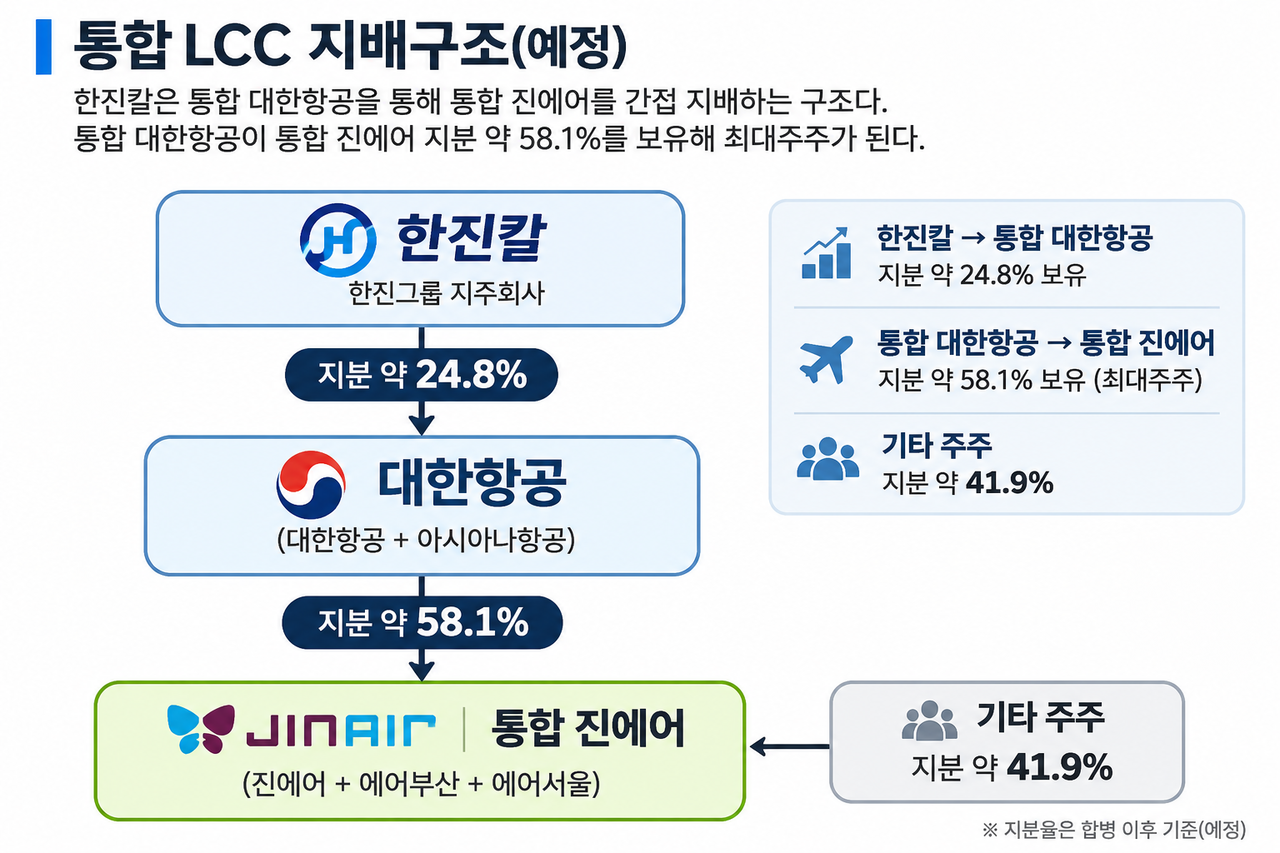
The combined LCC will sit under Hanjin KAL's indirect control through Korean Air. Following the merger of Korean Air and Asiana Airlines, Hanjin KAL will hold approximately 24.8% of the combined Korean Air, which in turn will hold about 58% of the combined LCC as its largest shareholder.
The core of the expected synergies lies in route optimization and cost reduction. The plan calls for more efficient scheduling of flights and airport slots on major short-haul international routes to Japan, Southeast Asia and China, as well as on domestic routes, to improve profitability.
The company also plans to consolidate aircraft operations, maintenance and procurement to achieve economies of scale, and to unify ground handling and in-flight service management. Aircraft will be redeployed to higher-margin routes to improve the overall operating structure.
Consolidating Air Busan and Air Seoul under the Jin Air brand — rather than maintaining separate brands — is part of the same strategy. Hanjin KAL said retaining individual brands would create duplicated investment in IT systems, airport facilities, maintenance and marketing, and would constrain operational optimization. The company cited major US carriers — Delta Air Lines, United Airlines and American Airlines — as examples of airlines that strengthened their competitiveness by unifying brands during past mergers.
Financial health management after the merger, however, remains a challenge. Hanjin KAL acknowledged that aligning accounting standards could temporarily push up the debt ratio, and said it aims to stabilize the financial structure through improved profitability going forward.
Hanjin KAL also concluded that the merger is unlikely to erode shareholder value. Share prices of the parent companies — Korean Air, Asiana Airlines and Hanjin KAL — showed no statistically significant negative reaction, and a review of 21 comparable past mergers found no consistent adverse impact.
On that basis, the company said it does not plan to introduce additional shareholder protection measures. It reasoned that both controlling and general shareholders would benefit from the merger's economic effects in proportion to their respective stakes. "At this point, we do not see a strong case for putting in place separate additional shareholder protection measures in connection with this merger," Hanjin KAL said.
As part of standard minority shareholder protection procedures, however, the company is collecting shareholder feedback through Nov. 27. Amendments to the Commercial Act last year expanded directors' duty of loyalty to cover shareholders, heightening the need to safeguard shareholder rights and procedural fairness in intra-group mergers. Hanjin KAL said it will strengthen oversight and cooperation to ensure the merger's benefits translate into enhanced shareholder value, while continuing to execute its existing value enhancement plan.
The three-way LCC merger cleared its major regulatory hurdles Thursday, when the Ministry of Land, Infrastructure and Transport granted merger approval and the Korea Fair Trade Commission approved the business combination. The combined carrier is scheduled to launch under the Jin Air brand on March 17 next year.
kwater@heraldcorp.com