KOTRA holds Korea-Switzerland partnership event in Zurich
65 Swiss, 24 Korean firms take part
110 consultations held across industrial automation, nuclear sectors
10 export contracts and MOUs signed
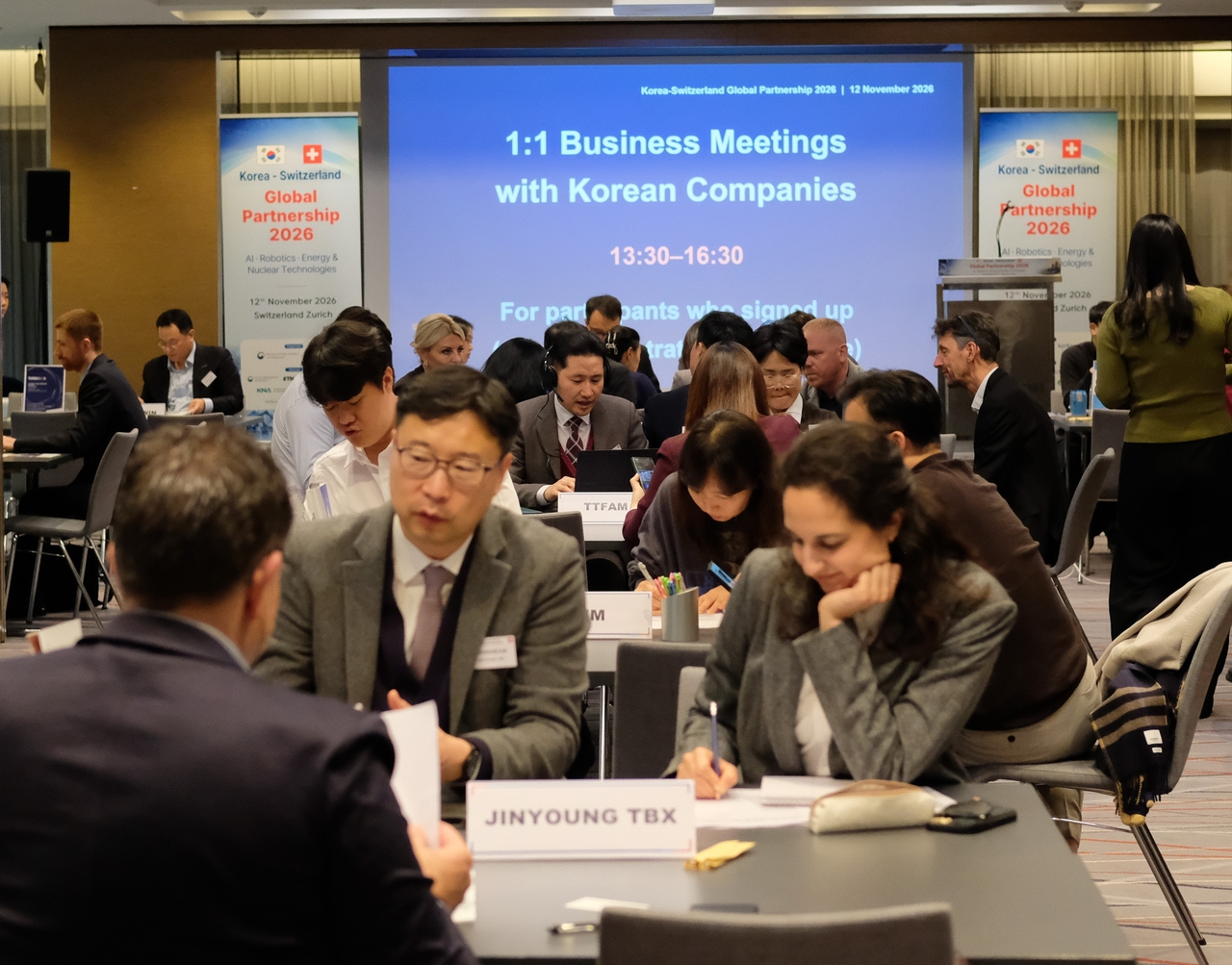
Swiss companies have shown strong interest in Korean nuclear power plant components, power equipment and AI-driven industrial automation technology, deepening cooperation between businesses from the two countries. A business consultation event held in Switzerland produced 110 partnership consultations and resulted in export contracts and MOUs worth a combined $23 million.
The Korea Trade-Investment Promotion Agency (KOTRA) announced Monday that it held the Korea-Switzerland Global Partnership 2026 at the Sheraton Hotel in Zurich on Thursday (local time).
The event brought together 65 Swiss companies and 24 Korean firms, including major European players such as Siemens alongside Korean materials, components and equipment manufacturers. Participants discussed potential cooperation in product supply, joint technology development and pilot projects.
A total of 110 consultations took place on site, with 10 export contracts and MOUs signed for a combined value of $23 million. KOTRA said both the scale of participation and the results were the largest for any single project since the Zurich trade office opened in 1972.
The event departed from the conventional format of Korean companies presenting their technologies one-sidedly. Instead, overseas firms first identified the products and technologies they needed, and KOTRA matched them with suitable Korean companies.
Key areas of cooperation included AI-powered industrial automation, precision machining, energy equipment and nuclear power plant components. Discussions went beyond simple parts supply to explore long-term partnerships through joint research and development and technology verification.
At a cooperation forum held before the business consultations, Swiss companies laid out in concrete terms the technologies and partnership conditions they required for actual projects.
The main demands presented included nuclear power plant components and transformer supply, exports of robots and equipment for data centers in Korea and Europe, joint development of specialty advanced materials, and AI-based video analysis and manufacturing solutions.
The Swiss side announced six cooperation needs, while Korean companies proposed five innovative technologies and discussed their commercialization potential.
Discussions were particularly active in the power and nuclear sectors, reflecting demand from local companies seeking to improve the efficiency of energy facilities or secure components applicable to existing power generation infrastructure.
A representative of Swiss engineering firm A, who attended the consultations, said it was "innovative" that Korean companies had rapidly integrated next-generation technologies such as digital transformation into advanced precision machining products, adding that "cooperation with Korean companies will play a key role in advancing Switzerland's precision manufacturing industry."
A representative of Swiss power company B said Korean high-efficiency power equipment and nuclear technology — backed by globally proven construction and operating experience — made Korea "the top-priority collaboration partner for European energy companies," adding that the company planned to continue supply chain cooperation with firms from the consultations that held technologies immediately applicable to ongoing projects.
In the nuclear sector, the two countries also established a framework for cooperation between their respective industry associations.
The Korea Nuclear Association signed an MOU with the Swiss Nuclear Forum. The two sides agreed to share information on the nuclear industry and inter-company cooperation opportunities, and to support Korean nuclear component manufacturers in entering the Swiss market.
Beyond company-to-company cooperation, the foundation for technology development linking university researchers with Korean firms is also expanding.
The Korean government earlier opened the Global Industry Technology Cooperation Center, a joint Korea-Switzerland research and development hub, at ETH Zurich on Nov. 4.
The center helps Korean companies pursue joint R&D with Swiss research institutions and translate developed technologies into actual products and commercial ventures.
Jang Tae-gwang, the center director who spoke at the cooperation forum, said the center would "connect Korean companies with innovative technologies in advanced industries to ETH Zurich researchers, supporting the commercialization of Korea-Switzerland technology cooperation outcomes."
Switzerland has ranked first in the Global Innovation Index published by the World Intellectual Property Organization for 16 consecutive years, from 2011 through this year. Korea ranked fourth globally this year, behind the United States.
As Swiss companies with strong R&D capabilities and precision manufacturing expertise move to build supply chain partnerships with Korean firms, analysts say Korean materials, components and equipment makers could gain broader access to the European market.
KOTRA said it plans to follow up with additional consultations and technology cooperation support based on the partnership needs identified at the event.
Kim Yeon-jae, head of KOTRA's Europe regional headquarters, said Switzerland was "the optimal technology cooperation beachhead for Korean companies entering the European market in terms of innovation and purchasing power," pledging to "make every effort to connect the cooperation needs of Swiss companies — which hold world-class technology and industrial networks in future strategic industries such as industrial automation and nuclear power — to tangible business opportunities for Korean firms."
kwater@heraldcorp.com