Financial regulators' exam oversight system draws fire after the top scorer of this year's tax accountant exam confessed Sunday to using AI to cheat — and revealed the same method was used on the certified public accountant first-stage exam as well.
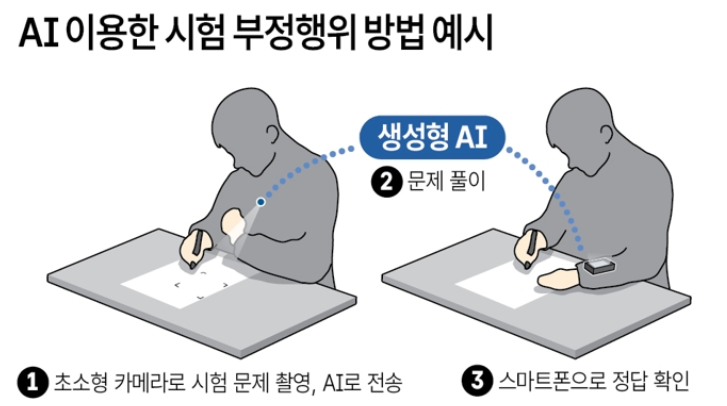
According to Yonhap, the suspect, identified only as A, admitted on YouTube to using a miniature camera, a smartphone and generative AI to cheat on both the tax accountant exam and the CPA first-stage exam, then turned themselves in to police.
A had placed first in both the first- and second-stage tax accountant exams held in April and July this year, but drew suspicion of AI-assisted cheating after posting unusually high scores.
A also admitted to cheating on the CPA first-stage exam in March, though A failed that exam and was therefore not eligible to sit the second stage.
The fact that financial regulators failed to catch the cheating on-site — even though A ultimately did not pass the CPA exam — is expected to fuel growing debate over the credibility of exam supervision.
The CPA exam is administered by the Financial Services Commission, with the Financial Supervisory Service directly overseeing the entire process — from eligibility verification and question setting to application processing, on-site supervision and grading.
On-site supervision is carried out by FSS staff alongside externally commissioned proctors, including teachers.
Unlike the tax accountant exam, which is outsourced to the Human Resources Development Service of Korea, financial regulators hold full authority over CPA exam operations — a fact that observers say makes their supervisory responsibility all the greater.
The FSS said in a press release Sunday that electronic devices are prohibited during the CPA exam, and that starting with this year's second-stage exam, proctors received training on AI-enabled glasses and similar devices, and all candidates' eyeglasses were physically inspected one by one.
None of those measures, however, prevented the cheating.
The FSS said it plans to "actively develop and implement countermeasures against cheating using continuously evolving high-tech devices, through expert consultations and cooperation with relevant agencies," adding that it would also "review ways to overhaul and strengthen relevant regulations and exam supervision procedures."
Anxiety is also mounting among exam candidates.
One person preparing for the CPA exam said they felt a sense of deflation, "as if the honest effort I put in has been invalidated," and questioned "whether similar cheating occurred in the past and whether proctors will be able to detect all these advanced devices going forward."
A total of 12,263 candidates sat this year's CPA first-stage exam, a competition ratio of 4.4 to 1, and 1,150 people ultimately passed after clearing the second stage.
Under Article 5-2 of the Certified Public Accountant Act, anyone caught cheating may have their exam suspended or their passing result canceled, and will be barred from sitting the exam for five years from the date of the disposition.
husn7@heraldcorp.com