Long snow-removal routes split to speed up response across 80.55 km of roads and back alleys; dedicated drivers and 1-ton vehicles assigned to each dong community center to prevent accidents and keep services running; priority clearance for vulnerable residents; road heating cables expanded to 47 sites
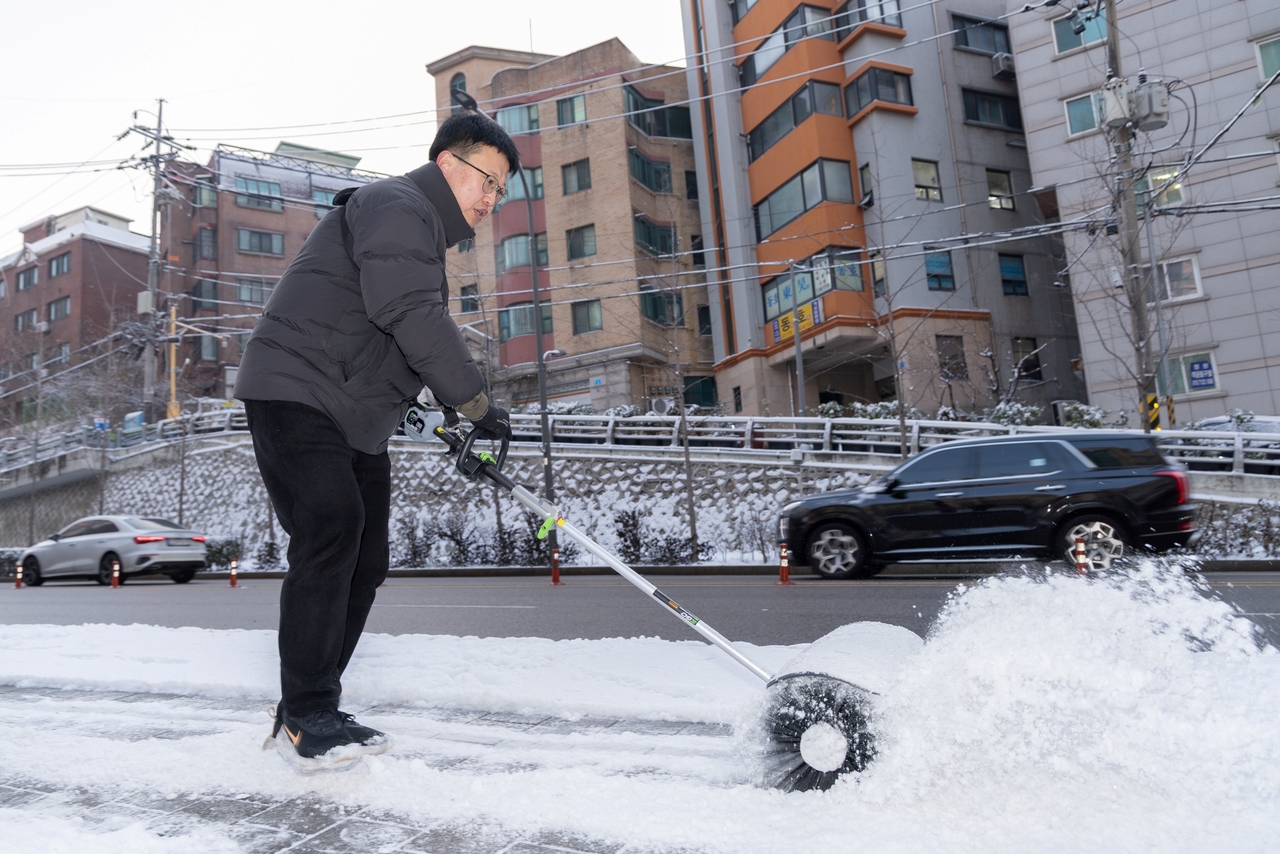
Mapo-gu will step up its winter snow-removal operations this year, targeting everything from main roads to narrow alleys and steep slopes for faster, more thorough clearance.
The district will run its winter snow-removal program from Sunday through March 31 next year. This year's plan focuses on improving operational efficiency, with a revamped on-site response system as its defining feature.
Routes that previously took too long to clear will be split into two separate sections to speed up response. The affected corridors are the 9.03-kilometer stretch covering World Cup-ro, Dongmak-ro and Sangamsan-ro, and the 10.34-kilometer stretch covering Jeungsan-ro, Moraenae-ro and Seongsan-ro.
Including those routes, the district has designated a total of 73 sections — covering 80.55 kilometers of main roads and back alleys — as snow-removal targets, with plans to clear snow without gaps from arterial roads down to side streets and slopes.
Snow-removal conditions at dong community centers will also change. Until now, three to four community center staff members had to handle snow clearance using administrative vehicles, which made it difficult to keep up with regular administrative duties and resident inquiries. Starting this year, each dong community center will be assigned a contracted driver and a 1-ton vehicle, reducing the manual workload on staff and helping prevent on-site accidents.
To better support the community centers, the number of 5-ton trucks at mobile forward supply bases will increase from one to two, and the transport method will shift from small-packaged de-icing agents alone to a combination of small packages and bulk-bag supplies. The district expects this to make it significantly easier to restock snow-removal vehicles and refill roadside salt bins across the area.
The district is also launching a new priority snow-removal service for vulnerable residents, including the elderly, children and people with disabilities. The program targets access roads with a gradient of 5 percent or more leading to school zones, senior centers, disability welfare facilities and apartment complexes more than 30 years old. Six contracted workers will spread de-icing agents or clear snow manually, starting with sections that pose the greatest risk to pedestrian safety. A total of 16 sites are designated for priority clearance this year.
The number of road heating cable installations will grow from 35 sites spanning 3,958 meters to 47 sites spanning 5,606 meters, with 12 new sites added this year. The heated sections are expected to prevent snow accumulation and icy road surfaces, reducing the risk of slip-and-fall accidents during winter.
Preparations are complete. The district will deploy 1,522 personnel — including staff, contracted workers and environmental public officials — along with 131 pieces of equipment such as vehicles and spreaders. It has also secured 2,061 tons of de-icing agent, 5,950 snow-removal supplies and 566 roadside salt bins.
During the snow-removal period, the district will keep its disaster safety response headquarters and a 24-hour operations center running, adjusting emergency duty levels based on weather conditions and snowfall amounts. District office staff, dong community center workers and private snow-removal contractors will respond together.
"When snow falls, it is important not only to clear it quickly but also to pay close attention to the alleys and slopes that residents use most," Mapo-gu District Mayor Yoo Dong-gyun said. "We will run the upgraded snow-removal system without gaps so that residents can walk and travel safely throughout the winter."
seouldream01@heraldcorp.com