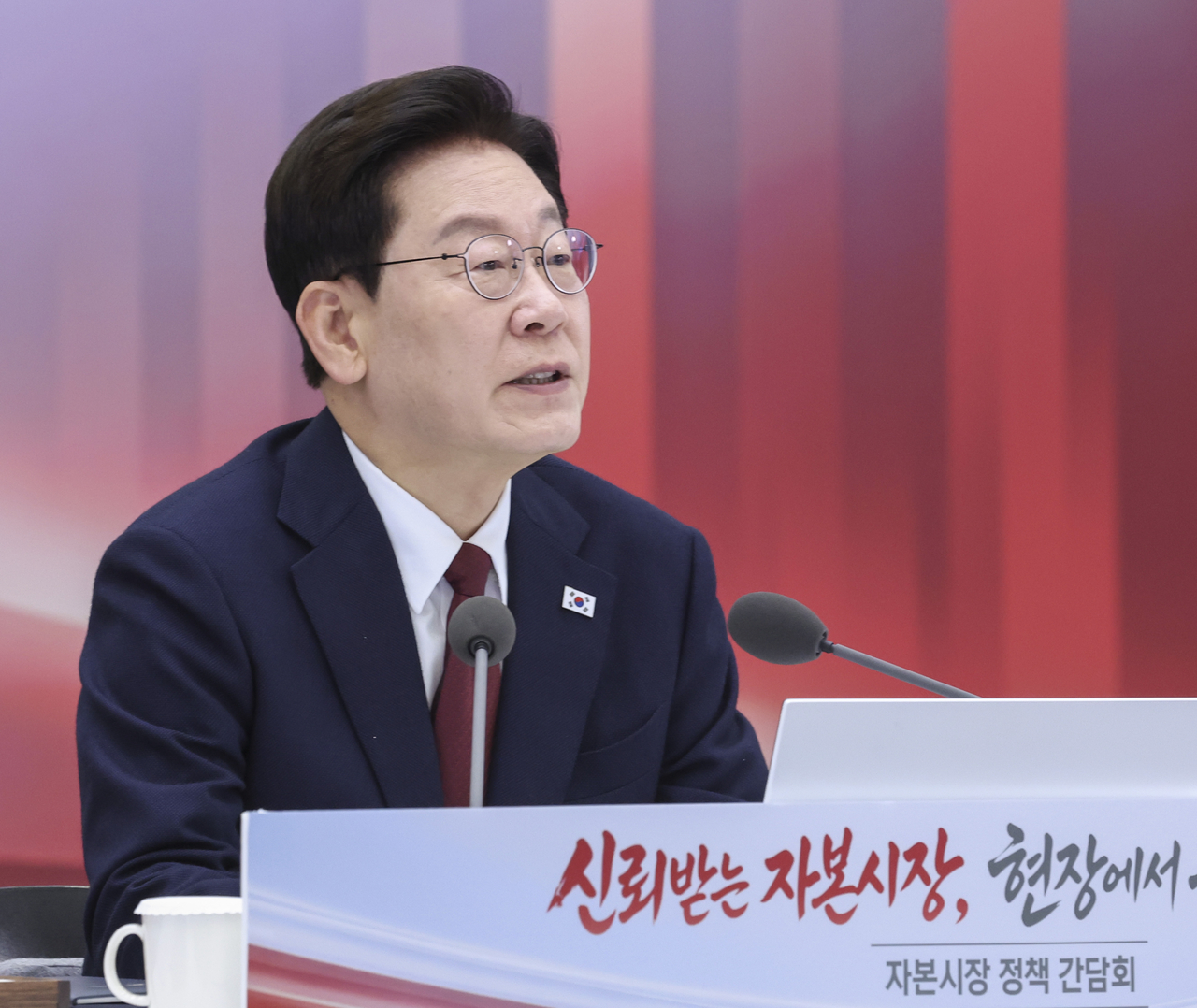
President Lee Jae Myung said hostile mergers and acquisitions must be promoted to break the chronic undervaluation of domestic stocks.
At a forum where participants were sharply divided over the mandatory tender offer regime — a key proposed amendment to the Capital Markets Act whose legislative progress has stalled over competing goals of protecting minority shareholders and facilitating M&A activity — Lee listened to attendees' views and held an impromptu show-of-hands vote. He said finding a solution that satisfies everyone would be difficult and pledged to make a swift policy decision.
Lee met with academics and financial investment industry experts Friday at the Korea Exchange in Yeouido, Seoul, for the Capital Markets Policy Forum to discuss ways to normalize the domestic capital market.
At the forum, Lee said attempts to acquire management control of undervalued companies could serve as a driver for improving corporate value.
"When a share price is abnormally low, the most powerful mechanism for normalizing the market is for someone to buy in and either sell at a fair price or run the company properly," Lee said. "In Korea, there is an emotional resistance to hostile M&A — a sense that it is an immoral act of taking what belongs to someone else — and policy authorities have in some ways implicitly operated to defend against it."
Lee then said that companies trading at a price-to-book ratio as low as 0.25 times going untouched by M&A activity was a sign that the system was not functioning. He called for a comprehensive review of institutional mechanisms that impede hostile M&A and ordered concrete discussions on ways to promote it.
Lee also raised the need to regulate listed companies where controlling shareholders and related parties hold stakes of 70 to 80 percent, making genuine competition for management control virtually impossible. "Enjoying all the benefits of a stock market listing while keeping less than 10 percent of shares in circulation and running the company as a de facto private entity is fundamentally at odds with the nature of the stock market," he said. "We need to review listing maintenance requirements and find ways to delist such companies."
The forum exposed sharp divisions among participants over the mandatory tender offer regime, a central issue in the proposed revision of the Capital Markets Act.
Some argued for a 100 percent tender offer requirement to protect minority shareholders, while others backed a "50 percent plus one share" threshold as more conducive to M&A activity.
Kim Woo-chan, a professor at Korea University's business school, argued that no country in the world has adopted a 50-percent-plus-one-share tender offer system. "Empirical research across 41 countries shows that even with a 100 percent mandatory tender offer, the controlling shareholder premium falls, acquisition costs do not rise significantly, and M&A activity does not contract," Kim said.
Park Byeong-geon, chief executive of Daeshin Private Equity and chair of the private equity fund managers' association, took the opposite view. "Given the scale of the domestic financial market and available capital, a 100 percent mandatory tender offer would significantly increase the financial burden on acquirers, dampening M&A activity by domestic private equity funds and companies, and could ultimately lead to Korean firms falling into the hands of foreign capital," Park said.
After hearing the competing arguments, Lee conducted an impromptu poll of forum attendees and online viewers before sharing his own policy thinking. Among those present in the room, a majority favored the 50-percent-plus-one-share option, while most participants in the online chat backed the 100 percent mandatory tender offer.
"A 100 percent buyout that gives minority shareholders an equal opportunity is the ideal, but if the financial burden on acquirers grows so large that M&A attempts are discouraged altogether, the overall market's opportunities and the size of the pie could shrink," Lee said. "This is similar to the debate over whether growth or distribution should come first."
Lee said he leaned toward growing the pie. "Even if I take criticism for it, I am closer to the side that says we need to dramatically promote M&A so the entire market normalizes and all shareholders benefit," he said. "Right now, the most critical task is not to craft a perfectly rational and ideal system, but to activate hostile M&A and break this abnormal undervaluation structure once and for all."
Lee also urged lawmakers to accelerate the legislative process. "This is a matter of policy judgment and decision-making where competing interests mean no single logical conclusion can emerge on its own," he said. "I hope the party continues its discussions but does not let the debate drag on too long. We should gather as much public opinion as possible, but in the end, we must make the decision and reach a conclusion ourselves."

jiyun@heraldcorp.com