468 students caught gambling over three years, yet only one prevention staffer and 20 million won budgeted for next year; lawmaker also flags school record duplication, bullying file deletions and private school employment rule gaps
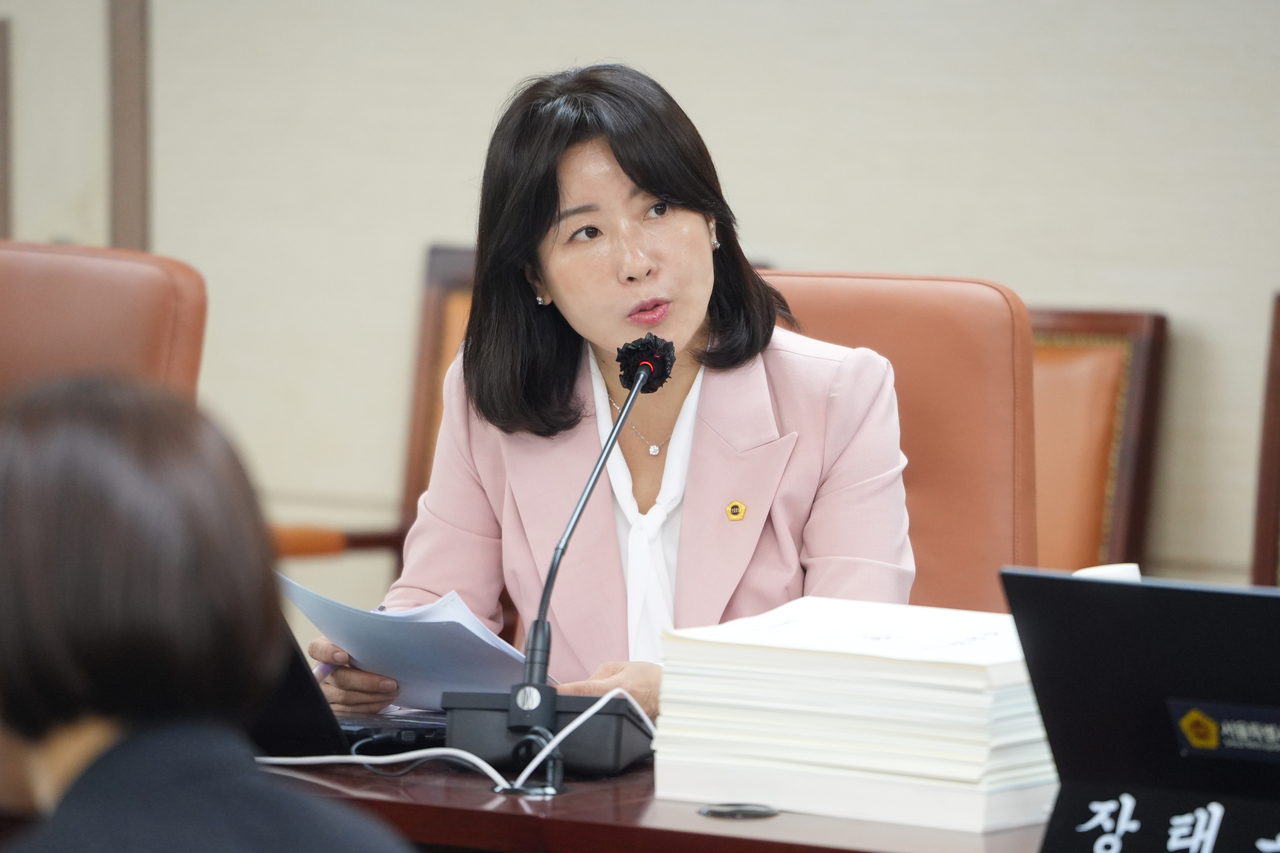
A total of 468 students in Seoul were caught gambling and disciplined over the past three years, yet the Seoul Metropolitan Office of Education has just one staff member dedicated to gambling prevention, a lawmaker said Thursday. Concerns were also raised over sloppy management of school record entries and the deletion of school violence disciplinary records, with calls for stronger oversight and systemic reform.
Yoon Yu-jin, a People Power Party lawmaker on the Seoul Metropolitan Council's education committee representing Songpa District 1, used Thursday's comprehensive administrative audit of the Seoul Metropolitan Office of Education to scrutinize the city's response to student gambling, follow-up measures on findings by the Board of Audit and Inspection, and the management of employment rules at private schools.
At the audit, Yoon said student gambling had moved beyond simple misconduct and could lead to additional crimes such as fraud and extortion, and challenged the education office's overall response framework.
Lee Baek-hyeong, a school police officer team leader from Dongjak Police Station who appeared as a reference witness, said many students start gambling at a friend's suggestion and that some become addicted using smartphones while hiding the habit from family and teachers.
Lee also shared field cases showing how the problem can escalate — students seeking gambling funds have turned to secondhand-market fraud and extortion, highlighting the severity of the issue.
Data submitted by the Seoul Metropolitan Office of Education showed that the number of students caught and disciplined for gambling fell from 237 in 2024 to 167 in 2025, with 64 cases recorded through the end of September this year, bringing the three-year total to 468.
Yoon said the figures almost certainly understate the true scale, noting that this year's count covers only through late September and excludes students who were never caught, making a separate survey of actual gambling prevalence necessary.
"This is not a problem that can be solved simply by warning students who are caught and giving them prevention education," Yoon said. "The education office needs to conduct its own survey to find out how many students are actually gambling, and then connect them to counseling and recovery support."
Yoon also said the way prevention education outcomes are measured needs to change — moving away from tracking the number of sessions held and participants enrolled, and toward an evaluation system that can determine whether students' awareness and behavior actually changed after the education.
Yoon particularly noted that the education office has only one staff member handling gambling prevention and that its proposed budget for the program next year stands at about 20 million won ($15,000), calling for more personnel and funding.
The reliability of school record management was another major focus of the audit.
A Board of Audit and Inspection report released in June found that 15,377 teachers at 239 high schools under review had entered duplicate content in the "subject-specific abilities and special notes" section of student school records.
In the "behavioral characteristics and general comments" section, 1,604 teachers at 236 schools were found to have written identical entries for 10,624 students.
Because school records are the primary document used to assess students' academic achievement and school life — and are used in university admissions — Yoon said the persistent practice of duplicate entries must be addressed to ensure accuracy and fairness.
The Seoul Metropolitan Office of Education said it had begun training one teacher per school and launched ongoing monitoring following the Board of Audit and Inspection findings.
Yoon questioned, however, whether training a single designated teacher at each school and passing information down through them could fundamentally change entrenched practices. Yoon also called on the education office to publicly disclose specifics of its ongoing monitoring — which schools and grade levels are being checked, what items are being reviewed and what improvements have resulted.
Procedural problems in the deletion of school violence disciplinary records were also examined in depth.
Under relevant law, certain school violence disciplinary measures may be expunged from a student's record upon graduation, provided legal requirements and procedures are met and the school's dedicated review body approves. However, the Board of Audit and Inspection found cases in which records were deleted for students who did not qualify, and instances where review body meetings lacked the required quorum.
When Yoon requested meeting minutes from the 42 schools that voted in 2025 to delete Level 6 or higher school violence disciplinary records, only 17 schools submitted the documents.
Of those, only seven schools had meeting minutes that confirmed all required supporting materials — including homeroom teacher opinions and proof of completed corrective measures — were in place. That represents just 16.7 percent of the 42 schools under review.
Yoon said that because the deletion of school violence records is a consequential administrative act that can affect a student's academic future and school life, the review process and the reasoning behind each decision must be clearly documented.
"If a perpetrator's record is deleted without proper procedure, it is tantamount to inflicting secondary harm on the victim, and it also undermines the very purpose of the system — keeping records to deter repeat offenses," Yoon said. "The system must be reformed so that the review process and the basis for each decision are always preserved when a disciplinary record is deleted."
In response, the director of the Seoul Metropolitan Office of Education's lifelong learning and career education bureau said the office would propose improvements to the relevant guidebook.
The management of employment rules governing working conditions for private school teachers was also raised.
Employment rules set out basic conditions covering working hours, leave, wages, safety and health, and the prevention of workplace harassment. The Seoul Metropolitan Office of Education, however, told Yoon in submitted materials that private schools are governed by higher-level statutes and therefore do not need to draft or file employment rules, and that the office does not manage them separately.
Yoon cited a Ministry of Employment and Labor advisory opinion from May 11, 2021, arguing that working conditions not separately governed by the Private School Act are still subject to the statutory obligation to draft and file employment rules.
Yoon said the obligation to draft and file employment rules may apply to private schools with 10 or more teaching staff, and that even schools operating their own personnel regulations need to separately verify whether they have completed the filing procedures required by law.
Yoon called on the education office to conduct a comprehensive survey of whether private schools in Seoul have drafted and filed employment rules for their teaching staff, take necessary action against schools that have not met their obligations, and report the results on a school-by-school basis.
In response, the director of the Seoul Metropolitan Office of Education's education policy bureau said the office would review the matter and report back.
Yoon said the problems identified through the audit were not mere administrative oversights but were directly tied to fundamental rights in schools — student safety, fairness in education and teachers' working conditions.
Yoon said the response to student gambling in particular requires a connected system running from prevention education through surveys of actual prevalence, counseling and recovery support, while school record management and the handling of school violence records must be continuously monitored to ensure legal procedures are being properly followed in practice.
"I listened to the voices of parents and school communities ahead of this administrative audit and demanded effective measures from the education office," Yoon said. "I will not stop at receiving answers in the audit chamber — I will follow through to make sure the measures the education office has promised are reflected in its budget and policies and translate into real change in students' daily lives."
7toy7@heraldcorp.com