Trade chief meets 24 European lawmakers in back-to-back sessions; says FTA has driven balanced growth for both sides
South Korea's trade negotiation chief joined forces with representatives from the automotive, battery and steel industries in a joint public-private push to engage senior EU officials in Brussels, seeking to counter the bloc's proposed Industrial Acceleration Act and a safeguard investigation targeting hybrid vehicles.
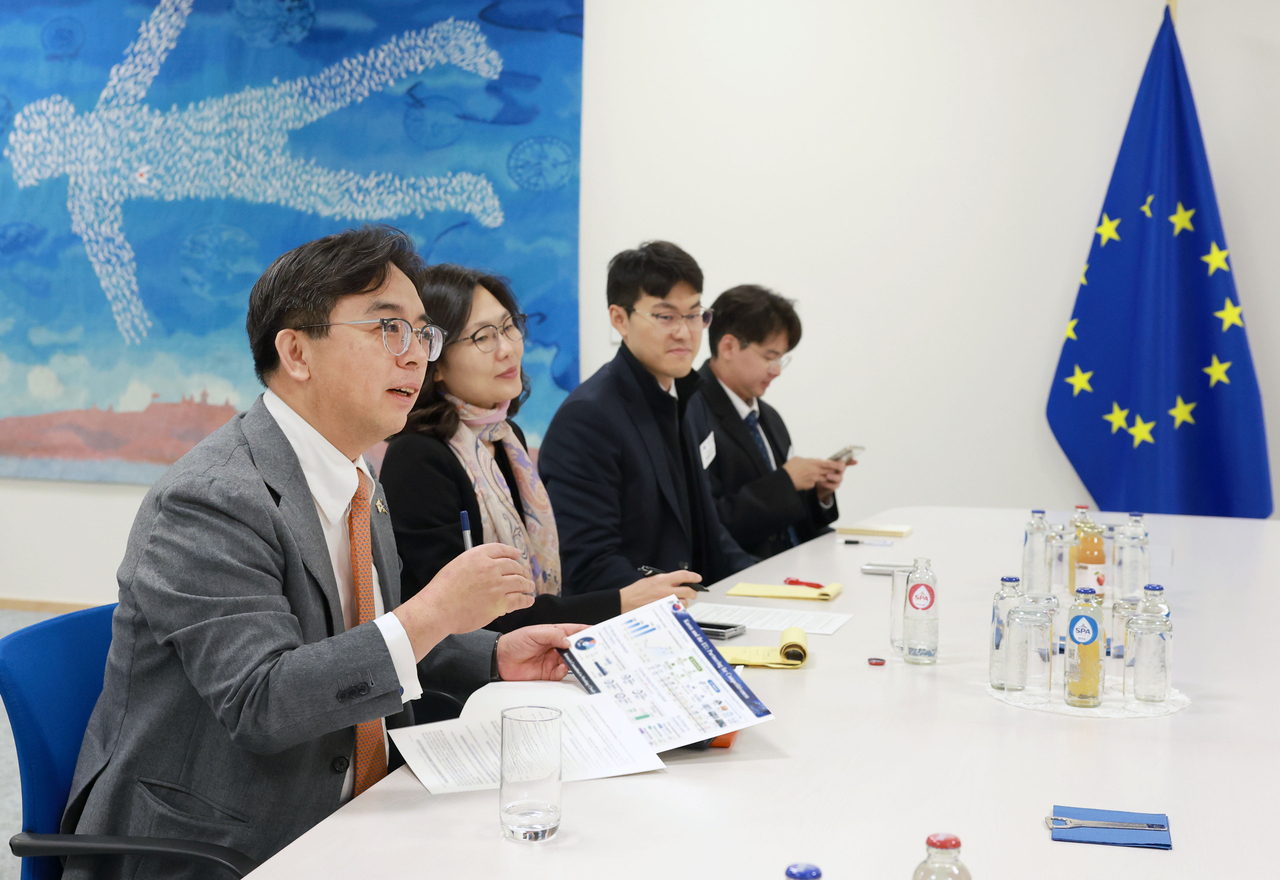
Park Jeong-seong, chief of the trade negotiation bureau at the Ministry of Trade, Industry and Energy, held back-to-back meetings with 24 key trade figures at the European Parliament in Brussels over two days beginning Tuesday, conveying South Korea's position and pressing the case for favorable treatment as a free trade agreement partner, the ministry said Friday.
The outreach aimed to inform European Parliament lawmakers — who are deeply involved in drafting protectionist measures such as the Industrial Acceleration Act (IAA), which is expected to deal a significant blow to South Korean exports of automobiles, batteries, steel, and nuclear and energy equipment if enacted — about Korean companies' contributions to EU investment, employment and supply chains, and to effectively communicate industry concerns.
About 15 business leaders accompanied Park in the parliamentary meetings, including Lee Sang-ju, Samsung Electronics' vice president for European external affairs; Lee Yong-geol, LG Energy Solution's representative for its Wroclaw, Poland operations; Lee Jae-wan, head of Posco's European representative office; and Kim Dong-jo, executive vice president of Hyundai Motor's strategic planning division.
Park hosted a Korea-EU Competitiveness Partnership Networking Reception at a Brussels hotel on Wednesday evening, attended by more than 30 Korean business figures as well as senior European Commission officials — including Dieter Ull Jørgensen, director-general of the Directorate-General for Trade, and Kerstin Jorna, director-general for Internal Market, Growth, Entrepreneurship and SMEs — along with European Parliament Vice President Martin Hojsík and other lawmakers.
Addressing EU officials at the event, Park highlighted the role the Korea-EU free trade agreement has played in fostering balanced industrial growth on both sides, and made a focused appeal that there was no need to erect trade barriers against South Korea.
"Over the past 15 years, bilateral goods trade has doubled, services trade has tripled, and South Korea's investment in the EU has quadrupled," Park said. "More importantly, our trade relationship has remained highly balanced rather than one-sided — through the FTA, we have achieved both growth and balance."
The remarks were widely interpreted as an indirect signal that while EU measures such as the IAA were originally conceived to address trade imbalances with China, South Korea — which has cultivated a healthy trade relationship with the EU — is being caught in the crossfire.
"The most effective way to address global overcapacity and oversupply is not to stoke new conflicts, but to work with trusted partners to promote innovation and strengthen competitiveness," Park said. "Erecting barriers cannot solve the problems of excessive concentration and insufficient capacity."
Park also met Thursday (local time) with Maroš Šefčovič, the European Commission's executive vice president for trade and economic security, to discuss deepening implementation of the Korea-EU FTA and advancing cooperation on launching the Korea-EU Competitiveness Partnership and establishing a new high-level economic dialogue — both agreed upon at the summit in June.
On the IAA, Park called for recognition of South Korea as a trusted partner on equal footing and for a relaxation of excessive local content requirements. Regarding the EU's recently launched safeguard investigation into hybrid vehicles, Park urged that the probe be conducted objectively in accordance with WTO rules, and requested that any future quota arrangements allocate sufficient volumes reflecting recent export trends and market demand to minimize the impact on South Korean exporters.
On the Carbon Border Adjustment Mechanism, Park requested swift and non-discriminatory recognition of South Korean verification bodies, and asked that any expansion of the mechanism to downstream steel and aluminum products be accompanied by a minimized list of covered items and an adequate transition period.
"We will continue to work actively through the joint public-private task force to ensure that Korean companies' positions are fully reflected in the EU legislative process, while maintaining close communication with the EU side on key trade issues including the hybrid vehicle safeguard and the Carbon Border Adjustment Mechanism," Park said.
oskymoon@heraldcorp.com