Gangdong, Seongdong post first weekly declines in 33 and 32 weeks respectively
October transaction volumes fall 69%, 84% year-on-year in each district
Experts see a pause, not the start of a sustained downturn
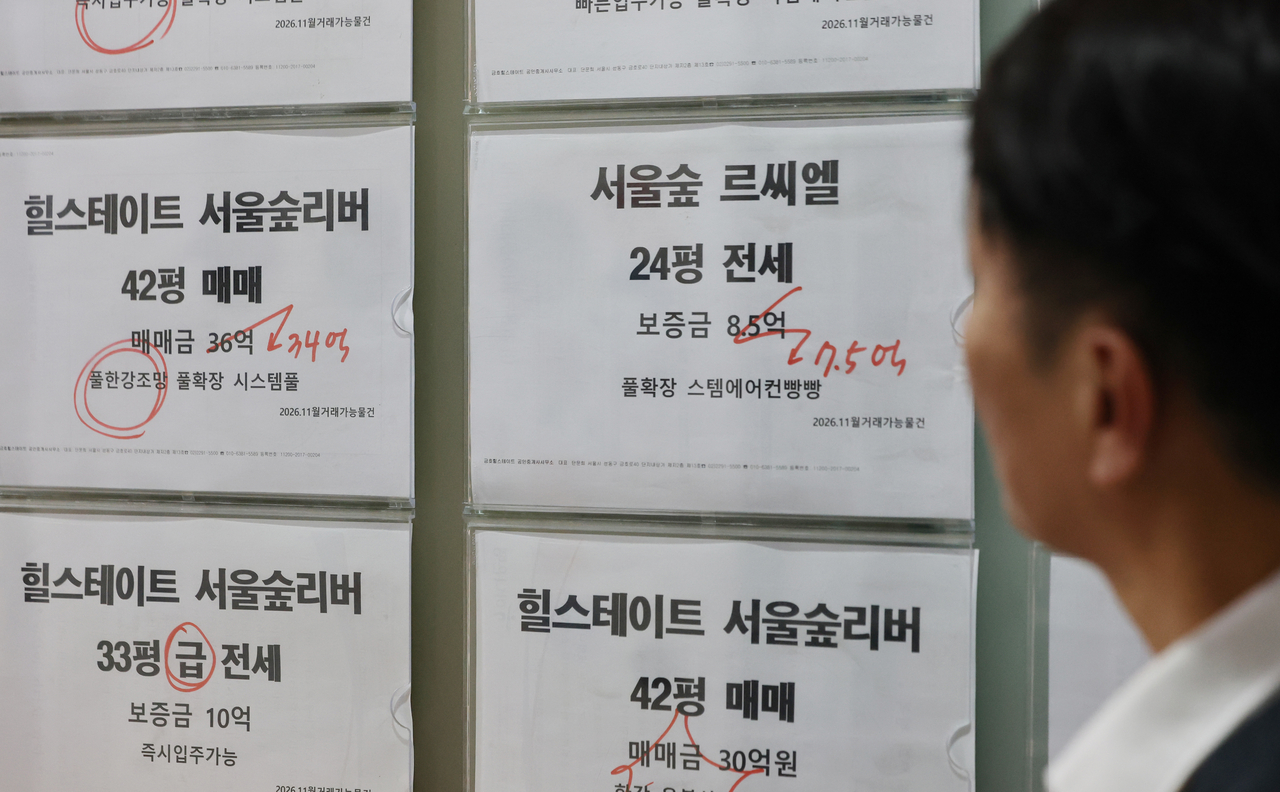
Apartment prices in Gangdong-gu and Seongdong-gu have turned negative, following the same trend already seen in Seoul's three Gangnam districts — Gangnam-gu, Seocho-gu and Songpa-gu. Tightened mortgage regulations and uncertainty over tax policy have dampened buyer demand, causing transaction volumes to fall sharply and a handful of distressed sales to drag down prices. The scale of the declines, however, remains modest relative to earlier gains. Some analysts say the market is undergoing a breathing pause driven by fatigue after a sharp run-up and a wait-and-see stance among buyers, rather than entering a full-blown downturn.
Gangdong, Seongdong join the slide as Gangnam-area correction spreads across Seoul
According to the Ministry of Land, Infrastructure and Transport's actual transaction price disclosure system, a 59-square-meter unit at Haengdang Daelim in Haengdang-dong, Seongdong-gu changed hands Nov. 6 at 1.575 billion won ($1.18 million) — 95 million won below the complex's record high of 1.67 billion won set in May, which was recorded on the 12th floor.
An 84-square-meter unit at Dunchon Prugio in Dunchon-dong, Gangdong-gu also sold Sunday at 1.58 billion won, on the first floor. That is 120 million won below the previous peak of 1.7 billion won for the same floor-plan type, which was on the 19th floor.
As below-peak transactions continued at several complexes, weekly apartment price indices for both districts turned negative. According to the Korea Real Estate Board, Seongdong-gu apartment prices fell 0.02 percent in the second week of November (as of Monday), the first weekly decline in 32 weeks since the fifth week of March. Gangdong-gu also slipped 0.01 percent over the same period, ending a 33-week streak of gains.
The downward trend is spreading beyond the Gangnam area to other major parts of Seoul. Gangnam-gu (minus 0.25 percent) and Seocho-gu (minus 0.26 percent) each posted a 14th consecutive weekly decline, while Songpa-gu (minus 0.35 percent) extended its losing streak to nine weeks and accelerated from the previous week's minus 0.17 percent. Mapo-gu's rate of increase narrowed from 0.25 percent to 0.10 percent, and Dongjak-gu edged up just 0.01 percent, in effect holding flat.
A Ministry of Land, Infrastructure and Transport official said the trend reflects "a process of finding appropriate price levels," adding that additional districts are expected to turn negative next week.
Market watchers point to a sharp drop in transaction volumes as the key factor reshaping prices. With year-end approaching, individual banks' total mortgage lending is nearing its annual cap, making it harder for buyers to secure financing, while unresolved uncertainty over tax reform has left many would-be buyers on the sidelines. As demand has dried up, sellers have begun trimming their asking prices to close deals.
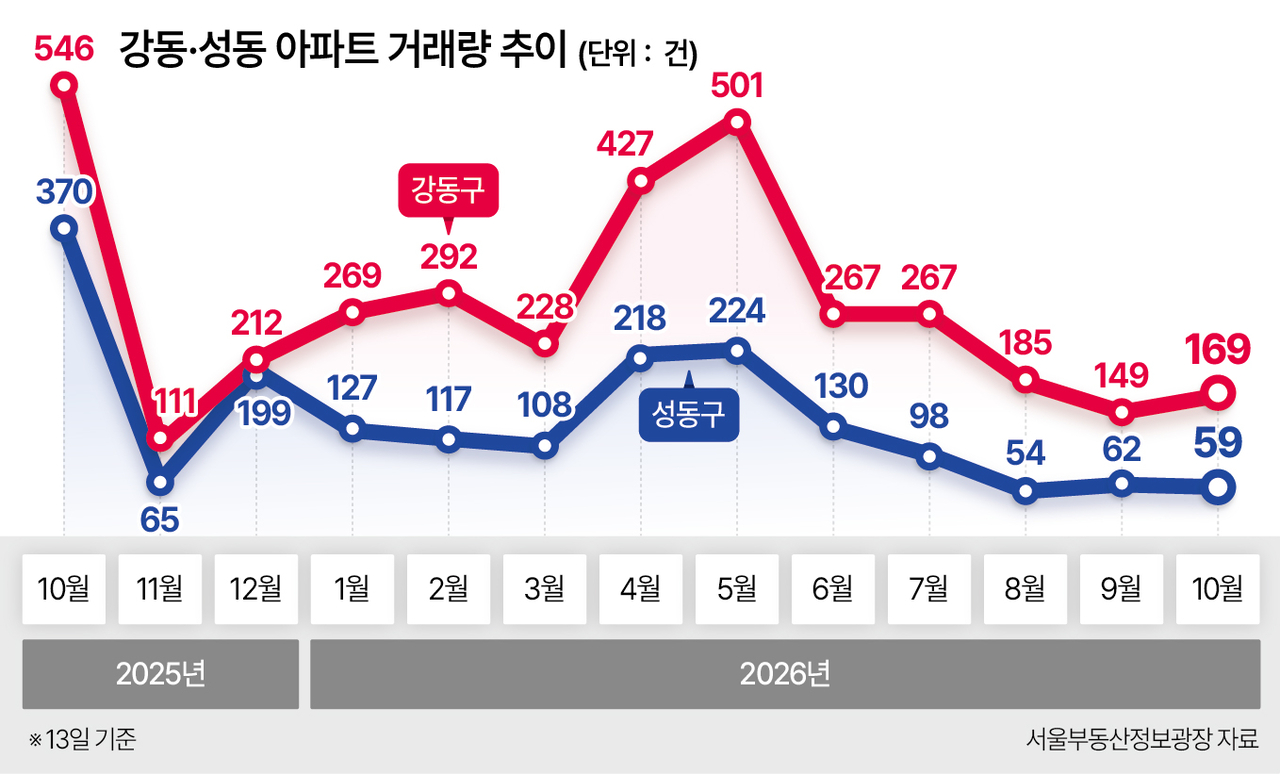
The transaction data bear this out. According to the Seoul Real Estate Information Plaza, Seoul apartment transactions totaled 3,724 in October, down 56.3 percent from 8,533 in the same month last year.
The contraction was especially pronounced in Gangdong-gu and Seongdong-gu, the two districts that recently turned negative. Gangdong-gu recorded 169 transactions last month, a 69 percent drop from 546 a year earlier. Seongdong-gu managed just 59 deals, an 84 percent decline from the same period last year.
Nam Hyeok-woo, a real estate researcher at Woori Bank, said prices in those areas had been trading in a range for some time, limiting asking-price cuts, but that the narrowing gap with Gangnam-gu prices had deepened buyer hesitancy and was now feeding downward pressure on asking prices. As buyer demand weakened, sellers began lowering their asking prices, and some of those discounted transactions are now pulling down the overall price statistics for the districts, Nam added.
Declines modest against record highs as most gains remain intact
Even so, many observers are reluctant to declare the start of a sustained price correction. A comparison of recent transaction prices with earlier deals shows that most of the earlier gains remain intact.
The Haengdang Daelim 59-square-meter unit that recently sold for 1.575 billion won — nearly 100 million won below the complex's record high — actually fetched 5 million won more than the previous transaction for the same floor-plan type, which closed at 1.57 billion won on the sixth floor.
The complex last traded in December last year at 1.345 billion won, then rose to 1.615 billion won in January — a gain of 270 million won within a month. The recent decline from the peak stands at 95 million won, meaning the complex has held on to most of that earlier surge.
The pattern is similar at Dunchon Prugio in Gangdong-gu. The 84-square-meter type sold in May at 1.54 billion won on the ninth floor, then rose to 1.68 billion won on the 12th floor in July — a gain of 140 million won in two months. The recent sale at 1.58 billion won on the first floor represents a 100 million won retreat from the peak, but still sits 40 million won above the May price. Given that the latest transaction involved a first-floor unit, some analysts say the effective price adjustment is even more limited than the headline figure suggests.
Experts say the recent turn to negative territory should be read as a correction driven by a sharp drop in transactions, not as the opening of a full-blown bear market.
Jeong Jae-hun, a professor of urban planning and real estate, said the market is going through a natural cooling process after prices rose too far too fast, with accumulated fatigue at the peak pushing it briefly into a holding pattern. Higher interest rates are also weighing on buyer sentiment, contributing to the pause, Jeong added.
"The reason prices rise by hundreds of millions of won on the way up but correct only marginally on the way down is that sellers maintain strong downward price rigidity and are unwilling to cut asking prices significantly," Jeong said. "It is premature to call this a full-blown downturn based on minor adjustments in a handful of leading districts."
hss@heraldcorp.com