'Overemphasis on owner-occupancy backfiring, costs passed to tenants'
Seoul to amend ordinance to extend maintenance-fee support to youth
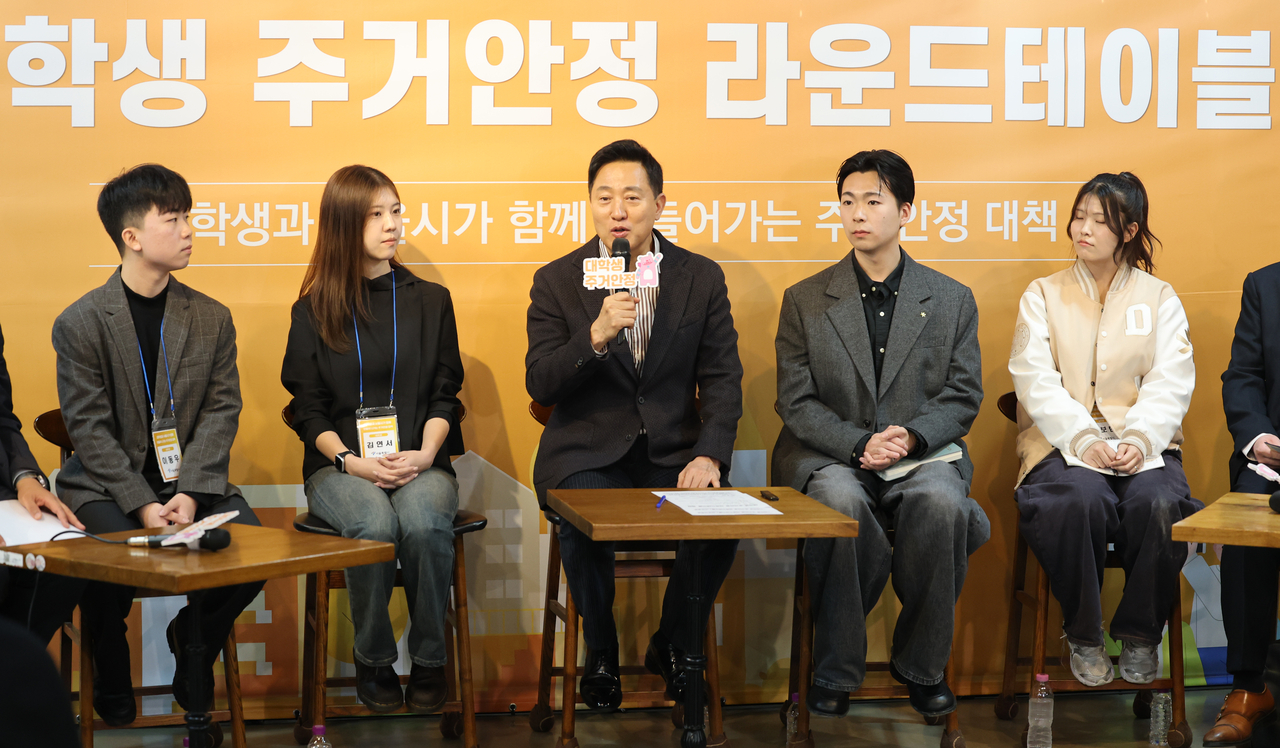
Seoul Mayor Oh Se-hoon criticized the central government's owner-occupancy-focused housing policies Thursday, saying they have backfired and driven up rental costs for young residents. The Seoul Metropolitan Government said it would respond by maximizing housing supply through public land and private-sector partnerships.
Oh made the remarks at a roundtable on student housing stability held at Dongguk University, where he met with university students, landlords and housing experts. "The sharp rise in jeonse and monthly rent prices is a side effect of the government's excessive emphasis on owner-occupancy," he said. "When you raise the cost burden on landlords, they have no choice but to pass it on to tenants — landlords are not running charities."
Oh said overarching housing policy remains in the hands of the central government. "Decisions on whether to ease or tighten mortgage lending, and how much tax to impose on real estate, are all made by the central government," he said.
Because financial and tax policy falls under central government authority, Oh said Seoul would focus its policy efforts on expanding supply. "What Seoul can ultimately do is maximize housing supply," he said, adding that providing public land or supporting private-sector supply are the main tools available.
The city currently uses several approaches: purchasing existing homes for public rental, securing units through public-contribution requirements in private development projects, and public-private partnerships in which private operators build and manage rental housing on city-owned land.
"If Seoul provides the land, the private sector can build on it and operate it as rental housing," Oh said. "We should not stick to a single supply method but use multiple approaches." He cautioned, however, that land and funding available for supply are limited, so it will not be easy to bring a 100-to-1 competition ratio down to 10-to-1 in the short term.
The roundtable brought together student representatives, private rental operators and housing experts to discuss ways to ease the financial burden on young renters. Students identified maintenance fees charged on top of monthly rent, anxiety over deposit refunds and rent hikes during lease renewals as their main concerns.
Kim Yeon-seo, a business administration student, said that even when a real estate platform lists monthly rent at 500,000 won ($374), tenants often end up paying an additional 100,000 to 200,000 won in maintenance fees. Kim called on the city to provide support for those costs.
Oh acknowledged the issue, saying some landlords raise maintenance fees because rent increases are subject to legal caps. "An ordinance amendment is under way so that maintenance fees can also be covered in youth support," he said. "Ultimately, whether it is rent or maintenance fees, the total housing cost borne by young people needs to come down."
Seong Chang-yeop, chairman of the Korea Housing Landlords Association, said regulations on multi-home owners are also affecting the non-apartment rental market — including multi-unit and multi-family homes where most university students live. He argued that rules on counting small non-apartment properties toward a landlord's total home count, and the heavier taxes that follow, should be eased, as the tax burden risks feeding through to higher rents.
Cho Gang-tae, chief executive of private rental operator Mangrove, proposed what he called a "20-30 rule": requiring that 20 percent of new youth housing units be offered at 30 percent below the surrounding market price, while leaving operators free to manage the remaining 80 percent at their discretion to keep supply viable.
Cha Myeong-don, a division head at the Korea Private School Promotion and Assistance Foundation, said the organization plans to supply about 1,500 units of affordable dormitory housing through a Seoul-model shared-housing public-private partnership, and proposed using additional Seoul public land to expand that supply further.
"Seoul will do its utmost to expand housing supply and support so that young people suffer a little less from housing difficulties," Oh said.
quq@heraldcorp.com