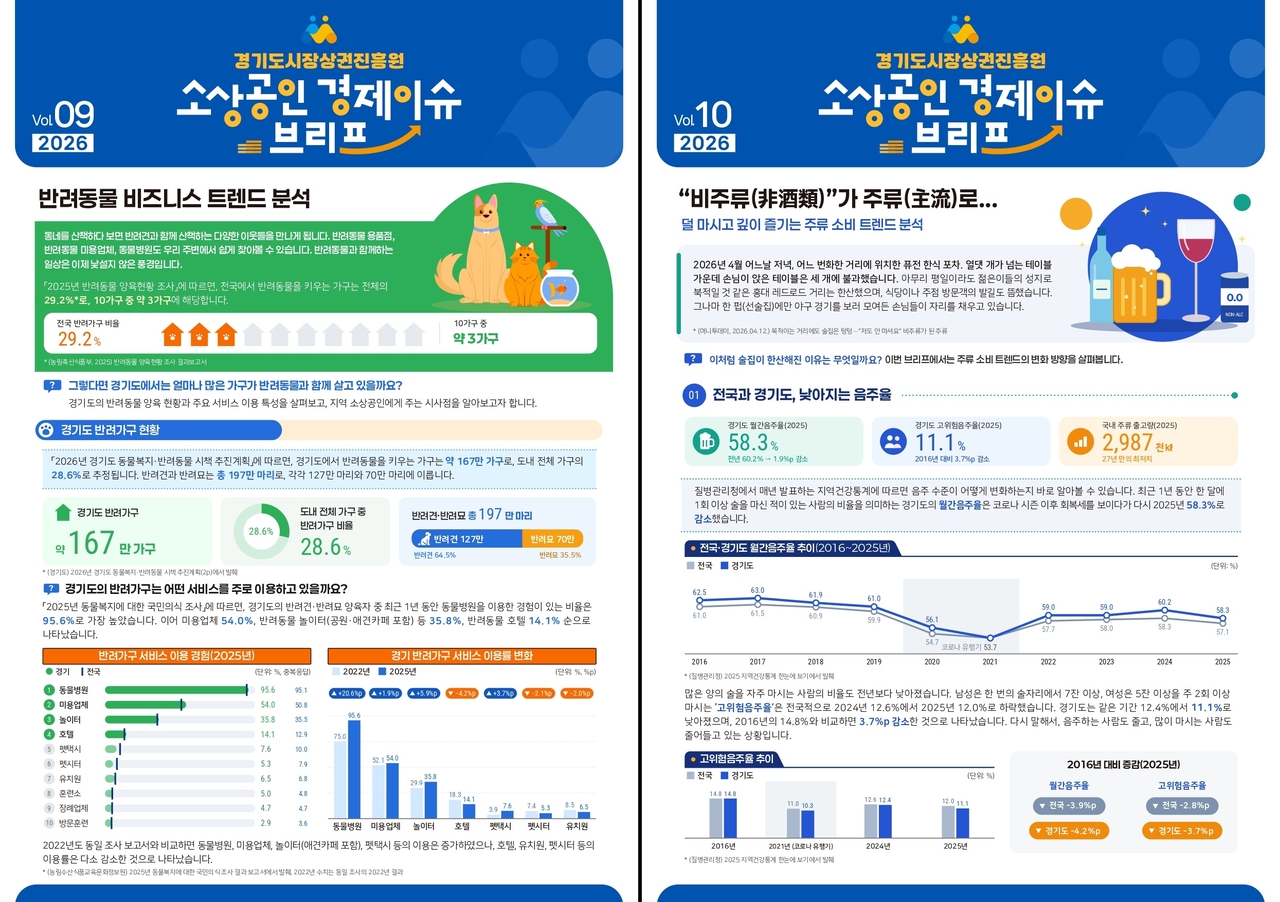
The Gyeonggi Center for Economic Promotion said Thursday it had published volumes 9 and 10 of its "Gyeonggi Province Small Business Economic Issue Brief" series, analyzing growth in the pet industry and shifting trends in alcohol consumption.
The September issue focused on pet business trends, while the October issue examined what the center described as a "drink less, savor more" shift in alcohol consumption. Both issues surveyed changes in the business environment for small operators across Gyeonggi Province and highlighted notable business cases.
The September issue highlighted growth in the pet industry driven by a rising number of pet-owning households. According to the 2026 Gyeonggi Province Animal Welfare and Pet Policy Implementation Plan, about 1.67 million households in the province own pets, accounting for 28.6 percent of all households.
The number of pet-related businesses in the province grew from 6,975 in 2023 to 7,595 in 2025, an average annual increase of 4.3 percent. The number of workers in the sector rose at an average annual rate of 11.0 percent over the same period.
The brief noted that the rapid expansion of the pet market is transforming traditional small-business models.
It surveyed a range of emerging services, including multi-purpose pet facilities catering to customers with animals, dedicated pet transport, care and funeral services, and pet-friendly restaurants.
The October issue analyzed market changes stemming from declining drinking rates and lower alcohol consumption. Gyeonggi Province's monthly drinking rate fell from 60.2 percent in 2024 to 58.3 percent in 2025, and domestic alcohol shipments last year hit their lowest level since 1998 — a 27-year low. The number of bars and beer-pub establishments in the province also declined, falling at average annual rates of 7.3 percent and 1.3 percent, respectively, from the second quarter of 2024 through the second quarter of 2026.
The brief noted that as overall alcohol consumption falls, drinking culture is shifting from quantity to quality. It highlighted a range of business cases reflecting this trend — including breweries offering wine-making and tasting experiences, venues combining wine with camping, and non-alcoholic craft beer brands — and stressed the importance of differentiating products and services to meet evolving consumer demand.
fob140@heraldcorp.com