'Three rounds of commercial law reform still not enough'
'Chungcheong mega-projects mark first step in regional growth'
'AI, robots to be integrated into manufacturing to upgrade traditional industries'
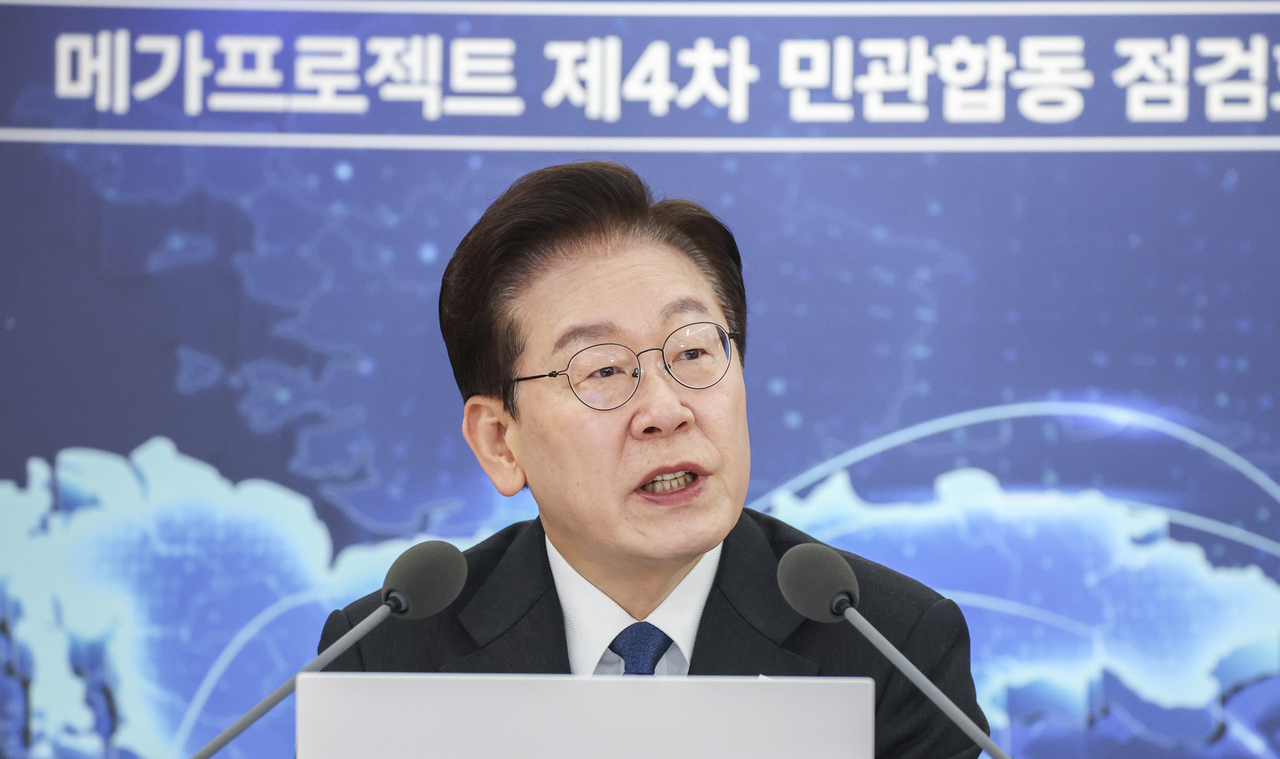
President Lee Jae Myung said Thursday that South Korea's capital market remains "an attractive and undervalued investment destination" despite recent external uncertainties rattling domestic stocks, and pledged to push ahead with further reforms to boost corporate value and expand shareholder returns.
Lee made the remarks while presiding over the 52nd senior secretaries meeting at Cheong Wa Dae on Thursday afternoon. "As everyone knows, the capital market is a core foundation for the sustained growth of the Korean economy," he said. "We must build a virtuous cycle in which the capital market supports corporate innovation and investment and drives the development of the national economy, which in turn strengthens the capital market itself — only then can we achieve a greater economic leap."
Lee acknowledged progress since his administration took office, noting that three rounds of amendments to the Commercial Act had improved transparency in corporate governance and put in place a range of shareholder protection measures. "But we are still far short," he said. "We must not stop here. Building on these achievements, we need to tighten the reins further so that our capital market can be reborn as a trusted, world-class advanced market."
He also called for consistent and swift pursuit of reforms to enhance corporate value and expand shareholder returns, alongside measures to encourage long-term investment. "We must also accelerate efforts to develop the Kosdaq market and overhaul the venture capital ecosystem, so that companies with innovative technologies and ideas can smoothly raise the capital they need at each stage of growth," he said.
Lee also stressed the need to strengthen the market's resilience against external volatility. "The domestic market has been significantly affected by recent instability in the external environment," he said. "But when you look at the fundamentals of the macroeconomy and the competitiveness of our companies, the domestic capital market remains an attractive and undervalued investment destination." He added that the focus should be on creating an environment where the market is properly valued, rather than reacting to short-term fluctuations. "We must continue our institutional and policy efforts to ensure that the healthy development of the capital market translates into corporate growth, an increase in household assets, and a breakthrough leap for the national economy," he said.
Lee, who had attended ground-breaking ceremonies for three major mega-projects in the Chungcheong region earlier Thursday, reaffirmed his commitment to regionally driven growth. "For all citizens to equally share in the opportunities and fruits of growth, each region across the country must become a driving force in national economic development," he said. "To that end, we must above all nurture strategic industries that maximize each region's unique characteristics and strengths, and concentrate our policy capacity — fiscal and financial support, and regulatory reform — on making that happen."
"Today, the three mega-projects that will lead regionally driven and breakthrough growth in Korea have taken their first full steps in the Chungcheong region," Lee said, adding that Cheong Wa Dae and the government should actively seek creative and bold solutions that go beyond existing practices and constraints to ensure projects in other regions also move forward with momentum. "We must also quickly advance substantive discussions to enhance the autonomy and accountability of local finances and establish a stable revenue structure," he said. "We will open, together with the people, an era of shared growth in which regional growth becomes national growth."
Lee also called for upgrading the competitiveness of existing key manufacturing industries as the era of AI transformation accelerates. "The faster the industrial restructuring centered on AI advances, the more urgent it becomes to upgrade our existing core industries," he said. "We must devise a range of support measures to help traditional manufacturing sectors — automobiles, shipbuilding, steel, and petrochemicals — strengthen and develop their capabilities in line with the changes of the times."
To that end, Lee said the pace of integrating AI, robots and other advanced technologies into manufacturing must be quickened. "We must pursue industrial innovation that goes beyond improving process efficiency to elevate the competitiveness of traditional manufacturing across the entire value chain — from product development and production to supply chain management," he said. He particularly called for swift and bold measures in the automotive sector, given its wide upstream and downstream linkages, to secure world-leading competitiveness in electric vehicles and self-driving cars. "Everyone must join forces for the parallel development of traditional core industries and future advanced industries, in order to drive the ceaseless innovation and advancement of Korea's economy and industry," he added.
sunpine@heraldcorp.com