Korea Housing Institute's November housing business outlook
Seoul falls 23.2 points, Gyeonggi Province drops 16.7 points

Rising interest rates have sharply worsened the housing business outlook in Seoul, as the burden of buying a home grows heavier for end-users. The capital's index tumbled within a month of turning optimistic.
The Korea Housing Institute surveyed housing developers Thursday and found that the November housing business outlook index stood at 92.1, up 5.7 points from the previous month. A reading above the baseline of 100 indicates that more developers expect conditions to improve than to worsen.
The Greater Seoul metropolitan area index fell 14.4 points to 85.8. Seoul posted the steepest drop within the region, sliding 23.2 points to 86.8. Last month, Seoul's housing business outlook index had risen to 110 from 97.2 in September, signaling optimism — but within a month it gave back more than twice those gains. Gyeonggi Province fell 16.7 points to 83.3, while Incheon dropped 3.1 points to 87.5.
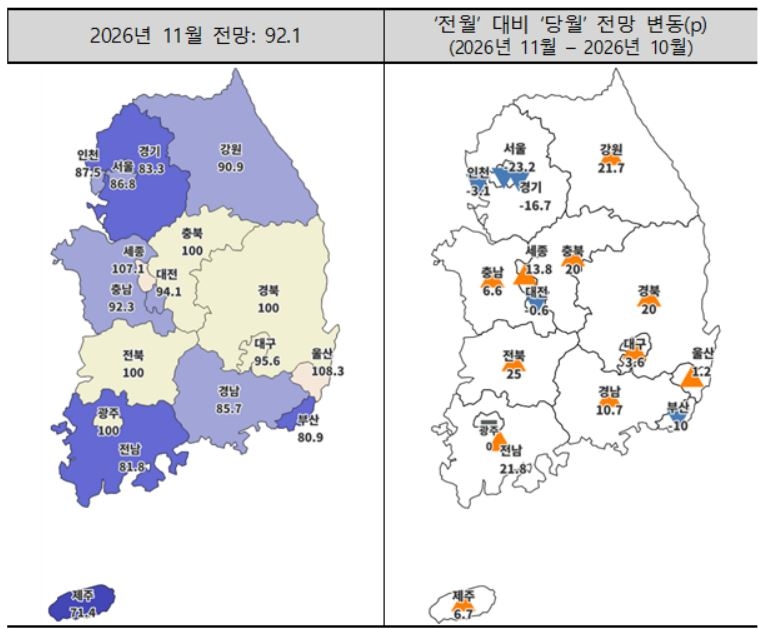
The Korea Housing Institute said the index fell sharply as rising interest rates increased the cost of buying a home and a wait-and-see mood spread among buyers in high-priced areas. It added that declining apartment transaction volumes in Seoul and falling apartment prices in the three Gangnam-area districts were slowing the city's overall price growth, adding to uncertainty about future housing demand.
Outside the metropolitan area, the index rose 10.0 points to 93.4, striking a markedly different tone from the capital region.
Most provinces posted gains: North Jeolla Province reached 100.0 (up 25.0 points), South Jeolla Province 81.8 (up 21.8 points), Gangwon Province 90.9 (up 21.7 points), North Chungcheong Province 100.0 (up 20.0 points), North Gyeongsang Province 100.0 (up 20.0 points) and Sejong 107.1 (up 13.8 points).
The institute attributed North Chungcheong Province's improvement to expectations that large-scale semiconductor investment would boost the local economy, while Sejong's gain reflected the announcement of plans to relocate additional central government agencies to the city.
The November financing index fell 11.0 points to 69.8, reflecting a contraction in developer sentiment as rising loan rates increased financial costs.
The materials supply index rose 3.2 points to 98.3, as expectations grew that a weaker exchange rate would ease the cost burden of imported raw materials.

hope@heraldcorp.com