- POSTECH, Samsung Research develop ultra-thin optical system that cuts light loss
- Prototype displays text outdoors in bright sunlight, reduces color distortion
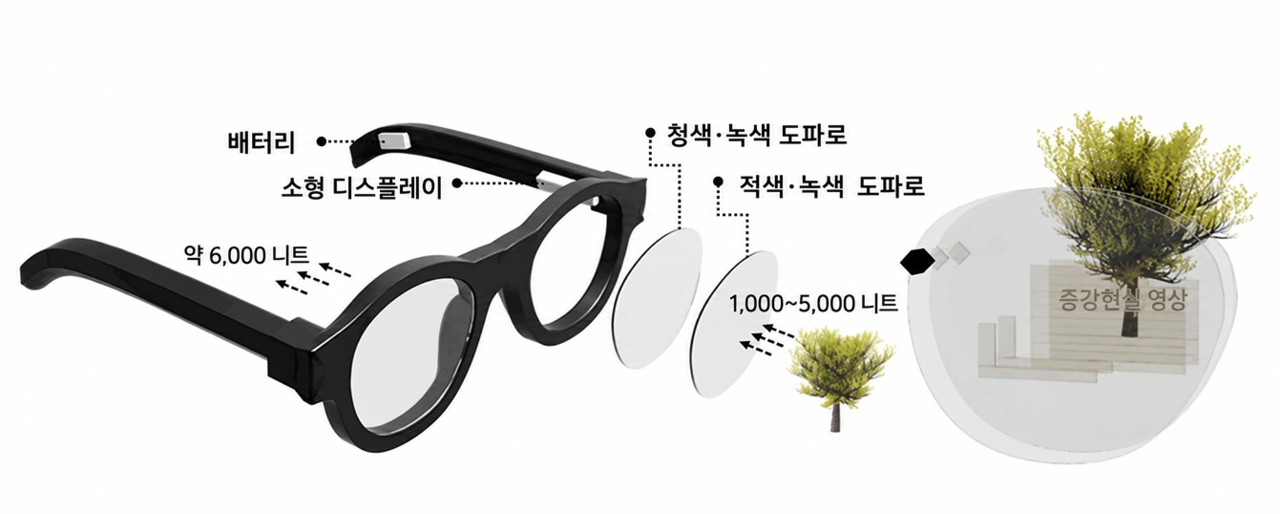
South Korean researchers have developed an ultra-thin augmented reality glasses technology capable of displaying sharp navigation directions and text messages over real-world scenery — even in bright sunlight. The lens is just 1.5 millimeters thick.
The Ministry of Science and ICT announced Thursday that a research team led by Professor Noh Jun-suk at Pohang University of Science and Technology (POSTECH) developed the ultra-thin metasurface waveguide-based AR optical technology in collaboration with Samsung Electronics' Samsung Research.
The findings were published Thursday in the international academic journal Nature.
AR glasses are devices that overlay digital information — such as navigation, text and video — onto the wearer's real-world view. They have drawn attention as a next-generation information device because they allow users to access a wide range of information without reaching for a smartphone.
Making such glasses thin and light enough to resemble ordinary eyewear while still delivering bright, clear images outdoors has proven difficult, however. Widening the area through which light is transmitted — necessary so the display remains visible even when the eyes move or the glasses slip — has typically caused significant light loss, dimming the image.
Conventional AR glasses feed light from a miniature display into a thin waveguide and use microscopic surface structures to direct it toward the eye. In the process, some light escapes in unintended directions, reducing brightness.
Color distortion has posed another challenge: red, green and blue light travel through the waveguide at different angles and efficiencies, warping the final image.
The research team overcame these limitations by precisely engineering light pathways at the nanometer scale.
The key innovation is a "metasurface" — an array of nanostructures smaller than the wavelength of light. By finely controlling the direction and path of light, the metasurface minimizes unnecessary light loss and keeps images bright regardless of where the wearer's eyes are positioned.
To reproduce color images, the team stacked two waveguide layers, each optimized for different parts of the spectrum: one primarily carrying blue and green light, the other red and green. Combining the two layers reduced the efficiency gap between colors.
The result was a metasurface waveguide optical system with a total thickness of just 1.5 millimeters.
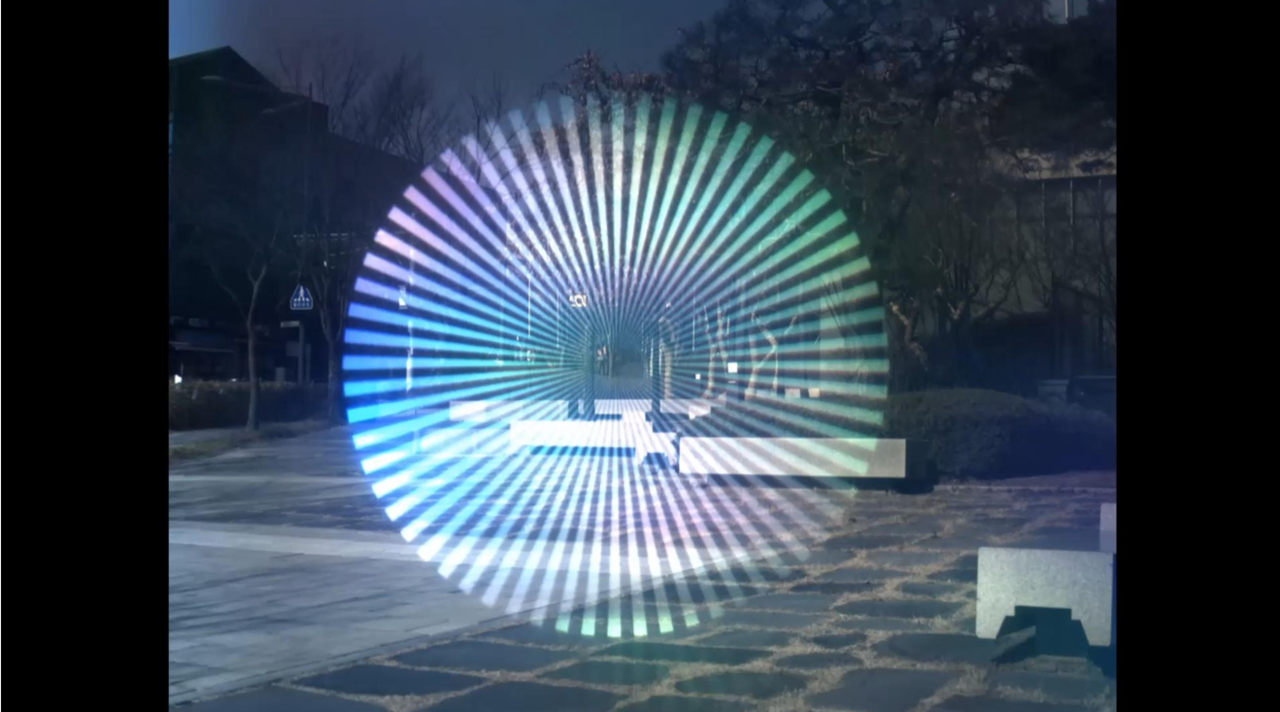
In a working prototype, the AR glasses successfully displayed white text over real-world scenery in bright outdoor sunlight. Indoors, the device rendered color images that remained visible across a range of eye positions.
The technology is significant because it achieves both a thinner form factor and adequate brightness — two goals that have historically been in tension. Its efficient use of light is also expected to reduce display power consumption in future devices.
However, further research is needed before commercialization. The team must raise average brightness to industry-standard levels, address a rainbow-like diffraction effect caused by ambient light striking the nanostructures, and ensure uniform color and brightness across the image. Developing a manufacturing process suited to mass production is also on the agenda.
The team plans to reduce the two waveguide layers to one and apply a large-area nanoimprint process to bring down production costs.
"This research demonstrates that by precisely controlling the path of light inside the lens, a thin lens can produce bright, clear images even outdoors," Noh said. "We will work to secure mass-production technology and integrate AI-based personalized image processing to develop AR glasses that people can wear comfortably in everyday life."
nbgkoo@heraldcorp.com