Memorial conference held at North Korea Graduate University; daughter recalls father's promise of family travel that never came
Korean and Chinese scholars gathered Wednesday to mark the first anniversary of the death of the late Dr. Kim Kwang-un, who led the planning and compilation of "Bukjoseon Sillok" (Records of North Korea), a 220-volume collection of historical source materials on North Korea. Colleagues and younger researchers remembered Kim as a scholar who broadened the foundations of North Korean historical research.
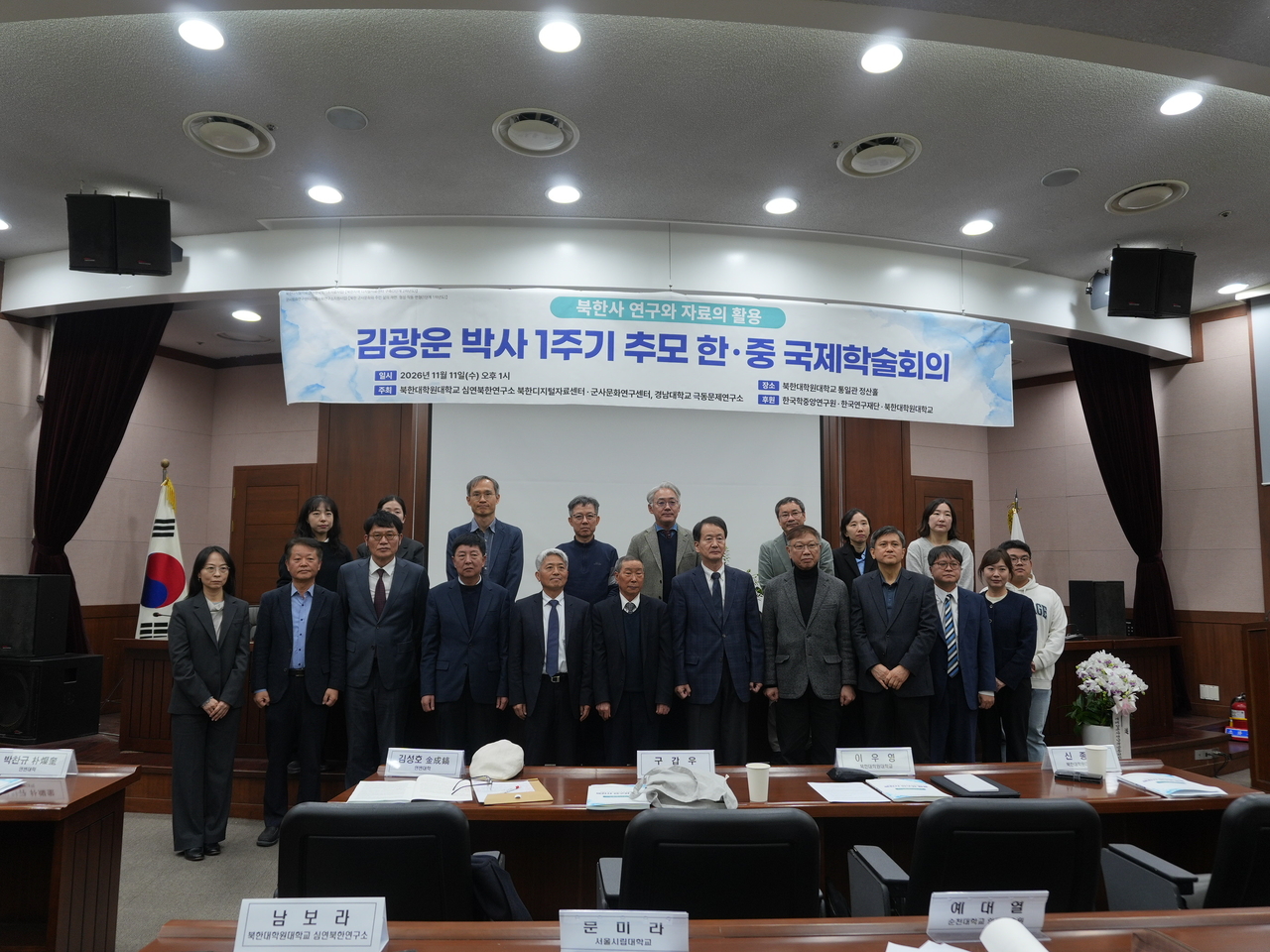
The conference, titled "North Korean Historical Research and the Use of Materials: A Korea-China International Academic Conference Commemorating the First Anniversary of Dr. Kim Kwang-un," was held Wednesday at Jeongsan Hall in the Unification Hall of North Korea Graduate University. It was co-hosted by the university's Simyeon Institute for North Korean Studies — which includes the North Korea Digital Materials Center and the Military Culture Research Center — and the Institute for Far Eastern Studies at Kyungnam University.
The conference was organized to review the scholarly achievements in Kim's major works, including "Modern History of Unified Independence," "Research on North Korean Political History I" and "Bukjoseon Sillok," and to examine the potential for expanding the use of research materials on North Korean history. Sessions also addressed the broader task of widening the scope of historical sources and research perspectives through topics such as captured North Korean documents, Goguryeo mural tombs and the history of the anti-Japanese independence movement.
The event was divided into two parts: the first, titled "The Research Achievements of the Late Kim Kwang-un," revisited his major works, while the second, "Horizons of North Korean Studies — Expanding Sources and Perspectives," examined materials and approaches in the field. Park So-hye, a researcher at the Simyeon Institute for North Korean Studies at North Korea Graduate University, served as master of ceremonies for the opening session.
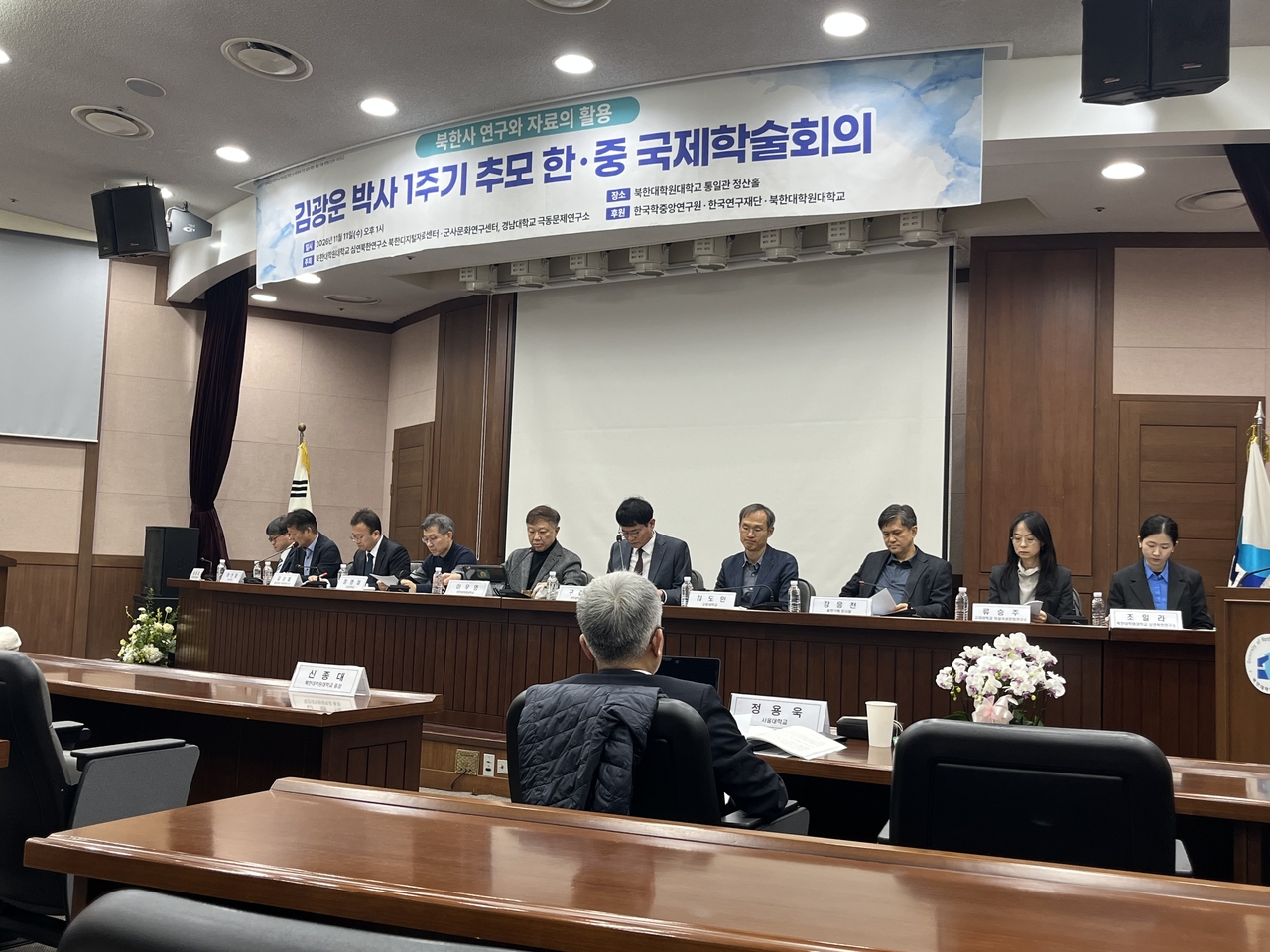
In the first session, moderated by Lee Woo-young, a professor at North Korea Graduate University, Lee Shin-cheol, chief executive of Historyde, examined Kim's critical perspective and contemporary relevance through "Modern History of Unified Independence." Ku Kab-woo, a professor at North Korea Graduate University, and Kim Sang-beom, a professor at the Institute for Far Eastern Studies at Kyungnam University, explored the scholarly legacy of North Korean studies in "Research on North Korean Political History I." Kang Eung-cheon, head of the publishing firm Munsacheol, addressed the research questions left by the source collection, focusing on the process of state formation documented in volumes 1 through 22 of "Bukjoseon Sillok."
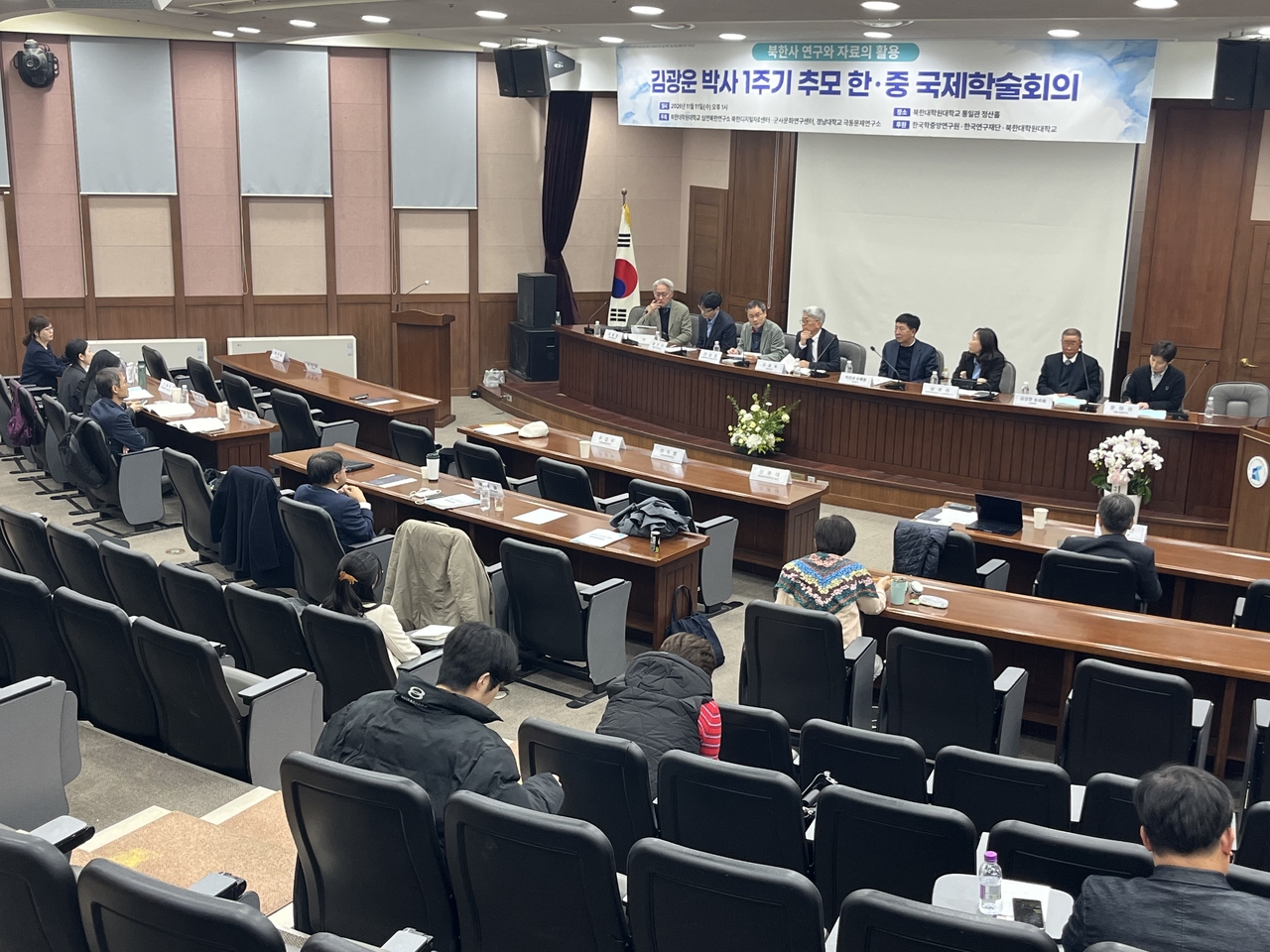
In the second session, moderated by Kim Dong-yeop, a professor at North Korea Graduate University, Jung Yong-wook, an emeritus professor at Seoul National University, presented on "The Formation and Composition of Captured North Korean Documents." Park Chan-gyu, a professor at Yanbian University, introduced research on newly surveyed Goguryeo mural tombs in the Nakrang district of Pyongyang, while Kim Seong-ho, also a professor at Yanbian University, examined the anti-Japanese revolutionary struggle of the Korean people alongside Yang Jingyu, a Chinese national hero of the anti-Japanese resistance.
The Academy of Korean Studies, the National Research Foundation of Korea and North Korea Graduate University supported the conference. It sought both to revisit Kim's scholarly contributions and to explore ways of continuing the work of collecting, organizing and drawing on historical materials in subsequent research.
Shin Jong-dae, president of North Korea Graduate University, delivered welcoming remarks. Jung Yong-wook, Park Chan-gyu and Kim Sang-beom offered tributes, reflecting on Kim's scholarly legacy and their shared time with him.
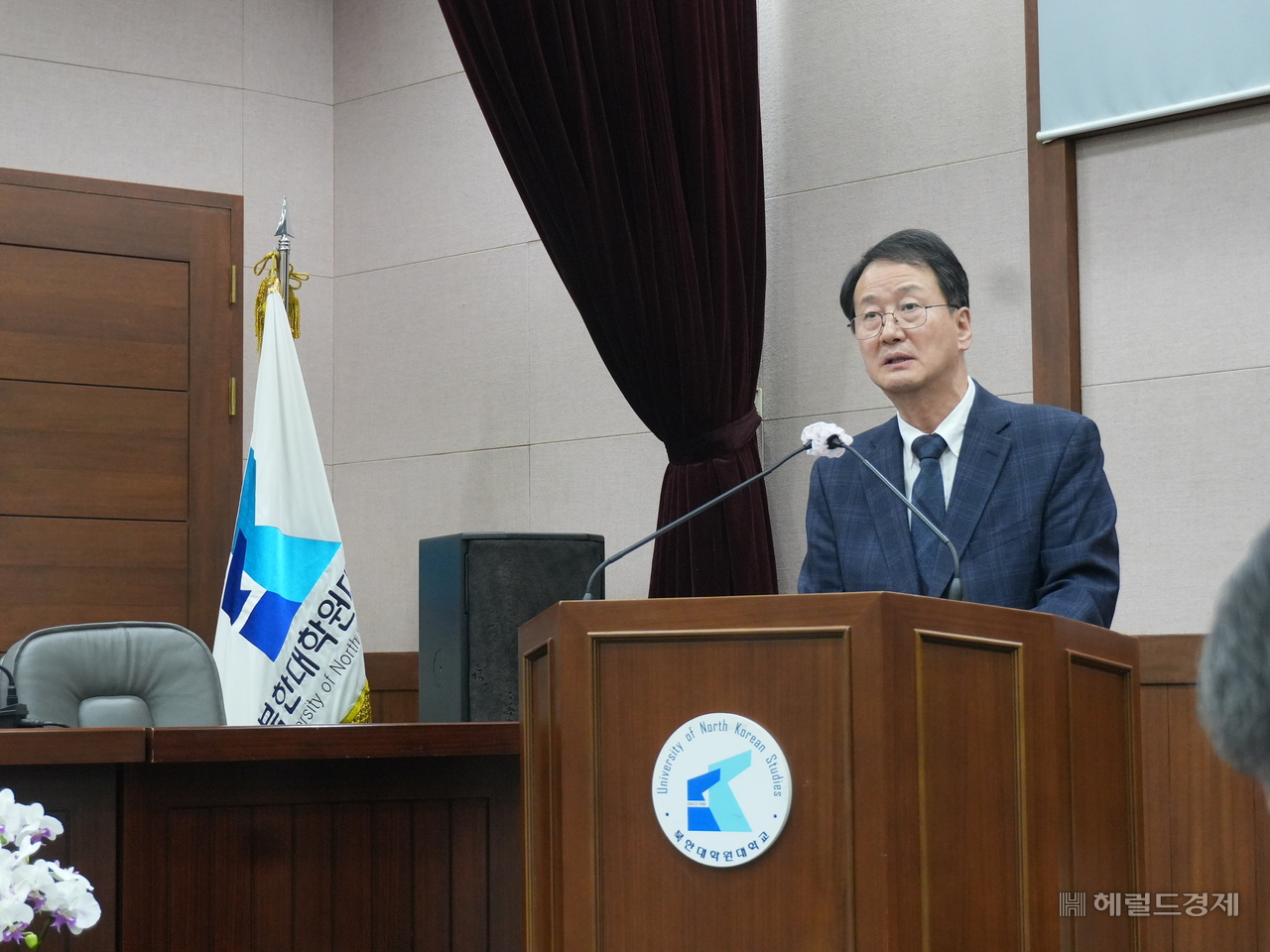
Shin said it falls to Kim's colleagues and younger scholars to advance North Korean historical research on the foundation of the records and achievements Kim left behind. "I believe that is the tribute and the duty that truly honors his dedication and passion," Shin said, adding that the conference itself was organized to put that conviction into practice.
Jung, a longtime friend of Kim, remembered him as a "romantic" — a scholar of passion and warmth. Jung recalled first meeting Kim in the late 1980s, when research space was scarce, and the two held seminars at each other's homes. After studying, they would read poetry and sing together.
Jung said Kim's scholarship cannot be fully assessed through his books and papers alone, citing his overseas archival work, his role in facilitating inter-Korean academic exchanges and his compilation of "Bukjoseon Sillok." The effort to gather materials that other researchers could use, and to foster connections across the academic community, must also be recognized, Jung said.
"Kim Kwang-un made fellow travelers of everyone he met," Jung said in tribute. "I was glad he was there, and I would like to think I was that kind of presence for him as well."
Park Chan-gyu spoke of Kim's footprint in Chinese academic circles. To Park, Kim was someone as close as an older brother — a friend and a partner in scholarly work. Kim's contributions to the study of modern North Korean history earned recognition in China, but at Yanbian University he was remembered by faculty and students as a colleague of candid, straightforward character who placed great value on loyalty.
According to Park, Kim sustained more than a decade of academic exchange with Yanbian University researchers, beginning with a survey of historical documents on North Korean history. Kim connected South Korea's National Institute of Korean History with Yanbian University and organized international academic conferences where researchers from the two countries could share materials and findings.
Kim also contributed to training the next generation of scholars. Park said Kim supported Yanbian University graduates in pursuing doctoral programs in South Korea, and that researchers who completed their degrees and returned to China went on to teach and conduct research on the Korean Peninsula at universities across the country. Kim also participated in building Yanbian University's document and materials room, laying the groundwork for classifying and organizing historical sources.
Park said the most meaningful tribute would be to carry on Kim's scholarly spirit and his passion for people, and to continue the Korea-China academic exchanges he had pursued during his lifetime.
For Kim Sang-beom, what remained most vivid was the light that never went out in Kim's office late into the night. Even on days when fatigue made him want to leave early, the sight of Kim's office light kept him going. Kim Sang-beom said that while one office light had gone dark, Kim's teachings remain lit inside him "24 hours a day, 365 days a year."
The picture of Kim's daily life that emerged from the scholars' recollections resonated with the memories of Kim Myeong-seon, Kim's daughter, who is continuing her father's research. In an interview to mark the first anniversary of his death, Kim Myeong-seon said her father "spent most of his time in the office from 9 in the morning until 11 at night, seven days a week."
"Bukjoseon Sillok: Chronology and Historical Materials," Kim Kwang-un's defining achievement, is a chronologically organized collection of materials on North Korea from the Aug. 15, 1945, liberation onward. Publication began in 2018, and 220 volumes had been released by last year. The project was conceived not merely as individual research but as an effort to build a foundation of materials that other researchers could draw upon.
Kim Myeong-seon said that when her father first announced his compilation plan, she wondered "whether such a thing was even possible." The shortage of personnel was a major difficulty throughout the vast process of gathering and organizing materials. The late hours her father kept, which the family witnessed firsthand, reflected the weight of that undertaking.
Underlying his perseverance was a firm conviction about the importance of source materials. "Before he even began compiling 'Bukjoseon Sillok,' my father always stressed how important materials were," Kim Myeong-seon said. "He would tell me — I was in a master's program at the time — that solid materials to back up your research were just as important as having a sharp research question."
Follow-up writings he had been preparing alongside the compilation work were left unfinished. "In between everything else, he kept working toward writing volumes 2 and 3 of 'Research on North Korean Political History,'" Kim Myeong-seon said. "In the end, those two books never made it into the world."
Kim had told his family that within a few years he hoped to wrap up his ongoing projects and focus on writing — and that when that time came, he would spend more time with them and take trips together. "But that time never came," Kim Myeong-seon said, "and all that remains are the promises he made to us that he never got to keep."
Even amid his demanding schedule, Kim never let a day pass without reaching out to his family. While staying in China, he would send updates on his daily routine and photos of his meals, and when he missed his grandchildren he would video call. Every night before bed, he would send a message wishing them good night.
"The night before he passed away, he sent his usual good-night message, just like always," Kim Myeong-seon said. "I never could have imagined that would be his last."
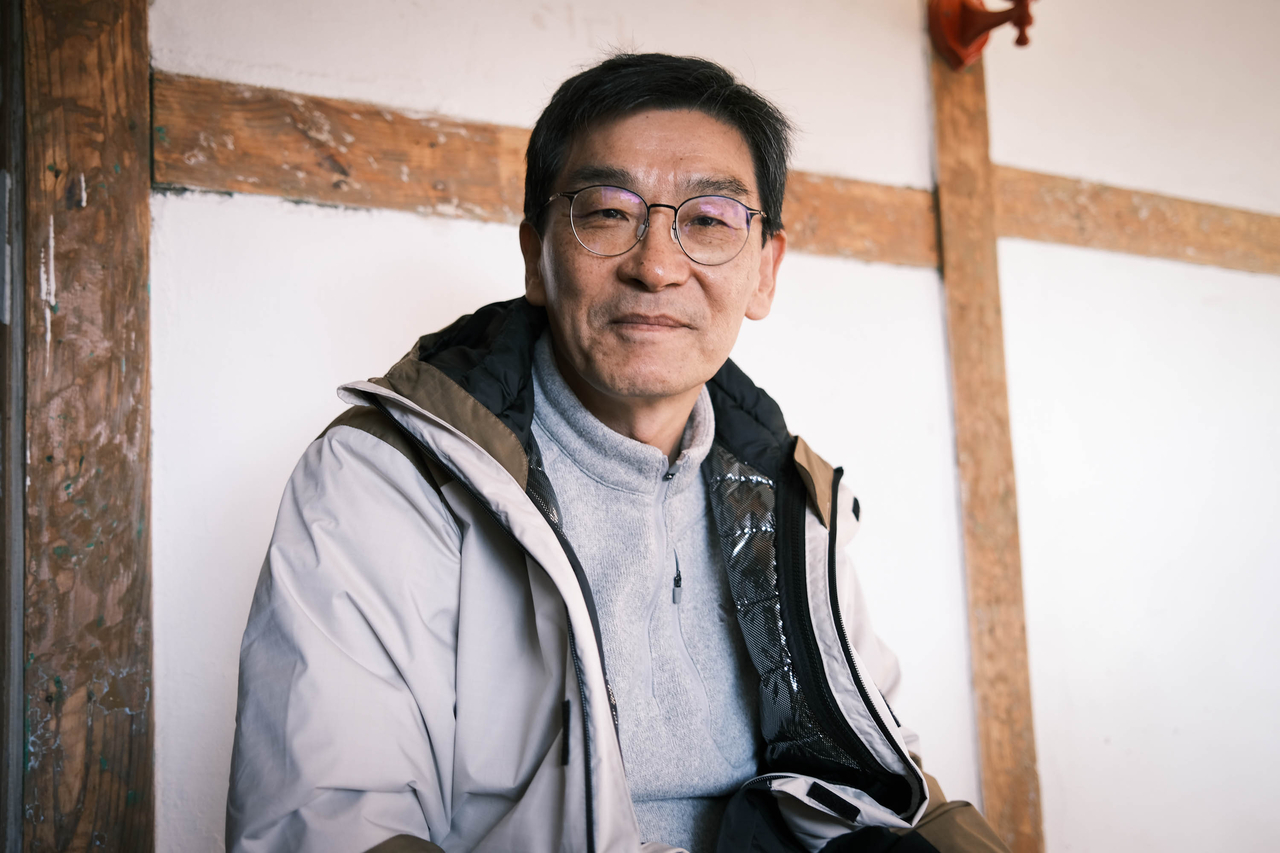
The late Dr. Kim Kwang-un died Saturday in Yanbian, China, at the age of 66. He studied history at Hanyang University and completed his graduate studies there before working as a research editor and senior research editor at the National Institute of Korean History. He continued his research on North Korean history and historical source compilation at North Korea Graduate University and the Institute for Far Eastern Studies at Kyungnam University.
For the academic community, Kim left behind a vast body of records and a wealth of research yet to be done. For his family, his absence remained something they had not grown accustomed to. "It has been a year since my father passed away, but I don't know how that time went by," Kim Myeong-seon said. "I still can't believe he is gone. I don't yet know whether a day will come when I can accept his absence."
sjkim@heraldcorp.com