Core assets such as government bonds to lead integration
Government to pilot bond tokenization next year
Legal clarity on settlement finality remains unresolved
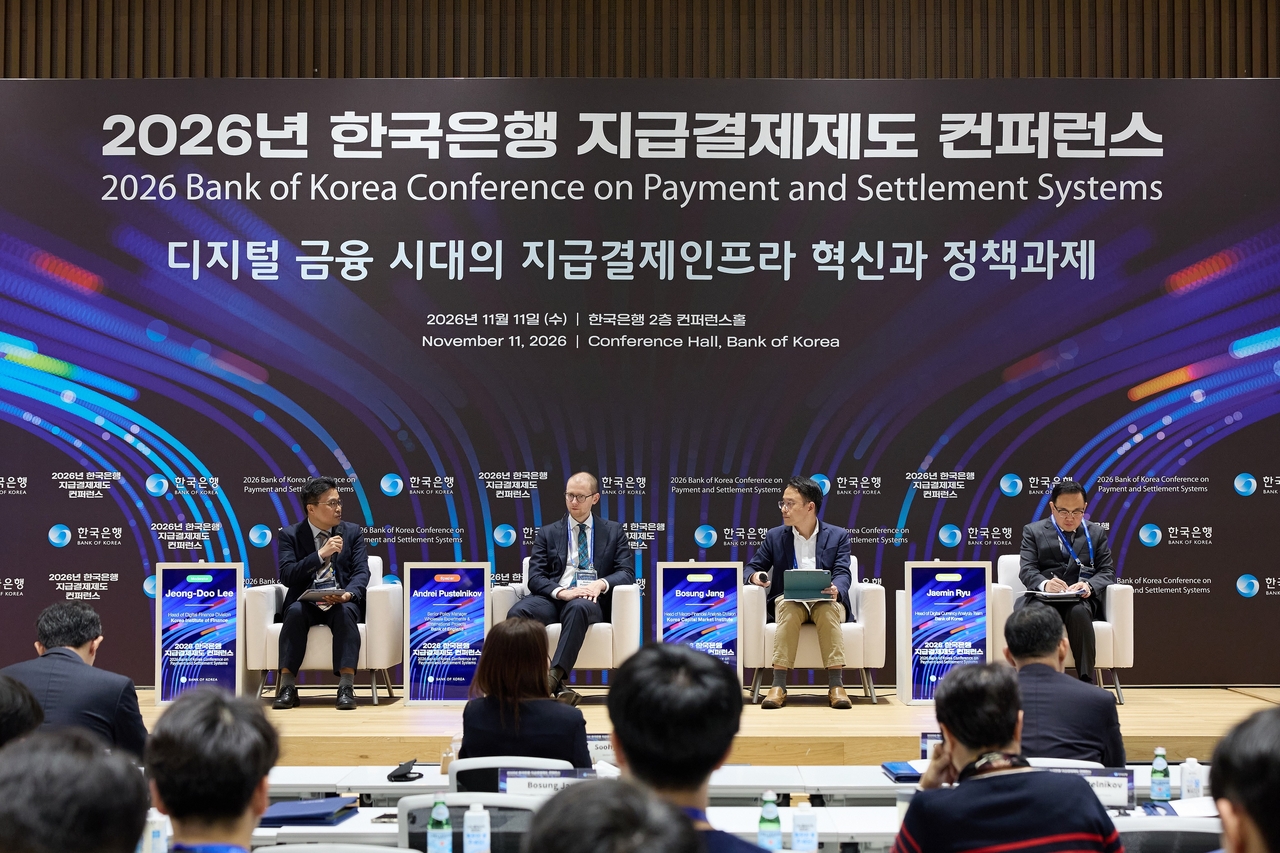
Experts are calling for central bank money to be used in the settlement of tokenized asset transactions.
Ryu Jae-min, head of the Bank of Korea's CBDC analysis team, said at a panel discussion during Session 1 of the 2026 Payment and Settlement Systems Conference on Wednesday that the Principles for Financial Market Infrastructures, known as PFMI, explicitly states that fund settlements within financial market infrastructure should be conducted in central bank money wherever possible. "There is no reason that principle should change just because the platform is a tokenized one," Ryu said.
Ryu outlined two approaches to supplying central bank money to a tokenized ecosystem. The first involves linking existing large-value payment systems — such as BOK-Wire, the Bank of Korea's interbank settlement network — to tokenized asset platforms. The second involves tokenizing central bank reserves directly and issuing them onto the platform for circulation.
The first approach allows existing liquidity-saving mechanisms to remain in use, but its operating hours do not align with tokenized platforms that run around the clock. The second enables fully atomic settlement — the simultaneous exchange of assets and payment — but raises unresolved questions about liquidity management.
The Bank of Korea's Project Han River, a pilot program testing the use of wholesale CBDC and deposit token-based digital currency for institutional purposes, falls under the second approach.
Ryu described Project Han River as a hub-and-spoke structure in which the Bank of Korea's digital currency system serves as the hub and other tokenized asset platforms act as spokes, with all payment settlements conducted in central bank money. "Systemically important assets like government bonds will be routed through the hub," Ryu said.
The government announced in its second-half economic growth strategy in July that it would pursue a government bond tokenization pilot linked to the Bank of Korea's wholesale CBDC next year. The Bank of Korea also established an asset tokenization unit in August. Ryu added that a Bank of England deputy governor visited the Bank of Korea last month to share updates on each institution's tokenization projects and discuss areas for cooperation.
Jang Bo-seong, head of the macro-finance division at the Korea Capital Market Institute, said central bank money-based settlement is essential for large-scale, systemically significant transactions such as government bonds and repurchase agreements. Jang also said the role of the central bank in STO fund settlement has not been sufficiently recognized domestically.
Regulatory reform was also identified as a challenge. Jang noted that while the Debtor Rehabilitation and Bankruptcy Act includes special provisions on settlement finality for payment systems designated by the Bank of Korea, how those provisions apply to distributed ledger-based settlement has yet to be worked out. The settlement finality provisions serve as a safeguard against the risk of cascading failures across the financial system.
On the Financial Services Commission's roadmap released in September — which calls for building securities tokenization infrastructure first before transitioning to on-chain settlement in a final phase — Jang said the pace of progress on securities and payment settlement should not diverge too sharply, and recommended starting with standardized assets such as government bonds.
Andrei Pustelnikov, a team head at the Bank of England, said the bank is piloting a synchronized settlement approach using its existing central bank payment system, with a target of live deployment in 2028. The goal is to improve the efficiency of tokenized asset transactions while maintaining financial system stability.
Synchronized settlement is a technology that eliminates settlement risk by linking a central bank's payment system with external asset platforms so that asset transfers and payment settlements are completed simultaneously on a mutually conditional basis.
The Bank of England is currently testing tokenized securities settlement with 18 institutions, including the London Stock Exchange, and plans to publish operational and regulatory guidelines next year.
The Bank of England is also participating in Project Agorá, a cross-border initiative with the Bank of Korea and other major central banks to issue and operate tokenized reserves and commercial bank deposits on a shared international payment and settlement platform.
kimstar@heraldcorp.com