AI-based future education, literacy improvement and mental wellness among priorities
Budget aims to back 'Together to the Future, Ahead in Busan Education' vision
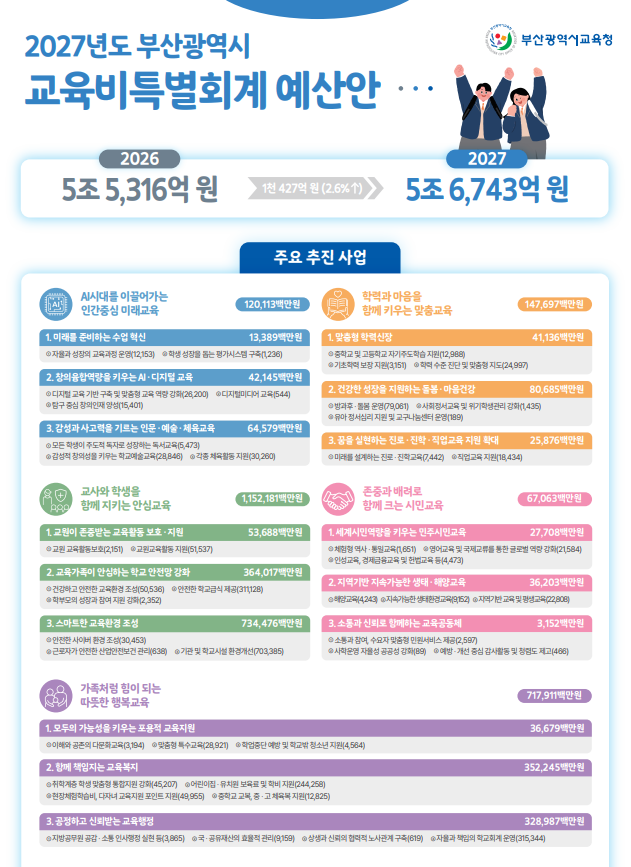
Busan Superintendent of Education Kim Seok-jun held a press conference Wednesday to announce that the city's education office had submitted a 5.67 trillion won ($4.22 billion) special education finance account budget proposal for 2027 to the Busan Metropolitan Council. The figure represents a 142.7 billion won, or 2.6 percent, increase from this year's base budget, though it is 118.2 billion won, or 2.0 percent, less than the total budget including supplementary appropriations.
The education office said it had significantly restructured existing projects and concentrated resources on AI-based future education, foundational academic support and safe learning environments, amid growing fiscal pressures from uncertainty over grants reform, rising personnel costs and the need to upgrade aging school facilities.
On the revenue side, transfers from the central government amount to 4.41 trillion won, up 379.6 billion won from this year. Local government transfers stand at 936.2 billion won, while fund transfers fall by 234 billion won to 160 billion won.
Expenditures are organized across five areas. Human-centered future education in the AI era receives 120.1 billion won. Of that, 42.1 billion won will go toward strengthening AI capabilities, including the full rollout of generative AI tools for teaching and learning across elementary, middle and high schools, while 71.5 billion won from the education informatization fund will be used to replace and distribute 42,600 smart learning devices. The office also plans to establish a tentatively named Opera Academy.
Personalized education receives 147.7 billion won. Some 41.1 billion won will support foundational academic achievement and academic improvement, while 80.7 billion won goes toward after-school care and mental health support. Starting next year, eligibility for after-school program vouchers will expand from third-graders to fourth-graders at the elementary level.
Safe education, the largest area by share, is allocated 1.15 trillion won. The office will expand support to place one safety officer for every 25 students during elementary school field trips, and plans to establish a tentatively named Staff Wellness Center and a tentatively named Parent Support Center. Some 734.5 billion won is earmarked for improving aging facilities through space-restructuring projects and for building new schools.
Civic education receives 67.1 billion won. Ecological and environmental education — including the operation of the Busan Environmental Experience Education Center, set to open in October 2027 — accounts for 9.1 billion won, while 4.2 billion won goes toward marine education, including the establishment of a tentatively named Busan Marine AI Education Center.
Happy education is allocated 717.9 billion won. Field trip subsidies for second-year high school students will rise from 400,000 won to 700,000 won, and out-of-school youth will receive a monthly 50,000 won activity allowance for educational participation. School operating budgets increase by 14.8 billion won through project restructuring.
"We will build a future education environment where students and school staff can grow together," Superintendent Kim said. The budget proposal will undergo a preliminary review by the council's education committee and a comprehensive review by the budget and accounts special committee starting late this month, before a final vote at the plenary session on Dec. 10.
kaf2002@heraldcorp.com