New tools forecast when carrier insects emerge and map high-risk areas, helping local governments prioritize control efforts
South Korea has developed a new method to predict when pine wilt disease carrier insects emerge and identify high-risk areas, enabling more timely surveillance and more efficient prioritization of control efforts.
The National Institute of Forest Science under the Korea Forest Service announced Wednesday that it has developed two predictive models — one forecasting the emergence timing of the pine wilt disease vector insect and another assessing the risk of disease outbreak by region.
Pine wilt disease spreads as vector insects carry the pine wood nematode from tree to tree. Removing infected dead trees and other sources of infection before the insects reach adulthood is the cornerstone of disease control.
In response, the institute developed the "vector insect emergence timing prediction model" and the "pine wilt disease outbreak risk assessment model," each incorporating the biological characteristics of the vector insect, regional weather data and the disease's outbreak patterns.
The emergence timing model uses projected regional temperatures to forecast when vector insects will reach adulthood. Field control teams can use this information to schedule the removal of dead infected trees, time pesticide applications and deploy lure traps at the most effective moments.
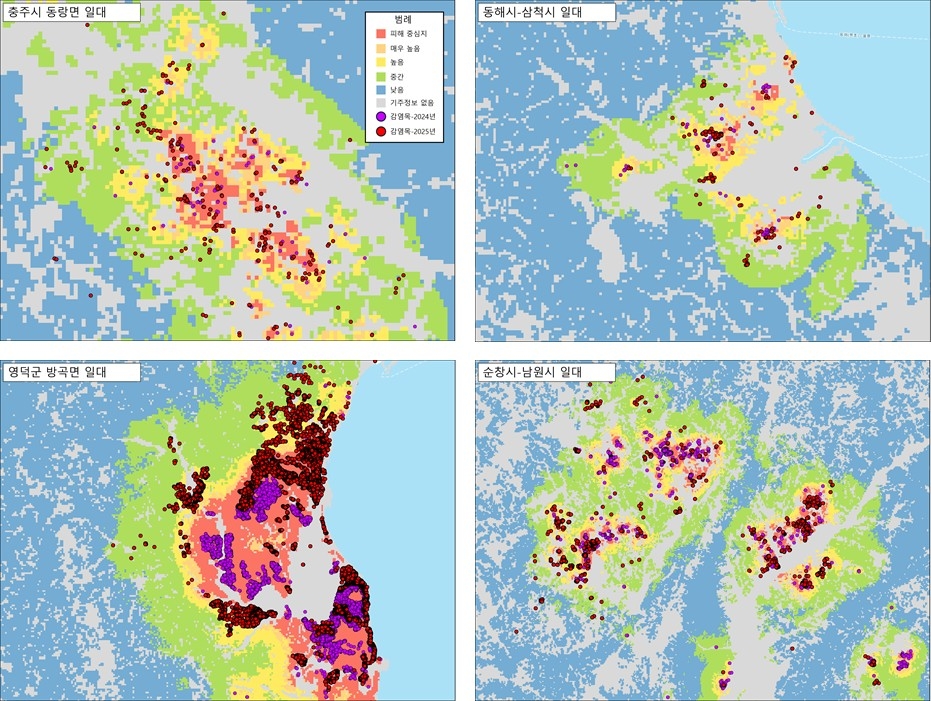
The outbreak risk assessment model divides the entire country into approximately 5.5 million grid cells of 100 meters by 100 meters and uses machine learning to evaluate risk across 58 variables — including pine wilt disease outbreak density, host tree distribution, a weather index covering the insects' active season from April through August, and population density near affected areas.
Based on these results, the institute compiles an "emergence outlook report" and distributes it to local governments and relevant agencies to support the development of pine wilt disease control strategies.
Han Hye-rim, head of the Forest Pest Research Division at the National Institute of Forest Science, said the institute would "continuously verify the predictive accuracy of the outbreak risk assessment model using annual pine wilt disease damage data." Han added that the institute would "update damaged-tree data each year to produce and distribute outbreak risk maps, supporting the establishment of effective national surveillance and control strategies as well as region-specific control plans."
kwonhl@heraldcorp.com