Rate collusion found in 150 of 345 auctions
Dealers coordinated by phone and messenger until moments before deadlines
Seven firms referred to serious crimes agency
Fifteen banks and brokerages that colluded for three and a half years in South Korea's government bond market will pay more than 1.6 trillion won ($1.19 billion) in fines — the largest penalty the Korea Fair Trade Commission has ever imposed in a single case.
The firms were found to have effectively neutralized the competitive bidding system by coordinating interest rates and volumes over the phone and through messaging apps until moments before auction deadlines.
The Fair Trade Commission announced Wednesday that it would issue corrective orders and impose a combined fine of 1.63 trillion won on 15 primary dealers that pre-agreed on bid rates or volumes — or exchanged bid-rate information — during competitive treasury bond auctions. Seven of the firms, found to have participated in collusion over longer periods and across more auctions, will be referred to the Serious Crimes Investigation Agency.
The 15 firms subject to sanctions are 10 brokerages — Kyobo, Daeshin, Meritz, Mirae Asset Securities, Samsung, Shinhan Securities, NH Investment & Securities, KB Securities, Kiwoom Securities and Korea Investment & Securities — and five banks: Kookmin, Nonghyup, Industrial Bank of Korea, Hana and Korea Development Bank. The seven firms referred for criminal investigation are Mirae Asset Securities, NH Investment & Securities, Industrial Bank of Korea, KB Securities, Kiwoom Securities, Korea Development Bank and Korea Investment & Securities.
The fine surpasses the previous record of 1.03 trillion won levied against Qualcomm in 2016 for abuse of market dominance. By firm, KB Securities received the largest individual penalty at 332.18 billion won, followed by NH Investment & Securities at 242.78 billion won, Mirae Asset Securities at 214.83 billion won, Shinhan Securities at 147.31 billion won and Industrial Bank of Korea at 135.84 billion won.
The commission's investigation found that the financial firms agreed to coordinate bid rates or volumes — or to exchange related information — in 150 of the 345 treasury bond auctions held between January 2020 and June 2023. In 145 of those cases, the collusion went beyond mere information exchange to include explicit agreements on specific bid rates or volumes. One auction involved an agreement on bid volumes as well.
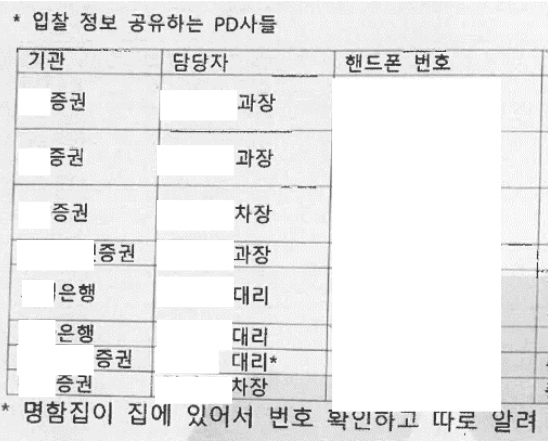
The collusion unfolded on auction days, beginning in the morning and continuing until just before bidding closed. Dealers first gathered information on competitors' intended volumes before exchanging or agreeing on bid rates. Communication records show that information was still being shared by phone and Telegram as little as one to two minutes before deadlines.
The practice had hardened into routine. Chat logs obtained by the commission show dealers skipping pleasantries and going straight to rate information. In one documented instance, two employees from different firms agreed over a five-second phone call to submit a bid rate of 3.70 percent.
The firms also built organizational structures to sustain the collusion. When a dealer changed posts, contact information for counterparts at rival firms was passed to the incoming employee; substitute contacts were provided during business trips or leave. Some firms went further, drafting internal manuals that instructed staff to survey the rates of at least five competitors 15 minutes before an auction and verify them again five minutes before the close.
The commission's analysis confirmed that the information exchanges had a measurable effect on actual bid rates. During the collusion period, two firms submitted identical rates in 46.7 percent of auctions — more than five times the 8.5 percent rate recorded after the collusion ended. Even within the collusion period, auctions that involved a phone call between dealers saw an identical-rate submission rate of 55.6 percent, roughly three times the 18.2 percent recorded when no call took place.
The goal of the collusion was to prevent winning bid rates from falling as competition intensified. In treasury bond auctions, firms offering lower rates are awarded bonds first, meaning fiercer competition tends to push winning rates down and issue prices up. The commission said the firms aligned their bid rates at similar levels or reduced their bid volumes to avoid that competition.
In one auction, a dealer who had initially planned to take 10 percent of the issuance agreed, after consulting with counterparts at other firms, to bid for only 6 percent — and followed through. The commission concluded that such conduct weakened competitive bidding and artificially pushed up treasury bond winning rates.
Only primary dealers and pre-qualified candidates designated by the Ministry of Economy and Finance may participate in treasury bond auctions. The designation requires meeting strict criteria covering financial soundness, staffing and track record, creating high barriers to entry. In exchange for obligations to underwrite, distribute and hold government bonds, designated dealers receive preferential underwriting rights and financial support. In this restricted market, 15 of the 18 primary dealers active at the time were found to have taken part in the collusion.
Treasury bonds are government-issued debt instruments used to fund fiscal spending and serve as a benchmark for pricing other financial products. When winning bid rates are artificially elevated, the government's borrowing costs rise, placing a burden on public finances. The commission said the collusion constituted a serious legal violation that effectively dismantled the competitive bidding system and caused losses to the national treasury.
Alongside the fines, the commission ordered all 15 firms to cease the illegal conduct, carry out compliance education and report the results, and establish internal disciplinary rules for employees found to have participated in the collusion.
A commission official said the agency would "continue to strictly sanction bid-rigging in the public sector that wastes the national budget and burdens the public, and will strengthen monitoring of collusion involving the exchange of competitively sensitive information, including in the financial sector."
y2k@heraldcorp.com