Federation of Korean Trade Unions' research arm publishes report on public institution reform
Report faults lack of feasibility review; unions say they were shut out of process
Concerns raised over expertise loss in power, port and labor education mergers
500,000-won monthly relocation allowance called inadequate; housing, education support demanded
Six principles put forward, including total employment guarantee and ban on worsening labor conditions
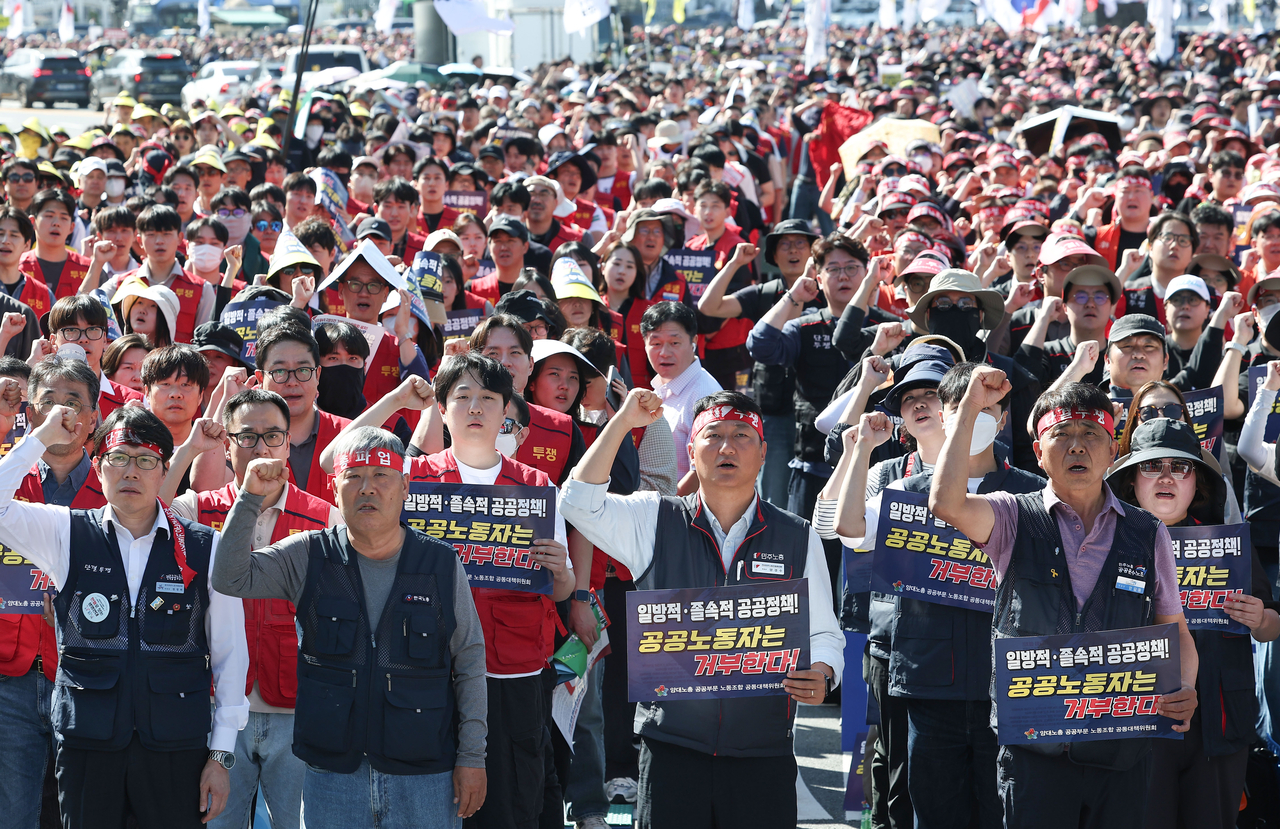
As the government pushes ahead with plans to merge 109 public institutions and relocate more than 350 Greater Seoul-area agencies in a second round of regional transfers, labor groups are raising growing concerns about a decline in public service quality and job insecurity. Critics say the government has moved at speed under the banner of efficiency and balanced national development without adequately verifying the economic benefits of the mergers or whether public services would actually improve. Particular concern has been raised that harmonizing the differing wage scales, job grades and welfare systems across institutions could drag conditions down to the lowest common denominator, while the costs of relocation — housing, schooling and caregiving — could be pushed onto individual workers.
According to a report published Wednesday by the research arm of the Federation of Korean Trade Unions, the public institution reform plan the government announced Sept. 3 centers on merging 109 agencies — roughly 20 percent of all public institutions. Central government agencies in the Greater Seoul area are to be relocated to Sejong on a priority basis starting in the first half of 2027, beginning with those whose scale and ripple effects are largest. More than 350 public institutions in the Greater Seoul area are also set to begin relocating next year under a policy of minimizing the number that remain in the capital region.
The report criticized the policy process for effectively bypassing any procedure to gather input from unions and workers. The Public Institution Management Committee passed the reform plan through a written vote in about an hour, and some institutional unions were notified of the mergers just one hour before the government's public announcement.
The report was written by Park Sung-kook, director of the Social Dialogue Research Center at Korea University's Institute for Labor Studies. It draws on a roundtable held Oct. 19 that brought together Jung Heung-jun, a professor at Seoul National University of Science and Technology, and policy officials from the Federation of Korean Trade Unions' affiliated public-sector federations — the Public Federation, the Public Workers' Federation and the Power Workers' Federation — to analyze the problems with the reform and the challenges facing labor.
'Efficiency when splitting, efficiency when merging' — merger rationale under fire
The report identified the most serious flaw in the government's merger drive as the absence of rigorous feasibility reviews.
Professor Jung said the mergers of the five state power companies, the reintegration of KTX and SRT, and the consolidation of parent and subsidiary entities had some justification from the standpoint of eliminating overlapping functions. However, he questioned whether it was appropriate to apply a simple efficiency argument to merging institutions such as the Korea Employment and Labor Education Institute, the Korea Labor Foundation, the four port authorities, Korea National Oil Corporation and Korea Gas Corporation, given that they differ in function and founding purpose.
Particular concern was raised that merging the Korea Employment and Labor Education Institute with the Korea Labor Foundation could weaken independent labor education functions. The port authorities are closely tied to regional economies, while the oil and gas corporations each possess distinct areas of expertise — resource exploration and retail distribution, respectively — making separate verification of the benefits of their consolidation necessary.
"If the labor education institute and the Korea Labor Foundation are combined, there is a real risk that labor education functions will largely disappear," Jung said. "I also question whether it makes sense to lump together port authorities that are directly tied to regional economies, or oil and gas corporations that carry enormous weight in energy security and overseas operations, under a simple efficiency argument."
The proposed merger of the five state power companies also drew scrutiny. The government is pursuing a plan to consolidate Korea South-East Power, Korea Midland Power, Korea Western Power, Korea Southern Power and Korea East-West Power into a single entity tentatively named Korea Power.
Noh Yu-geun, head of policy at the Federation of Korean Trade Unions' Power Workers' Federation, said the government split the power generation sector into five companies in 2001 on the grounds that competition would improve efficiency, and 25 years later is now saying it is more efficient to bring them back together.
"They talked about efficiency when separating them and they talk about efficiency when merging them," Noh said. "Shouldn't there first be an assessment of the outcomes and limitations of 25 years of separate operation?"
Fears of a race to the bottom on wages and benefits — unions call for exemption from total labor cost cap
Once public institution mergers begin in earnest, labor-management conflict over wages and working conditions is expected to be unavoidable.
With each institution operating under different wage structures, job-grade systems, benefit levels and severance arrangements, the question of which institution's standards will apply after a legal merger is bound to become a flashpoint.
The government's total labor cost cap — which controls the aggregate wage bill of public institutions — was singled out as a particular obstacle. Raising wages and benefits at merged institutions to the higher standard would require additional funding, but under the current system individual institutions have little room to improve compensation on their own.
Jung Yoon-hee, policy director at the Federation of Korean Trade Unions' Public Federation, said the government has set aside about 100 billion won ($74.4 million) in a future-response fund and is offering incentives such as an additional 1 percent wage increase for institutions that accept mergers, but argued that such measures cannot fundamentally close the compensation gap between institutions.
"Sacrifice by one side or a race to the bottom is absolutely unacceptable," Jung said. "An upward harmonization that carries over existing rights and collective agreements must be the premise."
The prospect of forced wide-area transfers, demotions in job grade or position, and workforce reductions from the elimination of overlapping departments were also cited as concerns.
Labor groups called for explicit guarantees — before any mergers take place — covering total employment protection, a ban on forced transfers, and retraining and education support for workers changing roles. They also said the government must provide additional budget support to maintain wage and benefit levels and grant exemptions from the total labor cost cap.
The restructuring of labor relations is another major variable. When multiple institutions are folded into one, disputes can arise over the validity of existing collective agreements and the consolidation of bargaining channels under a multiple-union framework.
Labor groups called for the establishment of a special tripartite consultative body — with direct union participation in the merger preparatory committee — and a multilayered bargaining structure that includes the Ministry of Economy and Finance and the relevant line ministries.
'500,000 won a month is not enough to settle in the regions' — second relocation round also draws resistance
According to the report, 33 institutions affiliated with the Federation of Korean Trade Unions' Public Federation are subject to the second round of regional relocations. Agencies under the jurisdiction of the Ministry of Employment and Labor included on the list are the Construction Workers' Mutual Aid Association, the Korea Labor Foundation, Korea Polytechnics, the Korea Employment and Labor Education Institute, the Korea Social Enterprise Promotion Agency, Korea JobWorld and the Korea Employment Agency for Persons with Disabilities.
Labor groups said they broadly support the policy goal of balanced national development, but argued that pressing ahead with a second round of relocations without adequately evaluating the outcomes and shortcomings of the first is problematic.
They said in particular that the government's proposed relocation allowance of 500,000 won per month, limited to two years, is insufficient to ease the economic and social burden on workers and their families.
"Most public institutions operate on a rotation system with cycles of three to four years," Jung Yoon-hee said. "Moving to a particular innovation city does not mean workers can simply put down roots there."
A unilateral relocation that fails to account for a spouse's job, children's schooling and family caregiving responsibilities could force workers into a dual life, commuting between the capital region and the provinces.
Labor groups called on the government to build up housing, education, medical and transportation infrastructure before relocations proceed, and to establish clear, objective criteria for allowing institutions whose work genuinely requires a presence in the capital region to remain.
"The synergies that would allow institutions, industries and regions to combine and revive a given area as a hub must be verified," said Ahn Jin-yong, head of Policy Division 1 at the Federation of Korean Trade Unions' Public Workers' Federation. "Institutions that cannot relocate without sacrificing their core functions, or where there is no real benefit to moving, should stay in the capital region."
Labor groups put forward six principles including total employment guarantee, raising prospect of clash with government
The report said that to minimize conflict between labor and the government during the reform process, unions must be guaranteed meaningful participation in decision-making.
To that end, it put forward six joint principles: preventing the erosion of public-service quality and institutional expertise; guaranteeing total employment; prohibiting any rollback of labor conditions; carrying over employment, seniority and collective agreements; preventing forced transfers; and making prior labor-government and labor-management consultation mandatory.
The report also argued that the government must move away from a model in which it unilaterally decides on mergers and then leaves individual institutions to manage the resulting labor-management conflict. A structure in which labor and management jointly discuss everything from the rationale for mergers to wage and benefit adjustments, workforce redeployment and settlement conditions is needed, it said.
The report also proposed building a verification mechanism at the National Assembly level. Through public hearings and legislative forums linked to the relevant standing committees, the merits of each merger should be scrutinized, and the government should be required to present concrete evidence of improvements to public services and cost savings.
The government's reform drive does, however, carry a policy rationale: eliminating overlapping functions and reducing operational inefficiency. Even within labor circles, some mergers — such as those involving the five power companies and rail agencies — are acknowledged as necessary. The central question going forward is therefore expected to be less about whether to merge at all, and more about how to demonstrate genuine efficiency gains and ensure employment and working conditions are protected.
The report said the consolidation and relocation of public institutions goes beyond a simple organizational reshuffle and directly affects the quality of public services and the lives of workers. How much the government accommodates labor's demands as it accelerates the reform is expected to shape the trajectory of public-sector labor relations next year.
fact0514@heraldcorp.com