
Amid a sharp recent decline in the Kospi that has left many investors nursing losses, legendary trader Larry Williams is pointing to the first week of December as a key turning point. Based on his market cycle analysis, Williams predicted that the Korean stock market will begin a rebound in early December and sustain an upward trend through mid-February next year.
In a recent interview with Jisikinside, Williams offered his outlook on the Korean market. "From where we stand now, the Korean market should start getting stronger again from mid-to-late November, or from early December," he said. "It has already taken quite a hit, but a decent rally should get underway."
When pressed for a more specific date, Williams pointed to Dec. 7. "If I had to name an exact date, it would be around Dec. 7," he said. "I expect the market to start moving higher during the first week of December." He added that the upward trend could extend through mid-February next year.
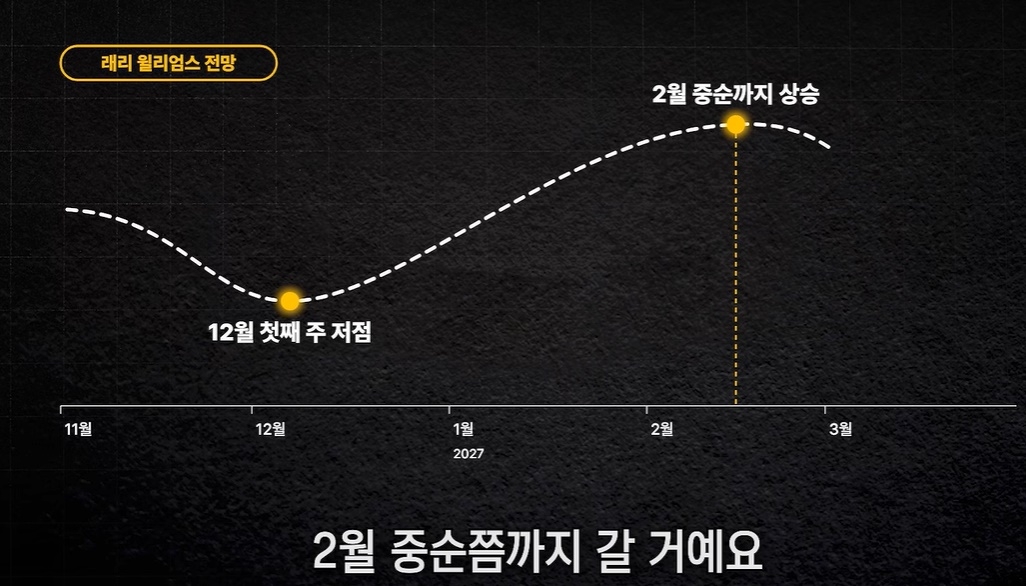
Williams bases his forecast on market cycles — the analysis of recurring patterns in historical price movements. "Cycles are the way markets have actually moved," he said, explaining that he uses past price behavior to project future lows and highs.
He particularly identified international crude oil prices as a key variable for gauging the direction of the Korean market, noting that oil price movements tend to lead Korean equities by roughly six to eight weeks. "The Korean market is quite sensitive to crude oil prices," Williams said. "There have been cases where the Korean market peaked about 10 weeks after oil prices hit their high."
On major domestic semiconductor stocks such as Samsung Electronics and SK hynix, Williams said he sees no clear warning signals at this point. "We are in a low zone right now," he said, adding that another buying opportunity would likely emerge around mid-March next year. He also suggested the market could reach a peak around August, saying, "I'm not worried about the market until August."
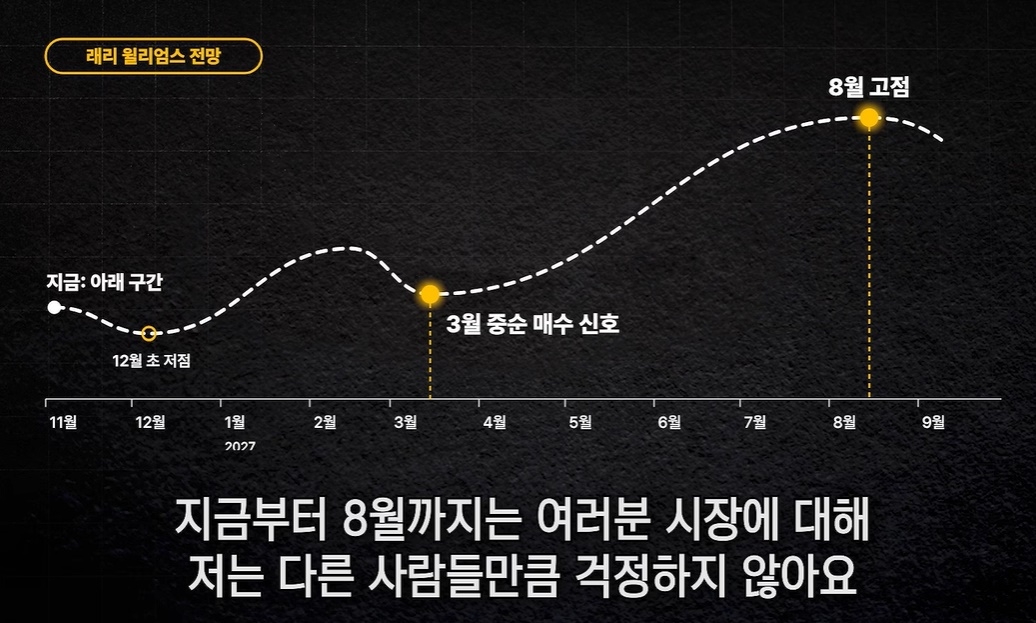
On concerns about a bubble in AI-related stocks, Williams said the upward momentum has not yet run out. He drew a distinction between the current AI boom and the dot-com bubble, noting that today's AI companies are generating real profits — unlike the firms of that earlier era. "Over 65 years of investing, I have seen about eight major bear markets, and the probability of a major bear market coming now is really low," he said.
As long as companies continue to show earnings and profits, he said, the stock market can sustain a positive trend. "The long-term trend of the current market is still pointing upward," Williams said.
bbo@heraldcorp.com