Ministry of Employment and Labor, Korea Employment Agency for Persons with Disabilities hold performance-sharing event; next year's disability employment support budget rises to 987.6 billion won
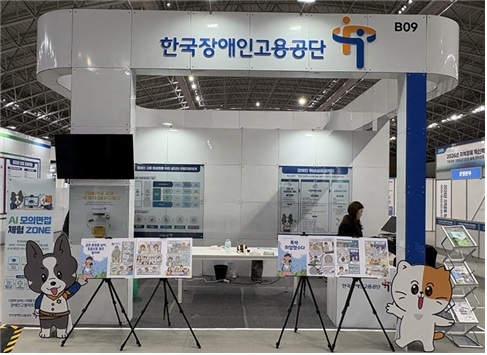
New jobs for workers with disabilities are emerging in fields once considered out of reach — verifying errors and bias in AI-generated responses, and inspecting safety helmets and harnesses used on industrial sites. What was long confined to simple, repetitive tasks is expanding into specialized areas such as AI quality control and industrial safety. Companies in gaming, finance and fashion retail are also redesigning existing roles to bring in more workers with disabilities.
The Ministry of Employment and Labor and the Korea Employment Agency for Persons with Disabilities held the "2026 Disability Employment Consulting and Job Development Performance-Sharing Event" on Wednesday at Peace & Park Convention in Yongsan-gu, Seoul. Held under the theme "Reimagining Jobs, Broadening Employment," the event drew about 180 participants from large corporations, public institutions and organizations involved in disability employment.
The event highlighted not only progress in expanding disability employment at existing workplaces but also newly developed roles in emerging industries such as AI and robotics.
A standout example was the "AI safety" role — a position dedicated to identifying hallucinations, bias and contextual errors in AI-generated responses and improving their quality. The Seoul Northern branch of the Korea Employment Agency for Persons with Disabilities developed the role in partnership with Linkage Lab.
The position is notable for drawing on human judgment and verification skills rather than simple data entry or repetitive checking. It led directly to the hiring of 14 workers with disabilities across AI-related sub-roles. The case received the Minister of Employment and Labor Award at a job development competition held during the event.
A new employment model also emerged in industrial safety. The "personal protective equipment (PPE) precision inspector" — which won a ministerial award at a disability employment ideas competition — is a role in which workers with developmental disabilities conduct detailed indoor inspections of protective gear such as safety helmets and harnesses for visible defects and damage. The model drew attention for linking serious-accident prevention on industrial sites with job creation for people with disabilities.
Established companies also broadened disability hiring by redesigning existing roles.
Game developer Neowiz had struggled to hire workers with disabilities because of its workforce structure, which centers on specialized roles in game development and art. The company addressed this by converting in-house welfare services into new jobs — expanding nine roles including a car-care service for employee vehicles, foreign-language training for staff and an IT help desk, and establishing a dedicated disability employment unit called "Able Hands."
As a result, Neowiz's disability employment rate climbed from 1.03 percent in 2021 to 3.30 percent in 2025, a gain of 2.27 percentage points. The number of workers with severe disabilities rose to 10, and those with disabilities who are women increased to six.
Fashion retailer Musinsa Retail Service broke down store operations into granular tasks to create disability-friendly roles — attaching security tags, swapping price-change stickers, sorting clothing by size and stocking shelves were all redesigned as positions suited for workers with disabilities.
Through this approach, the company expanded disability hiring across 11 stores nationwide, including locations in Hongdae, Seongsu and Yongsan. The number of workers with disabilities grew from four in 2024 to 19 in 2025, pushing the disability employment rate to 3.71 percent.
In the financial sector, the Korea Post Financial Development Institute was named a top disability-employing company. It moved beyond its traditional focus on financial counseling and administrative hiring to add roles in culture and arts, financial office support and health-care services, while building a tailored support system that includes mentoring and on-site job coaches.
Its disability employment rate rose from 2.99 percent in 2022 to 5.90 percent in 2025, and the number of workers with severe disabilities at the institute increased from three to 11 over the same period.
CJ Olive Networks developed roles in general affairs support and safety management assistance, hiring 15 new workers with disabilities. The Korea Marine Environment Management Corporation also improved its disability hiring systems and working conditions, lifting its employment rate from 2.76 percent to 5.79 percent.
At the event, the Korea Post Financial Development Institute, Neowiz and Musinsa Retail Service received the Minister of Employment and Labor Award, while CJ Olive Networks and the Korea Marine Environment Management Corporation received the Korea Employment Agency for Persons with Disabilities Chairman's Award.
The government is also increasing its disability employment support budget to build on these results. The 2027 budget proposal allocates 987.6 billion won ($735 million) for disability employment support — up 63 billion won, or 6.8 percent, from this year.
The additional funds are earmarked for expanding on-site job coaches and improving their pay, subsidizing commuting costs for workers with severe disabilities, and strengthening assistive technology support. The government also plans to expand support for regionally balanced subsidiary-type standard workplaces to create a more stable foundation for disability employment.
Deputy Minister of Employment and Labor Kwon Chang-jun said the award-winning companies "did not simply accept the reality that hiring people with disabilities is difficult — they asked how they could work together and found new ways to make it happen." He added that "sustainable change will only come when the government opens the path, companies put it into practice on the ground, and those results spread to more workplaces."
Lee Jong-seong, chairman of the Korea Employment Agency for Persons with Disabilities, said disability employment "is not simply a numerical concept of filling quotas, but a substantive process of realizing the values of diversity and inclusion." Lee said the agency would "actively collaborate with companies to expand disability employment consulting and provide strong support for job development."
fact0514@heraldcorp.com