Sejong National Pilot City: 5 years of smart service buildout, 10 years of operation — services keep evolving after residents move in
From robot delivery to personalized healthcare, residential convenience grows over time
First large-scale complex in the national pilot city, 'Sejong Smart City El Sujaein,' draws attention for its post-move-in value
A new residential paradigm is gaining traction — the "update city," where new lifestyle services are added in stages and existing functions are upgraded even after residents move in, breaking from the old model in which all infrastructure was fixed at completion. It goes beyond simple housing supply, continuously incorporating technological advances and shifting resident needs into urban development long after a complex opens.
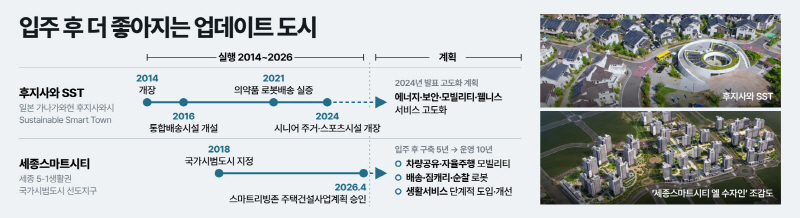
Japan's Fujisawa Sustainable Smart Town is widely cited as a leading example of a smart city that has continued expanding its facilities and services well after residents moved in. Developed under Panasonic's leadership and established in 2014, the town introduced an integrated delivery facility in 2016 and in 2021 conducted a pilot program using autonomous robots to deliver pharmaceuticals.
In 2024, a senior residential facility and a multipurpose sports complex opened, and on the occasion of the town's 10th anniversary, plans were announced to upgrade existing services across energy, security and mobility — underscoring the project's ongoing evolution.
South Korea is now pursuing a similar advanced urban development model in earnest. The most prominent example is the 5-1 residential zone in Hapgang-dong, Sejong, designated a smart city national pilot site in 2018. The pilot district development project has adopted a long-term structure — five years for smart service buildout and 10 years of operation — designed so that new services can be introduced and existing functions improved on an ongoing basis even after the city is built.
A range of everyday lifestyle services are set to be rolled out in phases at the Sejong National Pilot City in line with the city's development schedule. In the mobility sector, vehicle-sharing and autonomous driving services are planned, while delivery robots, luggage-carrying robots and patrol robots are to be deployed within the residential complex, significantly expanding convenience across transportation, delivery and safety.
Smart home town services linking wall pads to a dedicated app, personalized healthcare services and smart farm facilities are also slated for introduction to enhance residents' daily convenience. An official at Sejong Smart City Co. — an SPC involving the Korea Land and Housing Corp., Sejong City and private-sector participants — said the company plans "to build an urban operating system using an AI data hub and digital twin technology to support the stable rollout of new services."
This development approach is also reshaping how homebuyers evaluate their options. Long-term residential convenience after move-in — not just location, brand and complex design at the time of completion — is becoming a key competitive factor.
Amid this trend, BS Hanyang is conducting pre-sales for "Sejong Smart City El Sujaein" on blocks L6, L7, L8 and L11 in the 5-1 residential zone of Hapgang-dong, Sejong. The first large-scale complex to be supplied in the national pilot city's pilot district, the development will comprise a total of 2,316 units — 2,191 apartments and 125 officetels — with all apartment units offering an exclusive use area of 84 square meters, a highly sought-after floor plan.
The complex will be located in the Smart Living Zone, a residential-focused area, while the adjacent Innovation Venture Startup Zone is planned to house business, commercial and cultural facilities. The surrounding natural environment — including the Geum River and Miho River — along with planned sites for kindergartens and elementary, middle and high schools, future expansion of wide-area transportation networks and the growing role of the administrative capital are also seen as key factors enhancing the long-term residential value of the area.
"The national pilot city is structured so that the range of available services grows over time after move-in," a pre-sales official said. "As new functions take hold in daily life and the quality of services improves, residents' long-term satisfaction with their homes will rise accordingly."
leechemy@heraldcorp.com