Professor Won Yoo-jip's team develops next-generation file system
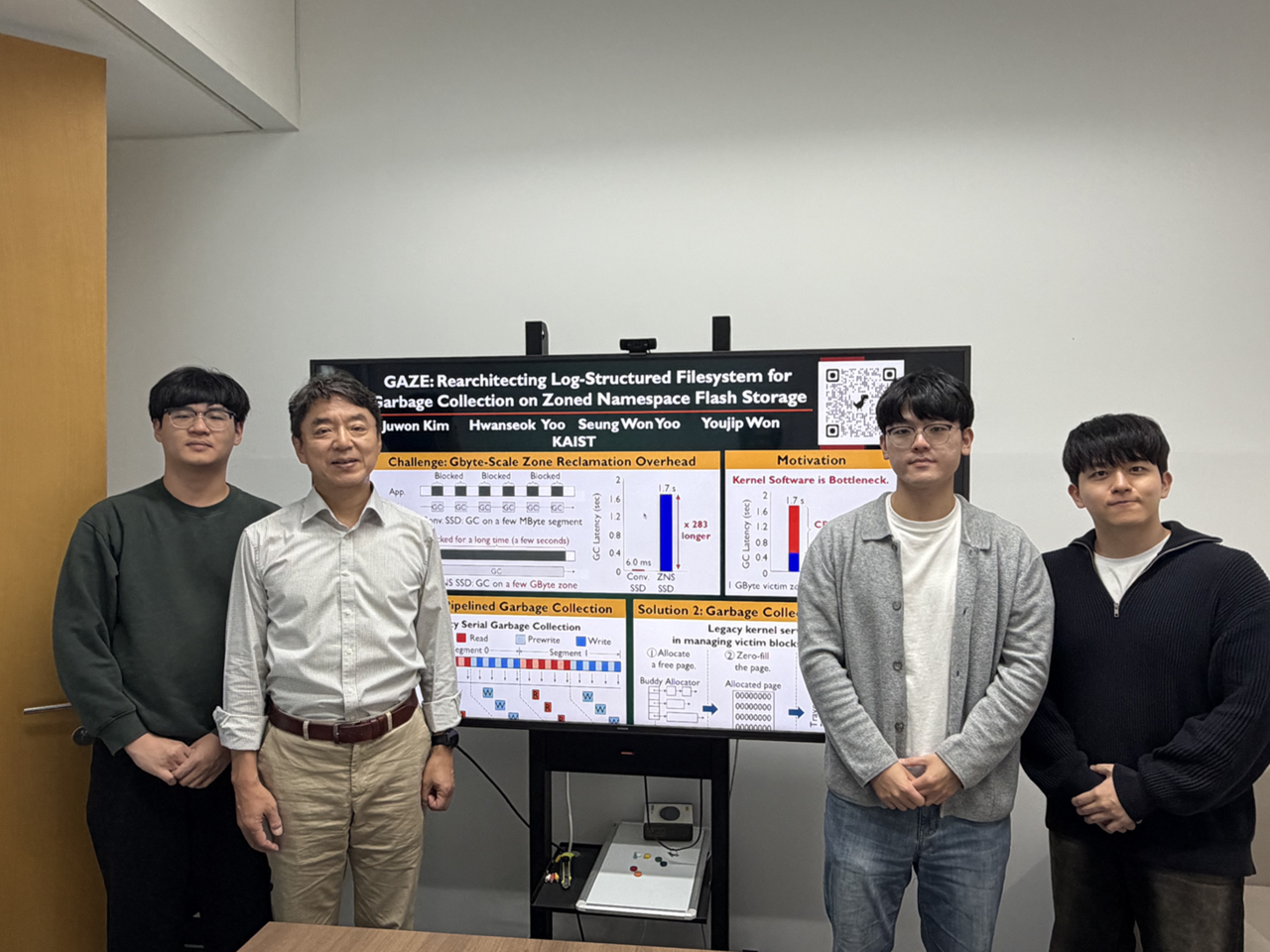
Researchers have developed a technology that cuts the time AI systems spend waiting for data, boosting storage processing performance by up to three times.
KAIST announced Wednesday that a research team led by Professor Won Yoo-jip of the School of Electrical Engineering has developed GAZE, a new file system technology that resolves data processing bottlenecks in next-generation flash storage devices.
For AI to generate responses quickly, the speed at which storage devices supply the necessary data is just as important as the raw computing power of GPUs and other processors.
The research team focused on ZNS (Zoned Namespace), a next-generation flash storage format that divides storage space into large sections called zones and writes data sequentially within them.
The problem lies in the unnecessary wait time created during storage cleanup. Flash storage devices perform a process called garbage collection — moving existing data and clearing space so that used areas can be reused.
Conventional file systems were designed to handle relatively small storage areas, making them inefficient when processing the large zones used in ZNS devices.
The team's analysis found that cleaning a 1-gigabyte storage zone using the conventional method took about 1.7 seconds. The CPU's data-status checks and memory management tasks — rather than the storage device itself — accounted for a significant share of that burden.
To address this, the team developed a technique that divides the cleanup process into four stages and handles them simultaneously. The system pre-allocates the memory needed for each task and is designed to accept new data even while a cleanup is underway. Where conventional systems had to wait until cleanup was complete before writing new data, GAZE runs multiple operations in parallel, minimizing unnecessary idle time.

When the team applied GAZE to F2FS, a Linux-based file system, data processing performance improved by up to three times compared with the conventional approach. The time required for storage cleanup also fell to roughly one-third of the original.
The achievement is particularly significant because it improves performance purely through software — without adding new dedicated hardware or changing the data storage format.
The technology is expected to find use in AI data centers and high-performance computing environments that must process large volumes of data quickly. Android smartphones running F2FS — including Google Pixel and Samsung Galaxy devices — are also candidates for future adoption.
However, the research validated file system data processing performance specifically; how much faster actual AI inference speeds become will require further verification.
"For AI to respond quickly, it is not enough to have computing power alone — supplying the necessary data on time is equally critical," Won said. "We expect this technology to serve as a foundation for accelerating AI inference speeds by reducing the time and idle periods spent on storage cleanup."
nbgkoo@heraldcorp.com