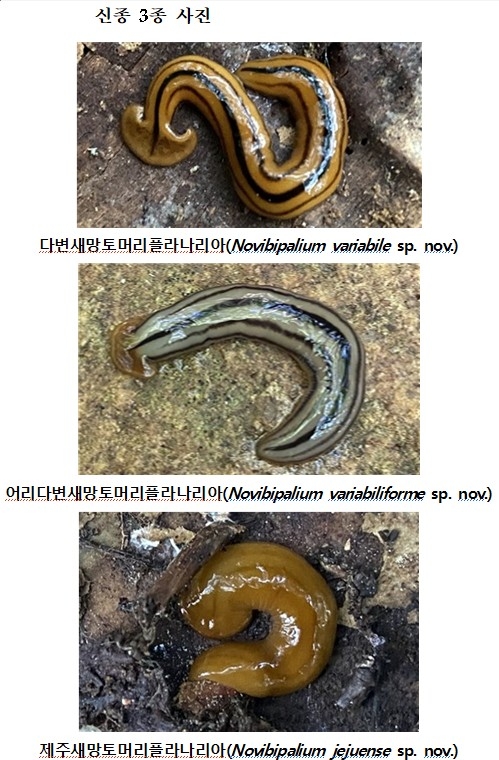
The National Nakdong River Institute of Biological Resources has identified three new species of wetland planarians through an international collaborative study.
Working with researchers from the University of São Paulo in Brazil, the institute conducted a comprehensive analysis of the genetic information and morphological characteristics of wetland planarians found in South Korea, confirming three new species of the genus Novibipalium, the institute said Wednesday.
Wetland planarians are flatworms that live under rocks and fallen leaves in moist mountain valleys. Researchers have been surveying domestic species diversity through international collaboration since 2022.
The three newly confirmed species are Novibipalium multistriatum, Novibipalium pseudomultistriatum and Novibipalium jejuense.
Two of the species — Novibipalium multistriatum and Novibipalium pseudomultistriatum — are distinct yet look so similar that they are nearly impossible to tell apart with the naked eye.
Conversely, individual specimens of Novibipalium multistriatum, despite belonging to the same species, show external variation in the number of dorsal stripes and body coloration.
To resolve these ambiguities, the researchers applied integrative taxonomic analysis — combining genetic data, external morphology and reproductive organ structure — to definitively establish the three new species.
The newly identified species are set to be added to the National Species List by the end of this year, alongside Bipalium guanglingense and Novibipalium koreense, which were reported as new species in 2025. The additions carry particular significance as they will mark the first time wetland planarians have been included in the national registry.
"This research is a scientific achievement in identifying new species of wetland planarians that are difficult to distinguish by appearance alone," said Ryu Si-hyeon, head of the institute's Diversity Conservation Research Division. "We will continue to discover undocumented organisms in Korea and share the diversity and value of our biological resources with the international community."
kbj7653@heraldcorp.com