District Mayor Jo Yu-jin personally reads texts and calls residents back; housing and urban issues top the list
A direct text-messaging hotline that lets residents contact Yeongdeungpo-gu District Mayor Jo Yu-jin personally has received more than 3,000 complaints and suggestions in its first 100 days, establishing itself as a new channel for civic communication.
The system has drawn praise for going beyond simple complaint intake: the district mayor personally reviews each message and calls residents back with updates, a practice officials say has strengthened public trust in local government.
Yeongdeungpo-gu said it received and processed a total of 3,035 submissions through the direct mayoral hotline in the 100 days since it launched on Aug. 3 — an average of about 30 a day.
The hotline requires no identity verification or administrative paperwork. Residents send a text to a dedicated mobile number, and the district mayor personally reviews the content, consults the relevant department, and relays the outcome back to the sender.
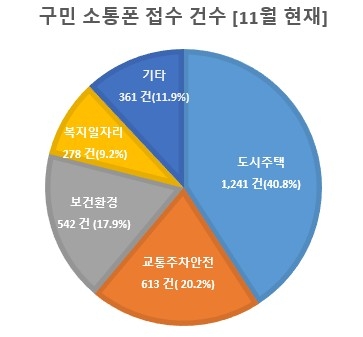
By category, housing and urban affairs — covering redevelopment, reconstruction, streetscapes and road drainage — accounted for the largest share at 1,241 cases, or more than 40 percent of the total.
Traffic, parking and safety followed with 613 cases, then public health and the environment with 542 and welfare and employment with 278.
The breakdown reflects residents' everyday concerns: residential conditions, traffic inconveniences and neighborhood safety dominated the submissions.
Many of the complaints centered on quality-of-life issues — widening sidewalks near Dangsan and Seonyudo stations, repairing streetlights and pavement signal lights, and fixing broken exercise equipment in parks.
The hotline also helped resolve long-neglected problems where responsibility had been unclear. One example involved paulownia tree roots beneath a bridge pillar at Dangsan Station that had threatened the structure's safety for years. After the complaint came in through the hotline, the district coordinated with the relevant agencies and resolved the issue, demonstrating the channel's ability to cut across departmental boundaries.
In some cases, the district mayor's direct involvement uncovered what residents actually needed.
When a resident complained about nighttime vehicle noise and requested a "noise-reduction traffic signal," District Mayor Jo called to clarify the request. It turned out the resident wanted a noise-reduction traffic sign, not a signal light — and the district installed one immediately.
The case illustrated how listening directly to residents and understanding the substance of their requests can lead to faster solutions.
The practice of having the district mayor personally call residents with updates has also been well received. One resident who had submitted a suggestion about sidewalk repairs said the experience caught them off guard. "After I sent the text, I got a call and heard the district mayor's voice — at first I thought it was an AI automated message," the resident said. "Seeing the mayor follow up on the scene in person and call to share the result made me trust the administration more."
Yeongdeungpo-gu plans to systematically analyze the more than 3,000 submissions to inform policy decisions, and to address recurring complaints through systemic reforms rather than one-off fixes.
"Staying in constant communication with residents is what keeps me grounded in my responsibilities," District Mayor Jo Yu-jin said, emphasizing the hotline's role in direct, field-oriented engagement with the community.
seouldream01@heraldcorp.com