Dunamu policy conference D-CON 2026
Kim Hyung-nyeon calls for opening won market to foreign non-residents, saying it would give Korea's digital asset industry 'a chance to leap forward'
Tokenization technology ready; research underway with Hana Bank, Samsung affiliates
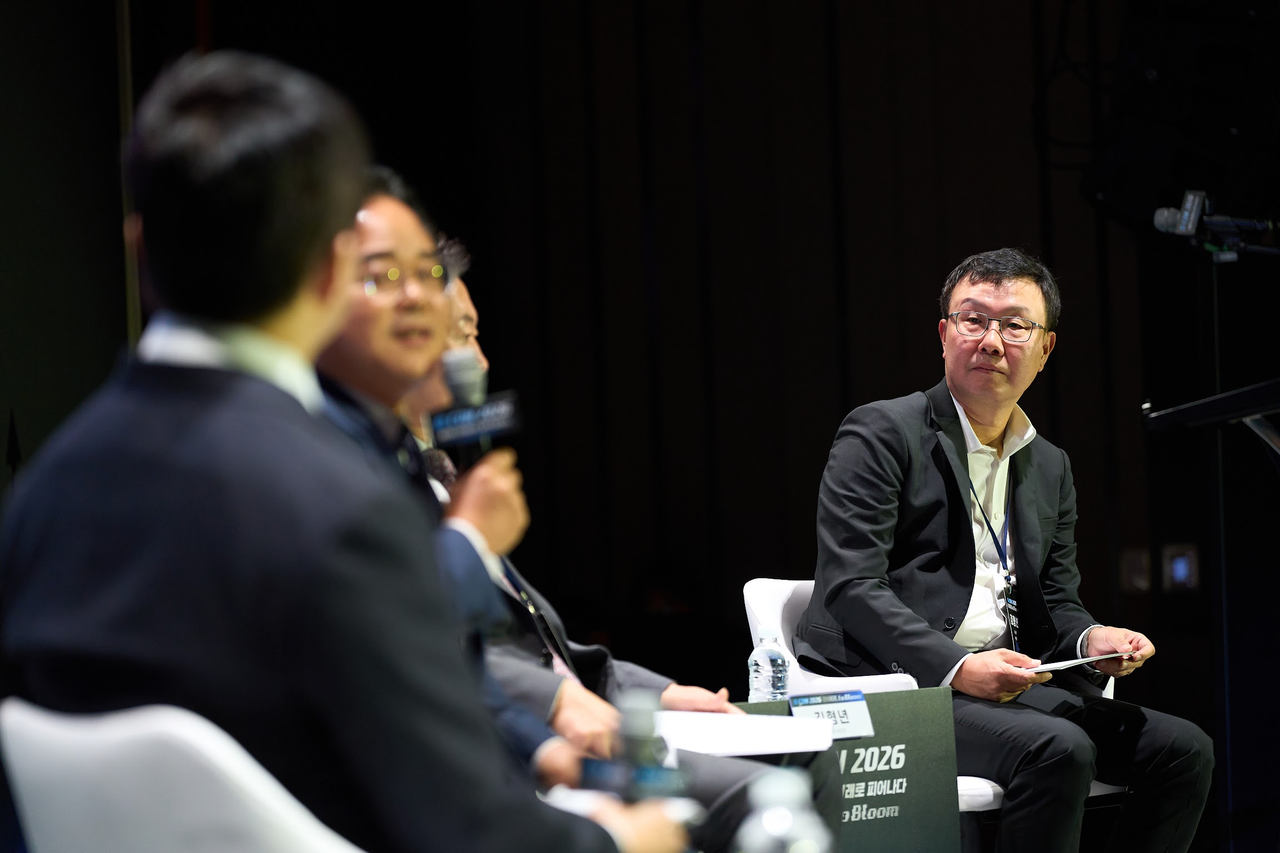
Dunamu Vice Chairman Kim Hyung-nyeon said Korea's digital asset market needs to open its won-denominated trading to foreign non-residents if it wants to stay competitive globally. Kim argued that overseas investors should be able to bring in dollars, convert them to won and trade domestic digital assets freely — and said any push to activate a won-denominated stablecoin should start from the same goal of improving foreign investors' access to the Korean market.
Speaking Tuesday at D-CON 2026, a Dunamu policy conference held in Yeouido, Seoul, Kim said, "What the industry wants in the blockchain market is to allow foreign non-residents to use Korean exchanges — whether they live in the United States, Europe or Southeast Asia."
Kim said the current environment makes that nearly impossible. "For a foreign non-resident to enter the domestic market right now, they have to bring in a stablecoin like Tether — and even signing up for a digital asset exchange is not easy, on top of which won-market trading is blocked," he said. "There is no way to convert dollars to won and trade bitcoin or other digital assets."
He added that product diversity matters, but the more fundamental need is a market where foreign non-residents can bring dollars, convert them to won and trade as freely as they would buying Korean stocks. "If that kind of market is created, an environment will open up that allows us to leap forward to the next level," he said.
Kim said opening domestic digital asset trading to foreigners would also broaden the use case for a won-denominated stablecoin. "I think enabling foreign non-residents to use domestic exchanges is part of what activating a won stablecoin would involve," he said.
Kim also warned that pairing dollar stablecoins with yield-like rewards could accelerate dollarization, and said institutionalizing a won stablecoin as quickly as possible is essential.
"Digital asset exchanges already hold customer deposits, much like brokerages do, and the Virtual Asset User Protection Act specifies how those deposits are managed and requires that usage fees be paid to customers," Kim said. "A stablecoin itself is not all that different from exchange deposits." He added that the industry needs to take a more strategic approach by layering technological elements on top of that existing framework.
Kim also expressed frustration at regulatory constraints holding back the domestic asset tokenization market. "As someone who runs an exchange, it is deeply painful to see Samsung Electronics and SK hynix — Korea's most representative stocks — being traded on overseas exchanges," he said. "It is suffocating to watch our own citizens trading domestic stocks on foreign exchanges, using leverage and trading around the clock."
Overseas markets have been moving to expand trading hours and improve settlement structures in traditional financial markets through stock tokenization, but domestic regulations including the Capital Markets Act make it difficult to offer such services in Korea. Dunamu said it has already completed the technical groundwork needed for a tokenization business in anticipation of regulatory changes.
"Over a long period of time, securities firms, financial companies and Dunamu itself have all finished the technical preparations," Kim said. "Whenever the regulations allow it or the conditions for doing business are in place, we will be ready to deploy what we have prepared."
Kim said Dunamu is also expanding cooperation with traditional financial institutions. "Since Hana Bank, Hanwha Securities and Samsung affiliates acquired the stake previously held by Kakao, we have been continuously researching what we can do together with the existing financial sector," he said, adding that the company is also pursuing regulatory sandbox applications across several business areas.
The conference also revealed a divide between ruling and opposition party lawmakers over when to enact a basic digital assets law. Democratic Party of Korea lawmaker Min Byung-deok said the government has been dragging its feet, claiming a bill was imminent, and that the delay can no longer continue. "The basic law must be passed no later than Jan. 18 next year," Min said.
People Power Party lawmaker Park Su-min took the opposite view, saying a later enactment may not be a bad thing. "The digital asset industry is evolving so fast that the moment a law is enacted, there may already be a need to revise it," Park said. Park added that financial authorities could reduce uncertainty for businesses by providing administrative guidance even before legislation is in place.
Meanwhile, the Korea Fair Trade Commission said Tuesday that a review report on the proposed merger between Naver Financial and Dunamu had been submitted to the commission, formally opening the deliberation process. Asked about the chances of approval, Kim said it was difficult to comment, but added, "We will do our best to explain our position."
kyoung@heraldcorp.com