Recipients of gifted Seoul properties up 62% in first 10 months of this year
Those in their 20s lead all age groups with a 2.2-fold increase
Experts warn of widening wealth gap within younger generations

The number of people receiving gifted properties in Seoul surged more than 60 percent in a single year, as rising home prices and heavier tax burdens have fueled a sharp increase in real estate transfers. Recipients in their 20s more than doubled compared with a year earlier, posting the highest growth rate of any age group. Industry observers warn that the spread of early gifting could deepen wealth inequality among younger Koreans.
According to the Supreme Court Registry Information Plaza, recipients of gifted collective buildings — a category that includes apartments, officetels and commercial properties — in Seoul numbered 12,522 in the first 10 months of this year, up 62 percent from 7,708 in the same period last year.
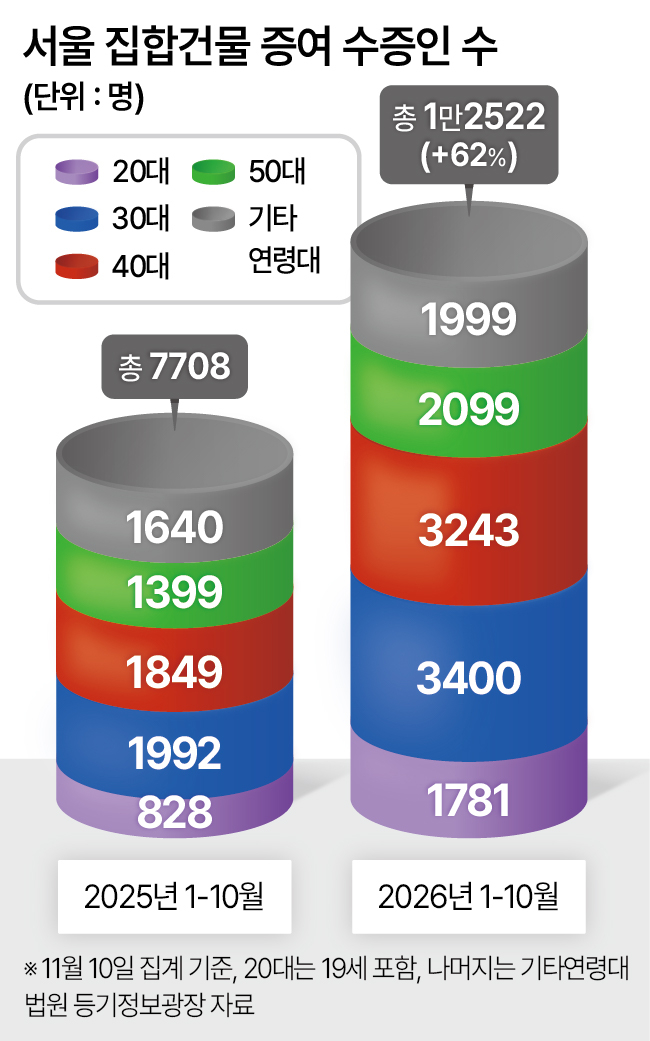
By age group, those in their 20s recorded the largest jump, rising 2.2-fold from 828 to 1,781 recipients. Those in their 40s followed with a 1.8-fold increase (1,849 to 3,243), while recipients in their 30s grew 1.7-fold (1,992 to 3,400) and those in their 50s rose 1.5-fold (1,399 to 2,099). Recipients in their 60s (932 to 1,095), those aged 70 and older (485 to 565) and minors (223 to 339) also posted gains.
With gifting to those in their 20s and 30s picking up pace, that cohort — totaling 5,181 recipients — now accounts for 41.4 percent of all recipients, nearly matching the 40s-and-50s group at 42.7 percent (5,342 recipients). The shift is notable compared with the same period last year, when the two groups were separated by about 5 percentage points — 36.6 percent for those in their 20s and 30s versus 42.1 percent for those in their 40s and 50s.
Market observers say that soaring home prices and tightening real estate regulations have made it harder for younger people to buy property on their own, pushing parents to transfer assets earlier. Compared with the past, when real estate typically passed to children through inheritance at death, property values have risen so sharply that the resulting tax burden has grown substantially. Lending restrictions have also cut off financing options, making homeownership increasingly out of reach for younger generations.
Kim Hyo-seon, a senior real estate specialist at KB Kookmin Bank, said gift tax is assessed based on the market value at the time of transfer, meaning that when property prices are expected to rise, transferring assets sooner reduces the tax burden. "It appears that more households are now considering lifetime gifts timed to when their children need to secure housing," Kim said.

Experts say that while early gifting helps younger generations build wealth, it also reduces the supply of homes on the market and risks widening the asset gap within the same generation. As wealth accumulation shifts to an earlier stage of life, the path to homeownership diverges sharply between those who receive property gifts and those who must buy on their own. Self-buyers are constrained by income and loan limits that dictate where and what they can afford, whereas those who receive property gifts may see their wealth advantage grow over time depending on the nature of the assets they inherit.
Woo Byung-tak, a specialist at Shinhan Premier Pathfinder, said that when real estate-heavy assets held by older generations are transferred to younger, more active consumers, intergenerational wealth gaps narrow. "However, because properties passed on to children are typically held for the long term, housing supply available for sale or lease on the open market could tighten," Woo said.
Kim said that if a proposed tax reform under review by the National Assembly changes the long-term holding deduction for capital gains tax to focus on the period of actual residence, gifts of homes where parents do not live — transferred so that children can move in themselves — could increase further. "As government policy shapes how assets are held and transferred, this is a critical moment to ensure consistency and predictability in policy," Kim said.
The anticipated tax overhaul, which signals a shift toward residence-based taxation including a strengthened property holding tax, is also seen as prompting asset holders to transfer wealth preemptively.
Looking at the overall gifting trend in the first 10 months of this year, transfers were concentrated in the three Gangnam districts — areas dense with high-priced apartments that are particularly sensitive to tax changes. Among Seoul's 25 autonomous districts, Songpa-gu (1,073 recipients), Gangnam-gu (1,071) and Seocho-gu (868) together accounted for 3,012 recipients, or 24 percent of the citywide total. Recipients who received gifts between March and May — ahead of the June 1 property tax assessment date — numbered 5,940, nearly half of all transfers during the period.
hope@heraldcorp.com